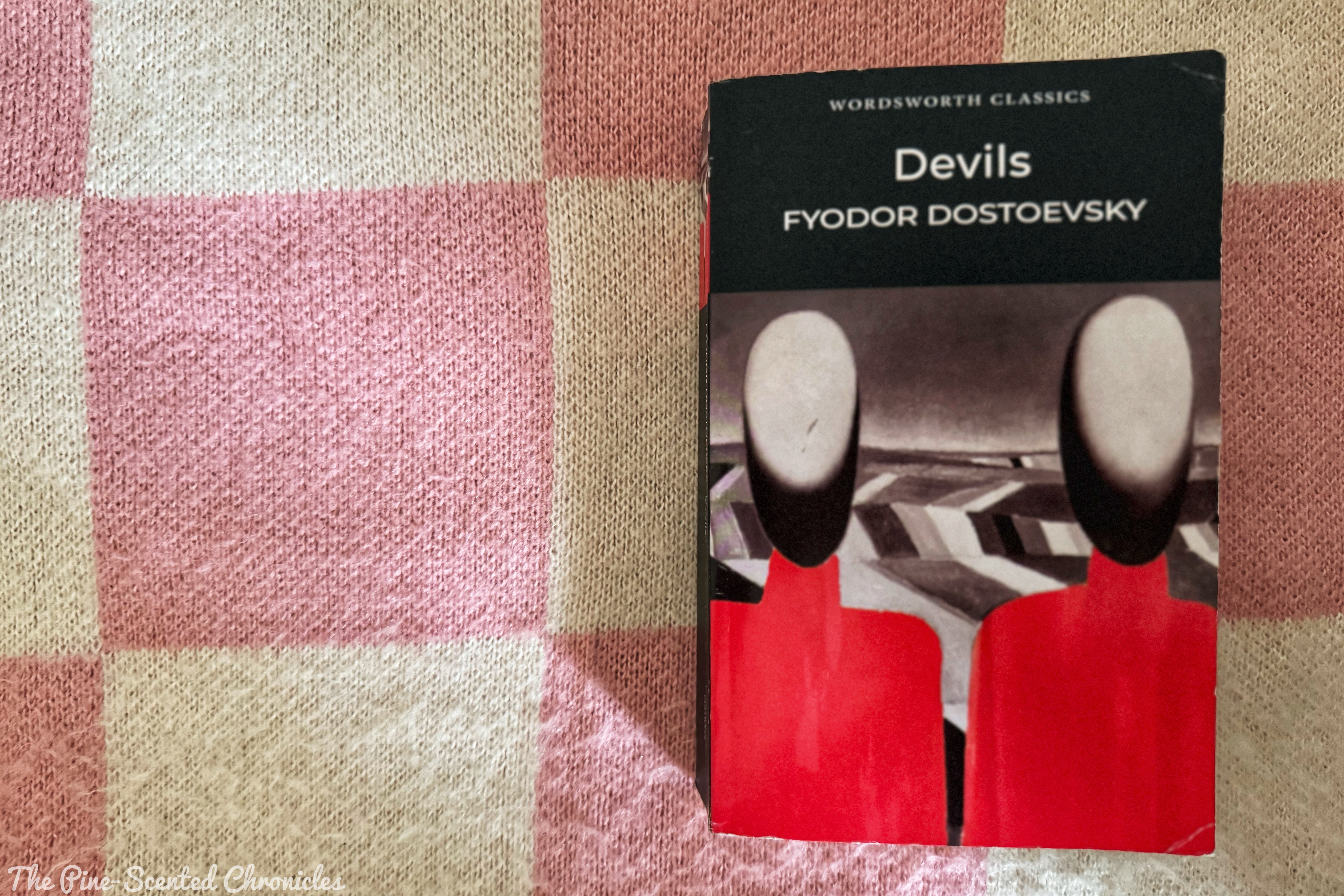
Born on November 11, 1821, in Moscow, Russia, Fyodor Mikhailovich Dostoyevsky is, without a doubt, one of the most renowned Russian writers; he along with a select few is synonymous with Russian literature. He is widely regarded by readers and literary critics alike as one of the best novelists of all time. A foray into the vast ambit of world literature as a whole would not be complete without a step into the world of Dostoyevsky. Originally published in serial form from 1871 to 1872 in the journal The Russian MessengerBésy (Бѣсы) is the third of Dostoyevsky’s four masterworks. It was translated into English as Devils; it would later be published under the English titles The Demons and The Possessed.

Like most of Dostoyevsky’s works, Devils, is not an easy read. Albeit complex and dense, it is a literary work that transcends time and borders. In its timelessness, it remains an integral part of contemporary political and literary discourses. It is a multifaceted and multilayered cautionary tale, a social and political commentary, and an in-depth psychological study. In a nutshell, Devils is a complex work that highlights everything great about Dostoyevsky’s prose. It is also a well of quotable passages and lines that leave indelible marks on the readers. Here are some of the memorable lines from the book that have left an impression on me.

Do check out my complete review of the Russian mastery storyteller’s beloved novel by clicking here.

“There is no doubt that these legendary gentlemen were capable of experiencing, even to an intense degree, the sensation of fear otherwise, they would have been much calmer, and would it have made the sense of danger into a necessity of their nature. No, but overcoming their own cowardice that of course, was what tempted them. A ceaseless reveling in victory and the awareness that no one can be victorious over you that was what attracted them.”

~ Fyodor Dostoyevsky, Devils 

“You can never control things with just the police in any society, anywhere. Every one of us, when he goes in, demands that a special policeman be assigned to protect him. They don’t understand that society protects itself. And what do our heads of families, our worthies, our wives, our young girls do in such circumstances? They say nothing and just pout. There is not even enough social initiative to restrain the pranksters.”

~ Fyodor Dostoyevsky, Devils 

Is this what is called remorse of conscience or repentance? I do not know, and I cannot tell to this day. Perhaps this remembrance even now contains something pleasurable for my passions. No what is unbearable to me is only this image alone, and precisely on the threshold, with its raised and threatening little fist, only that look alone, only that minute alone, only that shaking head. This is what I cannot bear, because since then it appears to me almost every day. It does not appear on its own, but I myself evoke it, and cannot help evoking it, even though I cannot live with it.

~ Fyodor Dostoyevsky, Devils 

A real fire is another matter: here the horror and a certain sense of personal danger, coupled with the exhilarating impression created by a nighttime fire, produces in the onlooker (not, of course, in the householder who has been completely burnt out) a certain concussion of the brain, and a challenge, as it were, to his own destructive instincts, which alas! lurk in every heart, even in the heart of the meekest titular councillor with a loving family.

~ Fyodor Dostoyevsky, Devils 

~ Fyodor Dostoyevsky, Devils 

Let’s suppose you lived on the moon. Let’s suppose you did all those absurd, vile things up there. From here, you know for certain that people up there will laugh at you and hold your name in contempt for a thousand years, eternally, over all the moon. But now you’re here and you’re looking at the moon from here. From here, what do you care about everything you perpetrated there, and that people up there will be holding you in contempt for a thousand years, isn’t that true?

~ Fyodor Dostoyevsky, Devils 

Quite often, too, a writer who has for a time been believed to possess a great store of ordinarily profound ideas, and who is expected to exercise an extraordinary and serious influence in the progress of society, in the end betrays such shallowness and insipidity of his fundamental idea that no one is sorry when he succeeds in writing himself out too soon.

~ Fyodor Dostoyevsky, Devils 

You cannot imagine what wrath and sadness overcome your whole soul when a great idea, which you have long cherished as holy, is caught up by the ignorant and dragged forth before fools like themselves into the street, and you suddenly meet it in the market unrecognizable, in the mud, absurdly set up, without proportion, without harmony, the plaything of foolish louts!

~ Fyodor Dostoyevsky, Devils 

“My immortality is necessary if only because God would not want to commit an injustice and utterly quench the flame of love for him once it has been kindled in my heart. And what is more precious than love? Love is higher than existence, love is the crown of being, and how is it possible that existence is not subordinate to it? If I have come to love him and have taken joy in my love, is it possible that he should extinguish both me and my joy and turn us into nothing? If God exists, then I am immortal too!”

~ Fyodor Dostoyevsky, Devils 

“Life is pain, life is fear, and man is unhappy. Now all is pain and fear. Now man loves life because he loves pain and fear. That’s how they’ve mad it. Life now is given in exchange for pain and fear, and that is the whole deceit. Man now is not yet the right man. There will be a new man, happy and proud. He for whom it will make no difference whether he loves or does not live, he will be the new man. he who overcomes pain and fear will himself be God. And this God will not be.”

~ Fyodor Dostoyevsky, Devils 

“Because reading books and having them bound represent two enormously different stages of development. First, people gradually get used to reading, over centuries naturally, but they don’t take care of their books and toss them around. Having books bound signifies respect for the book; it indicates that people not only love to read, but they view it an important occupation. Nowhere in Russia has that stage been reached. Europe has been binding its books for sometime.”

~ Fyodor Dostoyevsky, Devils