
First Impression Friday will be a meme where you talk about a book that you JUST STARTED! Maybe you’re only a chapter or two in, maybe a little farther. Based on this sampling of your current read, give a few impressions and predict what you’ll think by the end.
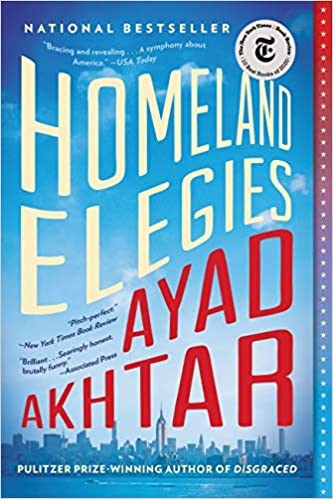
Synopsis:
A deeply personal work about identity and belonging in a nation coming apart at the seams, Homeland Elegies blends fact and fiction to tell an epic story of longing and dispossession in the world that 9/11 made. Part family drama, part social essay, part picaresque novel, at its heart it is the story of a father, a son, and the country they both call home.
Ayad Akhtar forges a new narrative voice to capture a country in which debt has ruined countless lives and the gods of finance rule, where immigrants live in fear, and where the nation’s unhealed wounds wreak havoc around the world. Akhtar attempts to make sense of it all through the lens of a story about one family, from a heartland town in America to palatial suites in Central Europe to guerrilla lookouts in the mountains of Afghanistan, and spares no one – least of all himself – in the process.
It’s the end of the workweek—yay! I hope the week has been kind to everyone, although the previous week was quite hectic for me personally. I am still trying to resolve a lot of issues, but more keep floating to the surface. Still, I can’t believe how time flies! We are nearly through the seventh month of the year. Time takes its natural course, with little regard for us. Nevertheless, I hope the first half of the year has been promising. As the year progresses, I hope everyone is given plenty of opportunities to grow and improve. With the weekend here, I hope everyone has a great one. It’s time to dress down and spend it either resting from the rigors of a demanding career, pursuing your passions, completing household chores, spending time with loved ones, or simply relaxing. It is going to be a damp weekend here in the Philippines. I hope you’re all doing well—physically, mentally, and emotionally.
After four months of exploring European literature, I was finally able to conclude the journey, which I had originally planned to complete in just two months. It was just enough time to finish all the works by European writers in my reading challenges. Ironically, it was these very books that ultimately extended my literary adventure into a four-month journey. With my European literary adventure this year officially complete—the longest I have spent immersed in European literature in a single year—I have commenced a new literary journey. With July being my birth month, I have decided to embark on a literary adventure into a literary territory that is closer to home: Asian literature. Apart from being part of the region, I have often dedicated July to the works of Japanese writers; Japanese literature is one of my favorite literary traditions in the world. I commenced this new literary journey with Mieko Kawakami’s latest translated novel, Sisters in Yellow.
With my insatiable appetite for Japanese literature, I have actually run out of books by Japanese writers, at least those on my bookshelf. Still, there are a few waiting to be read, and there are others that I am looking forward to. I am quite excited about the news of Haruki Murakami’s latest novel. I am looking forward to its English translation, as it promises to offer a different dimension of Murakami’s prose. My current read, however, is not a work by a Japanese writer. It even transports readers to the United States. Nevertheless, Ayad Akhtar was born to Pakistani parents. Akhtar has established a reputation as a playwright. For his work on Broadway, he received nominations for the Tony Award for Best Play for Disgraced (2015) and Junk (2017). He is also a renowned novelist. In 2012, Akhtar published his first novel, American Dervish. He gained even greater recognition as a novelist with his sophomore novel, Homeland Elegies.
Homeland Elegies first piqued my interest during the pandemic. Shortly after its release, it was listed by several literary publications as one of the best books of the year. The New York Times even named it one of the Ten Best Books of 2020. Half a decade later, I am finally reading the book, which I also included on my 2026 Top 26 Reading List. Akhtar’s sophomore novel, Homeland Elegies, begins with an overture dedicated “To America.” Akhtar himself serves as the spiritual guide, and the novel integrates elements of autobiographical memoir. In the overture, Akhtar recalls Professor Moroni, a memorable college professor. He is reminded of his professor, who instilled in him the idea that America is not what it claims to be. This sets the tone for the story—or at least that is what I can surmise so far, as I have only just begun reading the novel. We learn that Akhtar’s parents were doctors who emigrated from Pakistan to the United States in their younger years, drawn by America’s promise of opportunity for physicians.
Interestingly, Akhtar’s parents were the antithesis of each other, at least in terms of how they viewed America. Sikander adored America, including Donald Trump. His wife, Fatima, yearned to return to the country of her birth. She did not feel that she belonged in America. The novel’s first section, titled “Family Politics,” begins with Donald Trump’s first year in office. It was through him that Sikander developed an obsession with the American Dream. Sikander even tried to emulate Trump’s success. It was, however, all for naught, although their lives shared certain parallels. In an attempt to assimilate into American culture and its lifestyle, Sikander left his medical career to speculate in real estate. It, however, failed, prompting him to return to medicine. Due to a medical emergency, the Akhtar family became acquainted with Trump, with Sikander treating him for a heart condition. Although his acquaintance with Trump eventually came to an end, Sikander maintained the hedonistic and consumerist lifestyle he had embraced while working with him. Eventually, Sikander was forced to sell his private practice and declare bankruptcy.
This is where the story becomes even more interesting, as Akhtar fuses family history with contemporary American politics. Sikander’s support for Trump creates a wedge between him and his son. His son cannot understand why his father would support such a man. Details of Western involvement in the Middle East permeate this section of the novel. Ayad also notes how Islam is often misunderstood because of differences in beliefs and values. Meanwhile, Fatima feels nostalgic for her homeland. Ayad recalls Fatima’s affection for Sikander’s friend, Latif, who immigrated to America alongside him. However, Latif returned to Pakistan out of a sense of patriotism when the Soviets invaded Afghanistan. Portraits of Ayad’s circle of friends and extended family also enrich the novel’s first section.
“Scranton Memoirs” is the novel’s second part and focuses on Ayad’s struggles to assimilate into American culture. As a frame for this section, Ayad uses his experience of being profiled by a state trooper and a white business owner in Scranton. Both fixate on Ayad’s name and appearance; to them, he does not look American. They impress upon Ayad that there is more to being American than simply being born in America. Ayad’s relative, Shafat, was beaten in jail for questioning American values. This forced him to adopt Christianity and marry outside his faith in order to assimilate. The novel’s second part also centers on Ayad’s friendship with Riaz Rind, a wealthy Muslim American investor and financier. Riaz provides an interesting perspective on how to assimilate into American culture. Through him, Ayad learns how money and wealth subtly dictate American social interactions and acceptance into predominantly white circles. Wealth affords Ayad certain privileges. Rind’s investment company turns Ayad into a multimillionaire. But at what cost?
I have just started reading the novel’s third part, “Pox Americana.” I expect there will be further developments in Ayad’s character. It is fascinating how he traces his provenance and slowly captures a vivid portrait of his experience of integrating into American culture. Homeland Elegies is an exploration of both memory and identity, as Ayad struggles with belonging to two contrasting cultures. He is not American enough to belong fully to the United States, nor is he Pakistani enough to belong fully to Pakistan. The novel thus becomes his coming-of-age story. As he assimilates into American culture, his perspective begins to shift and change. Cultural touchstones further provide nuance and depth to the story. The contrast between Pakistan and the United States is subtly highlighted throughout the narrative. I would not be surprised if the final section of the novel grapples with the legacy of September 11, as it remains one of the defining events in the relationship between America and its Muslim communities.
I have to say that I am impressed by Ayad. His writing is immersive. It makes me look forward to seeing how his own story develops. It paints an intimate portrait of the writer. I am taking the book with me over the weekend, and I hope to finish it. How about you, fellow reader? What book or books are you taking with you this weekend? I certainly hope you enjoy them. For now, I hope everyone has a wonderful and restful weekend!

