
Happy Wednesday, everyone! Woah! Just like that, we are nearly midway through the eighth month of the year. How time flies! I hope the year has been kind and great to everyone. I know life isn’t a walk in the park, but it is my fervent prayer that everyone’s year is going well. Regardless, I hope the rest of the workweek goes smoothly.
That said, the middle of the week also brings a fresh WWW Wednesday update. WWW Wednesday is a bookish meme hosted originally by SAM@TAKING ON A WORLD OF WORDS.
The mechanics for WWW Wednesday are quite simple: you just have to answer three questions:
- What are you currently reading?
- What have you finished reading?
- What will you read next?

What are you currently reading?
It’s already the middle of the week, which means we have only two more days until the weekend. I hope everyone makes it through the workweek. Anyway, my 2026 reading journey is going as planned. I spent the first two months of the year reading works by Latin American and Caribbean writers. I then followed that with a venture into European literature, a journey that lasted four months. I think this is the longest time I have spent immersed in European literature in a single year. I am just glad I was finally able to complete all the works by European writers included in my reading challenges. Ironically, I first ventured into European literature because of these books, yet they were the last ones I read. In any case, I am glad I was finally able to conclude that journey. Nevertheless, it was one that I truly relished. Still, I am happy to begin a new literary adventure. In July, I decided to venture into the works of Asian writers. With the number of Asian works I wanted to read, it was inevitable that I would extend this journey into August.
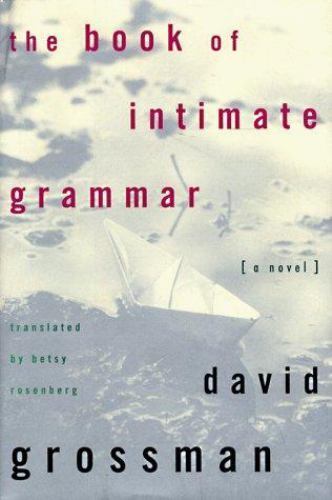
Over the past few years, I have also been venturing into the works of Israeli writers. Among the Israeli writers I discovered was David Grossman. In 2023, I read his International Booker Prize-winning novel, A Horse Walks Into a Bar. Three years later, I am reading my third Grossman novel, The Book of Intimate Grammar. Interestingly, I was not planning on reading this novel. However, my Asian literary adventure has been too focused on the works of Japanese, Indian, and Filipino writers. With this in mind, I decided to read The Book of Intimate Grammar, a book I recently acquired. Originally published in 1991 as ספר הדקדוק הפנימי (Sefer HaDikduk HaPenimi), the story takes place in the neighborhood of Beit HaKerem, Jerusalem, in the 1960s, before the Six-Day War. Beit HaKerem was a poor housing project that housed scores of Eastern European refugees.
At the heart of the story is Aron Kleinfeld, who is eleven years old when the novel begins. He is the son of a Polish refugee father. In the eyes of his parents, he is a source of enduring shame because he is short, myopic, and scrawny. He is also incapable of growing into the seemly shape of manhood. On the other hand, he is a sensitive and imaginative young boy. He is a great dreamer and the ringleader of escapades among his circle of friends. I just started reading the novel, but I am looking forward to what it has to offer me. From the onset, the novel promises to provide a different dimension of Grossman’s prose; at least, it is distinct from A Horse Walks Into a Bar and More Than I Love My Life. As I only started reading the book today, I don’t have many impressions to share yet. I will be sharing more of my thoughts on the book in this week’s First Impression Friday update.
What have you finished reading?

After a couple of slow reading weeks, I was finally able to regain some badly needed reading momentum over the past few weeks. I managed to complete two novels in the past week. I just hope I can sustain this momentum. Those slow reading weeks were due to a hectic workload. Anyway, admittedly, my venture into Philippine literature has been rather sparse. I used to be apprehensive about exploring my own country’s literary world. It was only in the past decade that I made a concerted effort to delve deeper into Philippine literature. It has been my goal to read at least two works by Filipino writers annually. This effort to explore Philippine literature more deeply has been paying off. I have been learning more about my own country’s history. Over the past few years, I have also come across names I would not have encountered otherwise. Among them is Edith L. Tiempo and her novel His Native Coast. Apparently, Tiempo was born in Bayombong, Nueva Vizcaya; her hometown is quite close to mine. I somehow feel a vestige of kinship with her. She was a prolific writer whose oeuvre spanned poetry, short stories, literary criticism, and, of course, novels.
His Native Coast is the second novel by a Filipino writer that I have read this year; I previously read Elaine Castillo’s America Is Not the Heart. His Native Coast is a book I acquired out of sheer curiosity. Even though I was not planning to read it this year, I made it part of my ongoing venture into Asian literature. The novel opens in Pagatban, situated in a mountainous forest in Negros. At the heart of the story is Marina Manuel. Marina is the daughter of an Ifugao woman (it is mentioned that she grew up in Lagawe) and a Batangas congressman, both of whom have passed away. The story begins during the twilight years of the Second World War, specifically in 1944. Before the war, Marina worked as a schoolteacher at Silliman University; Tiempo herself studied at and earned a degree from the same university in Dumaguete. Since the war began, Marina has been with the Pagatban underground resistance movement. However, with the war approaching its inevitable end, it is time for the resistance movement to make its move and descend to the lowlands. At the same time, American guerrilla forces have been arriving from Australia to reinforce the Philippine resistance movement. Among them is Lieutenant Michael Linder. In the second chapter, the guerrilla command and the U.S. Army run the town of Viñas until the disrupted civil government can take over. This leads to Marina and Michael’s fates inevitably crossing. As their bond grows, Michael develops a deep affection for Marina. He even proposes marriage. While the gesture touches her, Marina ultimately declines his proposal. With his military assignment over, Michael returns home to the United States, where he tries to readjust to life as a war veteran. However, his efforts are for naught, as the past constantly haunts him. As the old adage goes, absence makes the heart grow fonder. Through acquaintances, he learns about Marina’s marriage to Paulo Lacambre, the chief chemist at the Santa Rosa Sugar Central, owned by Don Gonzalo de Villa Beruz and his brother, Don Carlos. Still, Michael yearns for Marina and the land he left behind. As fate would have it, almost a decade later, Michael receives an offer to become the personnel manager at the Beruz brothers’ sugar central. Michael is given the task of identifying the culprit, or culprits, behind the nefarious activities at the sugar mill. For Michael, it is an unexpected opportunity that will bring him back to the place where he left his heart.
On the surface, the story is a typical romance. During the American occupation, American GIs often made romantic overtures to Filipinas. Stories of Filipinas entering into relationships with GIs are ubiquitous, especially in areas in close proximity to American military camps. Many Filipinas were eventually abandoned when the soldiers returned home. But there is more to His Native Coast than simply a GI falling in love with a Filipina. As the story unfolds, we learn about the concerns that occupy both characters. Michael’s existential quest is perhaps a residue of the war. As he travels through different Philippine landscapes and encounters people from diverse backgrounds, he develops a profound appreciation for the Philippines and its people. Marina herself is grappling with her own identity. She received a Western education at an American institution, Silliman University. She has also embraced several aspects of Western culture. However, she remains deeply conscious of her indigenous heritage. She constantly feels the weight of the culture she never fully inherited. The writing can be dense at times, but I ultimately find His Native Coast to be an insightful exploration of home, identity, and love.

From the Philippines, my literary journey next took me to China. I haven’t read that many works by Chinese writers this year. Like Philippine literature, my venture into Chinese literature has been quite limited. This is despite the vastness of Chinese literature. Regardless, I am just happy I was able to read at least one work this year. Technically, Jenny Tinghui Zhang is a Chinese-American writer; she was born in Changchun, China, but grew up in Austin, Texas, and Oxford, Mississippi. It was in 2022 that I first encountered her. Her debut novel, Four Treasures of the Sky, was highly recommended. Literary pundits and publications listed it as one of the best books of the year; it was also one of the most highly anticipated releases of the year. I was actually looking forward to reading the book. Obtaining a copy of it, however, proved to be a challenge. A couple of years later, I was finally able to secure a copy, which I then made part of my ongoing venture into Asian literature.
Four Treasures of the Sky actually reminds me of another Chinese-American debut novel, C Pam Zhang’s How Much of These Hills Is Gold. In a way, they share some similarities. Anyway, Zhang’s debut novel takes us to the 1880s. The novel follows Daiyu, a Chinese girl named after Lin Daiyu, a tragic heroine from a classic story her grandmother tells her. Daiyu, however, has always hated her name and its association with tragedy. She grows up in a fishing village near the port city of Zhifu, China. Her parents are tapestry merchants whose designs attract wealthy officials and mysterious visitors dressed in plain black clothing. When Daiyu is twelve, her parents mysteriously vanish; a letter months later confirms their arrest. Her grandmother dresses her in boys’ clothes, shaves her head, and sends her to Zhifu for safety. She tells her granddaughter that they will communicate through the rain. Adopting the identity of a boy named Feng, Daiyu finds work as a cleaner at a calligraphy school run by Master Wang. She has also been secretly studying by eavesdropping on lessons. When the master learns this, he begins giving her private instruction. He instills in her the belief that calligraphy cultivates character and unifies one’s present and potential selves. Just when fate starts to smile on her, tragedy strikes once again. Daiyu is charmed by Jasper, a human trafficker. She is drugged and wakes up in a dark room, where an old woman teaches her English. This is to prepare her for her new life in America. Smuggled across the ocean, she is sold to the tong, a Chinese criminal organization operating in San Francisco. Eventually, she is purchased by Madame Lee, who gives her the name Peony and teaches her the ways of a prostitute. During her stint at the brothel, she befriends Samuel, an eighteen-year-old who is half-Chinese and half-white and whose white half-brothers force him to visit the brothel. It is through Samuel that she is able to flee. Samuel provides her with men’s clothing and forged identification papers bearing the name Jacob Li. They board a train to Boise. It is supposed to be a promising new beginning. However, tragedy still follows Daiyu. At the inn where they stay in Boise, a gray-haired man from the train sexually assaults Daiyu at knifepoint after discovering that she is female. Samuel does nothing to protect her, despite sleeping in the same bed.
Devastated by the loss of her virginity, Daiyu takes her papers and leaves Samuel. She finds a new start as Jacob Li in the mining town of Pierce, Idaho, where she works at Pierce Big Store, a Chinese general store run by Nam, a jovial man in his fifties, and his stern partner, Lum. All the while, Zhang lays the groundwork for the story. With the passage of the Chinese Exclusion Act of 1882, the locals become emboldened, escalating anti-Chinese hostility. This echoes the hostility experienced by Asians during the spread of the COVID-19 pandemic. The novel underscores how the present can echo the past. The novel is also Daiyu’s coming-of-age story. Throughout her journey, Daiyu’s spirit becomes connected with that of her namesake, Lin Daiyu. This adds a layer of magic to the story. Lin Daiyu is also able to enter and exit Daiyu’s body. I found the concluding pages of the novel graphic, although I understand that this is both necessary and deliberate. They underscore the violence and prejudice that Chinese people and Asians in general have been subjected to. Unfortunately, the passage of time has not quelled these sentiments. Overall, Four Treasures of the Sky was an interesting and compelling read.
What will you read next?


 The Pine-Scented Chronicles