Happy Wednesday, everyone! Woah! Just like that, we are nearly through the eighth month of the year. Today is the last Wednesday of August. How time flies! I hope the year has been kind and great to everyone. I know life isn’t a walk in the park, but it is my fervent prayer that everyone’s year is going well. Regardless, I hope the rest of the workweek goes smoothly.
That said, the middle of the week also brings a fresh WWW Wednesday update. WWW Wednesday is a bookish meme originally hosted by SAM@TAKING ON A WORLD OF WORDS.
The mechanics for WWW Wednesday are quite simple: you just have to answer three questions:
- What are you currently reading?
- What have you finished reading?
- What will you read next?

What are you currently reading?

It’s already the middle of the week, which means we have only two more days until the weekend. I hope everyone makes it through the workweek. Anyway, my 2026 reading journey is going as planned. After opening the year with Latin American literature, I then spent four months reading European literature. I think this is the longest I have spent immersed in European literature in a single year. I am just glad I was finally able to complete all the European works included in my reading challenges. Ironically, I first ventured into European literature because of these books, yet they were the last ones I read. In any case, I am glad I was finally able to complete that journey. In July, I decided to venture into the works of Asian writers. Given the number of Asian works I wanted to read, it was inevitable that I would extend this journey into August. With August drawing to a close, I am now wrapping up this venture into Asian literature.
My current reading journey takes me to Turkey, to a writer whose work has recently grown on me. I first encountered Orhan Pamuk through a random encounter with an online bookseller. I eventually learned that he is a Nobel Laureate in Literature; back then, I wasn’t aware of the prestige that came with it. A decade later, after reading Snow, I am now reading my sixth Pamuk novel, The White Castle. Originally published in 1985 as Beyaz Kale, The White Castle is Pamuk’s third novel. It was also the work that further catapulted Pamuk to global recognition. The story comes in the form of a flashback, transporting readers from the present day to the seventeenth-century Ottoman Empire. In the mid-1980s, historian Faruk Darvinoglu recalls finding a manuscript in a storage room while looking through an archive in the governor’s office in Gebze. He hoped to authenticate the manuscript. An acquaintance told him that similar manuscripts could be found throughout Istanbul’s old wooden houses, mistaken for ancient Korans.
The manuscript transports readers to the seventeenth century, where we meet the narrator, a young Italian academic. While traveling from Venice to Naples with his family, a Turkish fleet captured his fellow passengers. The narrator, in an attempt to curry favor and hopefully receive lenient treatment, lied and told them he was a doctor. This, however, was for naught, as he was still taken as a slave. After curing the pasha, one of the leaders of the Turkish fleet, of his shortness of breath, the narrator was allowed some privileges, including working on the plans for the fireworks display to take place at the wedding of the pasha’s son. While working on this project, he met Hoja, who eventually became his master. Together, they embarked on a journey of mutual education. Hoja desires to learn from the Venetian scholar in order to elevate himself within the Ottoman court. However, the questions Hoja asks take on deeper meanings: “Why am I what I am?”
The White Castle is surely a propulsive and compelling read. Historical context, such as the emergence of a plague, provides nuance to the story. This provides the characters with a backdrop for their musings and intellectual discourses. The book is deceptively slender, but it is packed with ideas. I am looking forward to seeing how the story unfolds.
What have you finished reading?
As mentioned, I have been wrapping up my venture into Asian literature. This led me to revisit books that have long been gathering dust on my bookshelf. I have noticed how sparse my literary venture into the Middle East has been, although it is a region one often hears about, frequently for negative reasons. During the 2010s, Syria became part of the world’s collective memory. The outbreak of the Syrian Civil War tore the Middle Eastern nation apart. This was exacerbated by the rise of terrorist groups and the involvement of foreign powers, most prominently Russia. While I have long been familiar with Syria and Damascus (one of the oldest continuously inhabited cities in the world), I can’t say that I have explored its literature to any significant extent. The closest I came to it was Zeyn Joukhadar’s The Map of Salt and Stars, a book that explores the refugee crisis that followed the Syrian Civil War. Tenderly written, it is easily one of my favorite books.
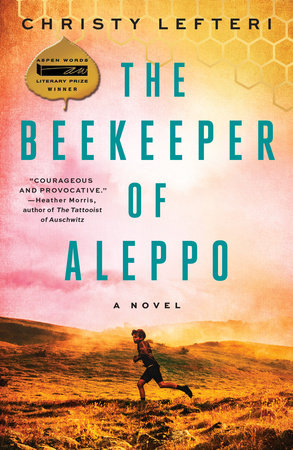
This places Christy Lefteri’s The Beekeeper of Aleppo in an interesting position. Interestingly, Lefteri was born to Greek Cypriot refugee parents who met in London after fleeing the 1974 invasion. In a way, it shares similarities with The Map of Salt and Stars, as Lefteri’s novel also explores the Syrian refugee crisis. Originally published in 2019, The Beekeeper of Aleppo chronicles the story of Nuri and Afra, who are from the city of Aleppo, the second-largest city in Syria. The novel opens in 2016, with Nuri and Afra in a bed-and-breakfast in England while attempting to claim asylum. Nuri confesses his fear about Afra’s eyes, fearing that her eyes are disappearing. While the reason for her blindness is not immediately explained, it is obviously causing distress between the couple. Along with refugees such as Moroccan Hazim and Diomande, they are all waiting to begin the process of claiming asylum in England. Lucy Fisher, a social worker, assists them by processing their paperwork and helping them prepare for their immigration interviews. There is a lingering fear of rejection. This raises the question of the circumstances that brought them to England. The answers, as always, lie in the past. In Aleppo, Nuri and his family are living a simple life. Nuri is a beekeeper, learning the craft from his cousin, Mustafa. Together, they run a successful business caring for their bees and selling honey-based products. Nuri cherished his work. Afra, on the other hand, earned a living as a prolific artist. The couple have a young son named Sami. Their family shares meals with Mustafa and his wife, Dahab, and their children, Firas and Aya. Their idyllic life, however, is slowly shattered by the encroaching war. Sensing trouble brewing on the horizon, Mustafa sends his wife and Aya to England. Soon after, the war makes its way into their city. Vandals destroy their apiaries, prompting Mustafa to plan his departure from Syria. Unfortunately, before they can leave, Firas is killed. Mustafa eventually flees to England. Before leaving, he leaves a note for Nuri, asking him to follow as soon as he can. Nuri, however, has a challenging time convincing Afra to leave. She is grief-stricken by the death of their son; just like her blindness, Lefteri leaves the details of Sami’s death unexplained. Afra refuses to leave Syria. She eventually changes her mind when soldiers threaten Nuri’s life and ransack their house. Thus begins their long journey to England, leaving their country behind.
The Syrian Civil War of the 2010s made waves, literally, especially through the refugee crisis it instigated, when ordinary Syrians were forced to flee their country. Many were smuggled by ship, some of which ended in disaster. In fact, one of the most enduring symbols of this crisis is the death by drowning of two-year-old Alan Kurdi. He and his parents were fleeing Syria and ISIL. The photograph of Kurdi’s drowned body became a symbol of the suffering of refugees trying to reach Europe. The Beekeeper of Aleppo subtly references this incident. On the ship on which Afra and Nuri are smuggled, they meet Mohammed, a young boy who seems to be alone. Nuri takes him under his wing, especially after Mohammed repeatedly expresses his fear that the ship will sink. As vivid as the historical details are, the depiction of Afra and Nuri’s journey is perhaps even more striking. It is richly rendered and is one of the novel’s finer elements. The novel also explores grief and the trauma caused by war, astutely examining the refugee crisis and the complexities of displacement. Overall, The Beekeeper of Aleppo is a quick but insightful read.

I was saddened by the recent death of the highly acclaimed Japanese writer. I first encountered Higashino through an online bookseller in the mid-2010s. I read his novel Salvation of a Saint. Although I was not as impressed as I had hoped to be, Higashino still left a mark on me. It was, after all, one of the first Japanese mystery novels I had read. Over a decade later, I am now reading my fourth Higashino novel. I also recently watched a film adaptation of one of his novels, A Midsummer’s Equation. The film was based on the sixth novel in Higashino’s hugely successful Detective Galileo series; interestingly, Salvation of a Saint was the fifth book in the series. Needless to say, Higashino has slowly grown on me. I have also read The Devotion of Suspect X, which left a deep impression on me. It also helped me understand and appreciate Higashino’s mystery-fiction prose. I must say, I am beginning to see a pattern emerging.
This makes Malice the fourth Higashino novel I have read. Originally published in 1995 as 悪意 (Akui), Malice is the first book in the Detective Kaga series; Higashino is also renowned for his Detective Galileo series. Malice opens with the shocking murder of Kunihiko Hidaka, a celebrated novelist, on the eve of his planned move to Vancouver. Hidaka is found strangled in his locked office by his wife, Rie, and his best friend, Osamu Nonoguchi. A brass paperweight is also found to be the murder weapon. At first, the crime seems unsolvable. Both Rie and Nonoguchi have ironclad alibis. A manuscript faxed by Hidaka to Nonoguchi at precisely 6:13 p.m. establishes Nonoguchi’s alibi; the novel opens with his narration. We learn that Nonoguchi is also a published writer; he writes children’s books and aspires to become a novelist himself. Just when it seems that the case is about to be closed, Detective Kyoichiro Kaga enters the investigation. He is appointed to investigate the case. Detective Kaga also shares a history with Nonoguchi. Nonoguchi taught at the same school where the detective once taught. As Detective Kaga digs deeper, he quickly realizes that the friendship between Hidaka and Nonoguchi is not what it seems. On the surface, Nonoguchi portrays himself as an ardent admirer of Hidaka and his works. Pieces of evidence gathered by the detective reveal a much different truth. The story unfolds through reflections and revelations intertwined with interviews with various individuals connected to the victims and the suspect. Kaga’s interviews with Hidaka and Nonoguchi’s former acquaintances, friends, and schoolmates reveal an entirely different story. Each interaction seems to hold a potential clue that could lead Kaga to the truth behind the case. As both Kaga and Nonoguchi take over the narration, the story’s complexion also alters. As the different layers are peeled back, the story’s focal point drastically shifts from who murdered Hidaka to what motivated his murder. Hidaka, Kaga learns, has achieved a level of success that his friend could only yearn for. Nonoguchi struggles to be recognized as a writer. Is there somehow a resentment brewing beneath the façade of friendship?
One of Malice’s most interesting facets lies in how it challenges readers’ understanding of the conventional mystery thriller. Rather than emphasizing the uncovering of the who or the how, the novel focuses on the why. This is further muddled by the contrasting narrations of Kaga and Nonoguchi; one is a clear narrator, while the other is unreliable. The intricate and complicated relationships and motivations uncovered by Kaga are indicative of human frailty. For one, Malice captures the destructive power of suppressed emotions. Jealousy and desperation are prevalent emotions, as characters strive to be recognized and create personal legacies. This paves the way for pivotal revelations toward the novel’s conclusion. The novel probes into the very essence of malice, which creates the tension that pushes the story forward. Kaga eventually unravels a tangled web of deceit, revealing the true motive behind Hidaka’s murder. Getting there was one of the novel’s finer elements. Overall, Malice’s central mystery is engaging, but its exploration of human nature elevates it.
What will you read next?