Happy Wednesday, everyone! Woah! Just like that, we are already in the ninth month of the year. Today is the first Wednesday of September. How time flies! I hope the year has been kind and great to everyone. I know life isn’t a walk in the park, but it is my fervent prayer that everyone’s year is going well. Regardless, I hope the rest of the workweek goes smoothly.
That said, the middle of the week also brings a fresh WWW Wednesday update. WWW Wednesday is a bookish meme originally hosted by SAM@TAKING ON A WORLD OF WORDS.
The mechanics for WWW Wednesday are quite simple: you just have to answer three questions:
- What are you currently reading?
- What have you finished reading?
- What will you read next?

What are you currently reading?

It’s already the middle of the week, which means we have only two more days until the weekend. I hope everyone makes it through the workweek. In July, I embarked on a literary adventure into a territory closer to home: Asian literature. This came after I spent the first two months of the year reading the works of Latin American writers and the succeeding four months reading the works of European writers. Apart from being part of the region, I have often dedicated July, my birth month, to the works of Japanese writers, as Japanese literature is one of my favorite literary traditions. Speaking of Japanese literature, I am quite excited about the news of Haruki Murakami’s latest novel. I am eagerly awaiting its English translation, as it promises to offer a different dimension to Murakami’s prose. I concluded this brief venture into Asian literature in August. But with the conclusion of one comes the commencement of another. With the start of a new month, I have commenced a new literary journey.
My reading journey next takes me to the United States. I realized that I have several works by American writers on my reading challenges. Among them is William Gibson’s novel, Neuromancer. I am not a big fan of speculative fiction, although the genre has been growing on me recently. Besides, the novel is listed as one of the 1,001 Books You Must Read Before You Die. Set in the near future, the novel interestingly opens in Chiba, Japan. We meet Henry Case, a former console cowboy who now works as a middleman for smugglers and drug dealers. Apparently, he was forced out of his former job after stealing from his bosses. He was punished by having his nervous system damaged, preventing him from ever jacking into the matrix again. In Japan, Case hoped to find a cure. Unfortunately, he ran out of money. He now resides on the edge of society, drug-addicted and indebted to his employers.
His misfortunes only grew when he ran into his ex, Linda Lee. Fortune started smiling on him when he met Molly, a razorgirl (cyborg) working for Armitage, a mysterious former military point man. Armitage’s mysterious employer tasked him with assembling a team to carry out a series of heists. Case signs on to the mission when Armitage promises him that he will restore his nervous system. Thus commenced a series of adventures and misadventures that took them across the world. They were joined by Peter Riviera, a psychopathic police spy and holographic illusionist, in Istanbul. A lead eventually brought them to Wintermute, an artificial intelligence created by the eccentric Tessier-Ashpool family. The family spends its time in rotating cryonic preservation in its home, Villa Straylight. The villa is located on Freeside, a cylindrical space habitat that serves as a pleasure retreat for the wealthy. I am nearly done with the book, and I am looking forward to seeing how the story unravels.
What have you finished reading?

With August drawing to a close, I have also been wrapping up my venture into Asian literature. Over the past decade, one of the names that has become a staple of my reading is Orhan Pamuk. Interestingly, I first encountered Orhan Pamuk through a random encounter with an online bookseller. I eventually learned that he is a Nobel Laureate in Literature; back then, I wasn’t aware of the prestige that came with it. The first novel I read by him was Snow, which I read back in 2016. While I initially struggled with it, the passage of time made me appreciate it. It would lead to a long-term writer-reader relationship with the Turkish writer. He is also one of my primers to the wonderful and exciting world of Turkish literature; the other writer who introduced me to this world is Elif Shafak. A decade after I read my first novel by the Nobel Laureate in Literature, I have completed my sixth Orhan Pamuk novel, The White Castle.
Originally published in 1985 as Beyaz Kale, The White Castle is Pamuk’s third novel. It was also the work that further catapulted Pamuk to global recognition. The story comes in the form of a flashback, transporting readers from the present day to the seventeenth-century Ottoman Empire. In the mid-1980s, historian Faruk Darvinoglu recalls finding a manuscript in a storage room while looking through an archive in the governor’s office in Gebze. He hoped to authenticate the manuscript. An acquaintance told him that similar manuscripts could be found throughout Istanbul’s old wooden houses, mistaken for ancient Korans. Taking over the narrative voice is a young Italian academic, whose story unfolds in the seventeenth century. Born to an affluent family, he sails with his family from Venice to Naples. From the dense fog that enveloped them emerged a Turkish fleet, catching the Italian ship by surprise. The ship’s captain hesitates to act, permitting the Turks to capture the ship. It was, in a way, a reversal of roles. The conquered have become the conquerors, as the Turks take control of the ship and capture the European travelers, taking them as their slaves. The narrator, in an attempt to curry favor and hopefully receive lenient treatment, lies and tells them he is a doctor. This, however, is for naught, as he is still taken as a slave. After curing the pasha, one of the leaders of the Turkish fleet, of his shortness of breath, the narrator is allowed some privileges, including working on the plans for the fireworks display to take place at the wedding of the pasha’s son. While working on this project, he meets Hoja, his mirror image, his doppelgänger, or look-alike. Hoja, which literally means “master,” eventually becomes his master. While living with Hoja, the narrator is subject to Hoja’s cruelty, ambitions, and inquiries. Still, they embark on a journey of mutual education. The narrator eventually learns why Hoja desires to learn from the Venetian scholar. Using the narrator’s knowledge of astronomy, as well as tales from Italy, he is able to entertain the young sultan. He does this to elevate himself within the Ottoman court. However, the questions Hoja asks take on deeper meanings: “Why am I what I am?”
The White Castle is surely a propulsive and compelling read. On the surface, it captures the dynamics of a slave-master relationship. Hoja tries to assert superiority over the narrator, whether by ridiculing him for his childhood or for his weakness and paranoia as a slave. Ironically, he also spends just as much time trying to learn from the narrator. Their slave-master dynamic slowly deteriorates as the story progresses. This sets the stage for the novel’s exploration of identity. Pamuk’s philosophical inquiries challenge the foundations of the self. The two main characters, interestingly, can switch identities. The ambiguity of the self is a major conflict for the narrator, while their duplicity is slowly revealed. The interactions between the two characters also underscore the power of knowledge. Historical contexts further provide nuance to the story. The plague that sweeps the city also provides the characters with a mantle upon which to reflect on their positions in society, the lives they live, and the people they really are. Short but surprisingly insightful, The White Castle is a masterstroke from the Turkish wordsmith.
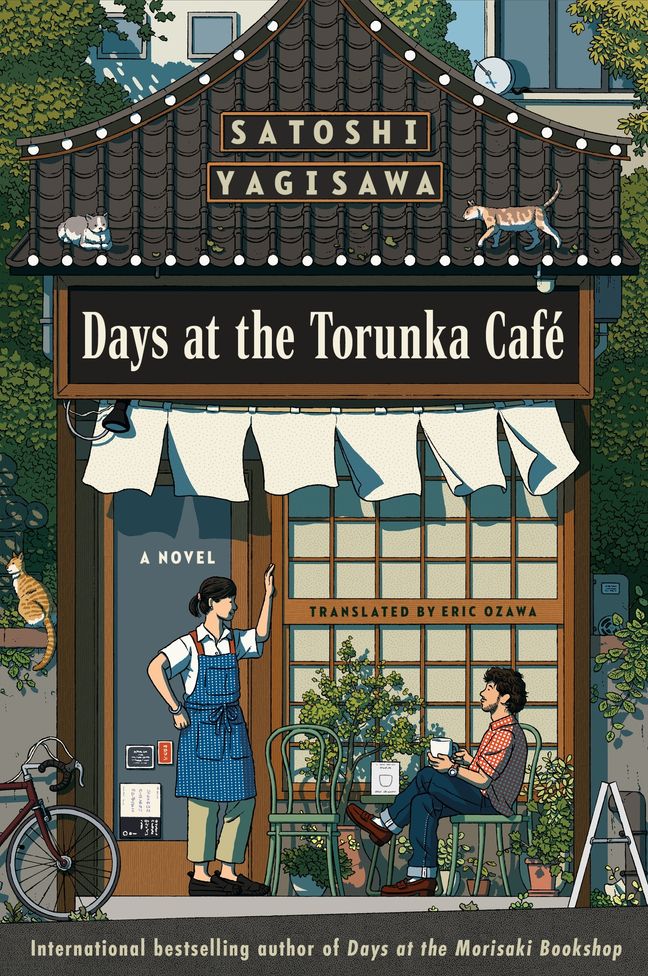
I have concluded my venture into Asian literature in the same manner that I commenced it: by reading a work by a Japanese writer. In July, I started this journey with Mieko Kawakami’s latest translated novel, Sisters in Yellow. I am now concluding it with Satoshi Yagisawa’s latest translated novel, Days at the Torunka Café. I first encountered the Japanese writer during a venture into a local bookstore, or perhaps it was through an online bookseller. Nevertheless, his novel Days at the Morisaki Bookshop was ubiquitous. This naturally piqued my interest. It also came at a time when Japanese literature had become proliferated with healing novels. I ended up liking the novel. It was brimming with tender moments, with Yagisawa masterfully capturing the intricacies and beauty of our daily interactions. Three years later, I have concluded my 2026 Asian literature venture with my third Yagisawa novel.
Originally published in 2013 as 純喫茶トルンカ, Days at the Torunka Café is set in the Yanaka neighborhood of downtown Tokyo, where the titular Torunka Café is situated. The novel is divided into three interconnected stories linked by the Torunka Café. The novel opens with Shūichi Okuyama, a twenty-one-year-old college student who works part-time at the Torunka. During a slow Sunday afternoon, he is working with the owner, Isao Tachibana, and Tachibana’s high school-aged daughter, Shizuku. With barely any customers, the only sounds filling the void are music and the ticking of the clock. The solitude is broken by the arrival of a young woman in a black coat and a scarlet scarf. She orders Colombian coffee, which Shūichi serves. However, the moment their eyes meet, she seizes his hands and says, “We meet at last.” The young woman, Chinatsu Yukimura, claims that she and Shūichi know each other. While they have never met each other in this life, they were lovers in a past one during the French Revolution; she was a man named Etienne, and Shūichi was a woman named Sylvie. This naturally baffles Shūichi, who is unsure what to make of what he is hearing. Meanwhile, Shizuku is delighted by the drama unfolding. Beyond her unusual claim of a former life, everything else about Chinatsu seems normal. On her return to the café, Chinatsu is more courteous, bringing sweets as a gift. Apparently, she lives nearby and found the café by chasing a cat. This unsettles Shūichi because it mirrors his own story of discovering the café. Chinatsu then becomes a regular visitor to the café, spending her Sunday afternoons there, quietly reading and occasionally engaging with Shizuku, who encourages her to share her story. The second story involves a middle-aged man named Hiroyuki Numata, who returns to the neighborhood to confront the life he left behind. He remembers the café as Nomura Coffee, the café he once frequented with Sanae, the woman he loved in his youth. He meets Ayako, Sanae’s daughter. Through a private investigator, Hiroyuki learns about Sanae’s death from cancer. The last story involves Shizuku. She confesses that she has avoided coffee for nearly ten years, ever since her older sister, Sumiré, secretly gave her a cup at the age of seven.
Interestingly, even Yagisawa’s Days at the Morisaki Bookshop and More Days at the Morisaki Bookshop offer the same aspect. They are about observed human behavior and the complex interactions that we have with those around us. In a way, these books instigate a simulacrum of introspection, mixed with curiosity and even confusion. The story of Chinatsu is also an incredulous one. But this shock factor reels readers in, as it did with me. The stories also explore our humanity, as they reflect on regret, lost opportunities, healing, grief, and self-identity. The stories also underscore the strength and beauty that can be found in establishing authentic and meaningful human connections while exploring the theme of opening oneself to new possibilities. All the while, all the stories find a connection in the past. In confronting the past, the characters learn to heal, forgive themselves, and move forward. Overall, Days at the Torunka Café is tender and warm, a quintessential Yagisawa work.
What will you read next?