
First Impression Friday will be a meme where you talk about a book that you JUST STARTED! Maybe you’re only a chapter or two in, maybe a little farther. Based on this sampling of your current read, give a few impressions and predict what you’ll think by the end.
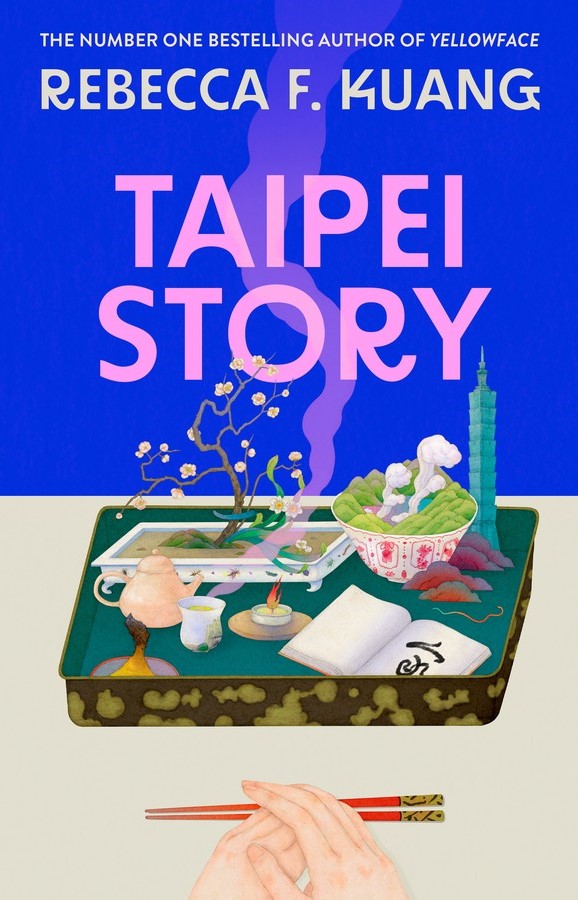
Synopsis:
Yale student Lily Chen arrives in Taipei hungry: for family, for culture, for connection.
But her summer of discovery quickly unravels. Her classes are gruelling, her roommate unbearable, and a reckless, deeply awkward trip to the hot springs with a guy she barely knows soon ignites vicious gossip.
Then her grandfather dies.
Grieving and adrift, Lily must confront her own questions about the culture she inherited but never fully understood. She embarks on a wryly funny, often devastating search for understanding: of herself, her family, and the meaning of home.
All over one unforgettable summer in Taipei.
It’s the end of the workweek—yay! I hope the week has been kind to everyone and that you’re all ending it on a high note. Just like that, we are already halfway through the tenth month of the year. Things are certainly looking up, at least professionally, although I am still trying to fully integrate into my new job and environment. I am also learning the ropes while looking for ways to improve the current processes. Still, I hope the rest of the year will be just as good. But how time flies! Time takes its natural course, with little regard for any of us. As the year approaches its inevitable close, I hope everyone is rewarded for their hard work. I hope everyone will be showered with blessings and good news. With the weekend finally here, I hope everyone has a great one. It’s time to dress down and spend the long weekend resting from the rigors of a demanding career, pursuing your passions, completing household chores, spending time with loved ones, or simply relaxing.
So far, October has brought fine weather, in stark contrast to the relentless rains of August and early September. Still, fear lingers as the prospect of a super El Niño threatens the entire country and most of the world. Some places are already experiencing drought. Unfortunately, forecasts suggest that it could wreak havoc over the next six months, and the situation could only intensify as the year goes on. I hope these forecasts are off the mark. Regardless of where you are in the Philippines or elsewhere in the world, I hope you’re all doing well—physically, mentally, and emotionally. Anyway, with the end of the workweek comes a fresh First Impression Friday update. In September, I crossed the Pacific from my previous literary venture into Asian literature. I am now in the midst of a literary adventure across the vast landscape of American literature.
American literature has been a staple of my annual literary journey. Given how readily available works by American writers are, I suppose one can never escape them. Thankfully, I have completed all the works by American writers in my ongoing reading challenges; they are the reason why I pivoted toward American literature. This allows me to pursue other books as well. Halfway through the year, I learned about Rebecca Kuang’s latest novel, Taipei Story. It was a little unusual, a deviation from her historical fantasy works. To be fair, Yellowface, the first novel by her that I read, was also a deviation. I was actually looking forward to reading Katabasis, which was released last year. However, I was unable to secure a copy of the book. Ironically, I was able to obtain a copy of Taipei Story, making it the first new book I read this year. By “new book,” I mean a book published in the current year. This also means that I am lagging behind on my 2026 Books I Look Forward To List.
At the heart of Taipei Story is Lily Chen, a Chinese American sophomore student majoring in East Asian Studies at Yale University. When we first meet her, she is about to board a plane from Boston to Taipei. She is enrolled in a ten-week intensive Mandarin program at National Taiwan University. Lily grew up speaking Chinese at home. However, she gradually lost most of her fluency. She sees the summer as an opportunity to reconnect not only with her language but also with her heritage. While waiting at the airport, she notices several Chinese American students who are also bound for Taipei. She initially assumes that most are from Mainland China. However, they are in the same boat as Lily. Some are students from high-profile universities such as Harvard. By traveling to Taipei, without the discomfort of blocked social media and restrictions that usually come with Mainland China, they can somehow reconnect with their culture.
Like Lily, they are looking forward to immersing themselves in Chinese culture. They are all headed to the same programs, deflating Lily’s enthusiasm as she realizes she isn’t unique in her quest. In Taipei, Lily reunites with Anna, a classmate from Yale’s Chinese language section and her designated roommate. To experience genuine Taipei, they rent an apartment in one of the city’s less glamorous districts. However, the room is far from what was advertised. It has only one bed, a tiny couch, and a bathroom where the showerhead sits over the toilet. The room also has bad plumbing, and the owner gives them a warning the moment they enter. Still, Lily and Anna decide to tough it out. Lily and Anna have only ever known each other in Chinese, and they notice how the language transforms them. Before she starts attending her classes, Lily sets out to explore Taipei. It is her own way of getting to know her new environment.
She meets with fellow Yale students, including Skipper Leys, a student in the Reserve Officers’ Training Corps (ROTC) who is preparing for Air Force intelligence; and John Cahan-Song, known as JC, whose mother is a linguistics professor famous for a bestselling memoir about raising multilingual children. Meanwhile, a pecking order forms. Lily and Anna are at the top because their Chinese is the strongest. Still, Lily is bothered by her complicity. Does her Chinese heritage exempt her from being an exploitative tourist? She has no roots in Taiwan and chose the program partly for convenience. Despite this, Lily persists in her studies, including private sessions with Teacher Sun. Teacher Sun identifies Lily’s paradox as a heritage speaker. While Lily has an intuitive ear for tones and grammar, she is lazy and inconsistent because some things come too easily to her.
As Lily and JC’s interactions increase, they gradually develop a quiet attraction. But while their affection for each other is growing, Anna confesses to Lily that she has a crush on JC. She even asks Lily to help her find out whether JC feels the same way about her. However, Lily does not act on it. This becomes a wedge between them when Anna discovers Lily’s text messages with JC. Lily is unapologetic about the messages, but she tries to reconcile with Anna. However, the breach of trust lingers. Their friendship starts to fall apart, especially after Lily goes with JC to a hot spring in Beitou. JC misreads the reservation dates, prompting Lily to skip classes and go without Anna. It is, however, a disappointing experience that commences a series of unfortunate events. Things quickly become awkward and take a turn for the worse.
Upon her return to her apartment, Lily receives a call from her mother. Her maternal grandfather, Gonggong, has passed away after a fall in Guangzhou. Lily cannot attend the funeral because she lacks a valid visa for mainland China. Still, she grieves in her own way, reminiscing about her relationship with Gonggong, which, ironically, consists of stilted video calls in which she repeats scripted greetings in halting Chinese. She wants to visit her grandparents, but only after she has become fluent. She hopes to have real conversations with them. Fate, however, has other plans. It becomes evident as the story progresses that Lily can be quite hard on herself. When she realizes that she cannot go to her grandfather’s funeral because of her lack of a valid visa, she blames it on her procrastination. I guess this can be attributed to how she was raised. Born to Asian parents, there are several expectations placed on her from a young age.
In a way, Taipei Story is the coming-of-age story of Lily. In trying to learn more about her heritage, she starts learning more about herself. However, she does come across as an underdeveloped character. Or perhaps it is simply because I am only halfway through the story. She drifts and lets herself be dictated to by everyone around her. Language becomes a device through which she is studied. As she explores Taipei, she takes note of words and signs and tries to decipher them and their meanings. References to Chinese literature and tradition enrich the story. All of these elements make her an interesting character. Due to her complex heritage, she is unsure where she belongs. She is too American to be Chinese, yet she looks too Chinese to be fully accepted as an American. Her flawed Chinese pronunciation is also an indicator of this.
Taipei Story is an interesting read. Kuang provides a vicarious reading experience that guides readers around Taipei. She tags readers along with the characters. I am looking forward to seeing how Lily’s story develops. Where will her journey take her? Will she find a greater sense of belonging? These are some of the questions I look forward to exploring as I delve deeper into the book this weekend.
How about you, fellow readers? What are you reading this weekend? I hope you’re enjoying your current book.

