The Reluctant Ruler
One of the inherent beauties of literature and writing is the freedom they allow writers to explore different forms. Over the course of history, numerous writers have pushed the boundaries of their oeuvre. They first establish a foothold in a particular literary form before venturing into others. Some writers begin with short stories or more formal forms of writing, such as essays and journalistic pieces, before expanding into full-length prose. There are also prose writers who eventually venture into writing poetry and children’s literature. The opposite holds true as well. It is not uncommon to find novelists whose literary careers began with poetry. Michael Ondaatje, Vladimir Nabokov, and even Margaret Atwood all published poetry before pivoting toward novels. Interestingly, their novels would go on to bring them global recognition. Still, their poetry underscores their versatility and the breadth of their literary output.
A number of successful novelists have also written poetry, including literary titans Iris Murdoch and James Baldwin. A handful of widely acclaimed poets have also produced critically acclaimed novels. Among them are Sylvia Plath, David Malouf, Rosmarie Waldrop, Anne Carson, and Rainer Maria Rilke. At times, this was a one-time endeavor, although their novels would become as revered as their poetry. These exemplary works include Plath’s The Bell Jar, Carson’s The Autobiography of Red, Malouf’s Remembering Babylon, Waldrop’s The Hanky of Pippin’s Daughter, and Rilke’s The Notebooks of Malte Laurids Brigge. Carson would even be recognized by the Swedish Academy with the Nobel Prize in Literature, with her novel in verse considered alongside her poetry. Joining this elite list is a new generation of poets turned novelists, including Lang Leav, Rene Karabash, Kaveh Akbar, and Ocean Vuong.
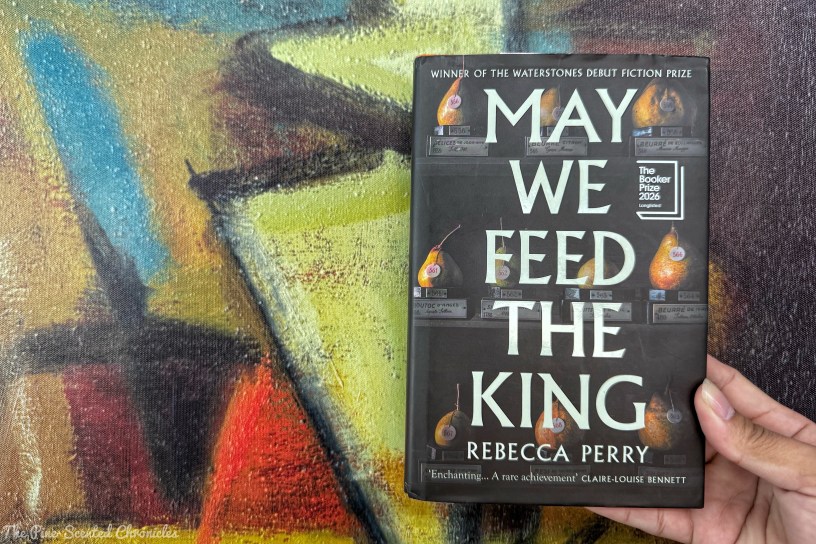
A more recent poet-turned-novelist is British writer Rebecca Perry. After completing a Master of Arts (MA) in Creative Writing at the Manchester Centre for New Writing in 2008, Perry made her literary debut in 2011 with her poetry pamphlet, Little Armoured. It was a literary sensation, earning her the 2011 Poetry Wales Purple Moose Poetry Prize. Her debut poetry collection, Beauty / Beauty (2015), was also critically acclaimed. It was shortlisted for the T. S. Eliot Prize and the Seamus Heaney Centre Prize for First Collection. All of this points to Perry as a writer of considerable talent. In 2026, she made a significant transition into fiction with the publication of her debut novel, May We Feed the King. It was a much-anticipated debut that won Perry the Waterstones Debut Fiction Prize. It gained even more international attention after being longlisted and eventually shortlisted for the Booker Prize.
I am still somewhat tethered to the King, but as a parent who loses their child in the supermarket might feel for the first few seconds, before the real panic sets in. Otherwise, floating about in this life, in this place, finding myself again queasy to be at home in the quiet, in the dark – though certainly less than before. The dining table a glowering vacancy still, but in the middle a silver fork – permitted for use by the King alone – with a single pomegranate seed impaled on the left prong. It would have been too great a risk to take nothing before that final meeting.
Rebecca Perry, May We Feed the King
May We Feed the King dances between two prominent narrative threads. In the contemporary period, there is an unnamed curator who arranges historically accurate replica scenes in medieval buildings. With more than two decades of experience placing replica food and furnishings in historic houses, the unnamed curator has recently been commissioned to recreate six scenes inside a former medieval palace that is about to celebrate its 750th anniversary. She takes her job far more seriously than anyone around her expects. Her guiding principle is that every scene must appear as though its occupants have just left the room. This conviction stems from a childhood memory of visiting a furniture superstore, where she squeezed a plastic grape in a display and felt transported into someone else’s life. Her fixation on details carries over into her work, which, as an adult, has become a source of personal sustenance.
At the palace, she maps the building and walks its corridors alone. She meets the Archivist, the keeper of the medieval palace’s historical records. The Archivist allows her access to the records, which include ledgers spanning five centuries, along with recipes, feast accounts, remedies, letters, and poems. As the curator notes, these extensive on-site archives are an almost unheard-of resource. She goes through the archives, and on her fifth day, she discovers the King. A single page is devoted to his reign, cluttered with marginalia, footnotes, and strikethroughs accumulated over centuries. This moves her deeply, as she sees the page as a reduction of a life. The King’s reign was so obscure that it has largely disappeared from the annals of history. The more she reads the archives, the more she wants to reconstruct his court and his meals. Gradually, she becomes increasingly immersed in history and attached to him.
The narrative gradually shifts to the King’s story centuries earlier. Like the Curator, he is simply referred to by his occupation. The youngest of three sons, he was never expected to rule. However, following the untimely deaths of his older brothers, he reluctantly ascended to the throne. The eldest brother was a violent man who died after a short reign. His second brother initially presided over a prosperous period but also died unexpectedly. Being King was a role the youngest son never wanted. His reluctance eventually shaped his reign. He was profoundly uncomfortable with kingship and did not crave power. He also found the constant attention and expectations of the court suffocating. He is a passive and pacifist king, qualities that do not serve him well. He rules a kingdom in an era when kingdoms and empires expect their leaders to don armor, lead armies into battle, bring glory to their nations, quell rebellions, and execute dissenters.
The King’s advisors are at their wits’ end over how to deal with him. They would have been content to rule in his name, but the King refuses to allow this, thwarting their efforts because he wants his country to live in peace. This resolve stems partly from the botched execution of a father and son accused of treason. His advisors pressured him to sign the execution warrant to demonstrate his authority. The decision haunted him for the rest of his life and strengthened his resolve not to raise an army for battle. The King’s passivity is met with growing aggression from his chief advisor. However, the arrival of his cousin’s wife from overseas gradually transforms the court. All the while, the Queen is in love with the assistant to the royal physician. The King and Queen share a marriage founded on mutual respect rather than passion.
His great gift to us – or at least it has been a gift to me – is the very lack of an ending, that could drive a historian mad. What a great – pardon my language – ‘fuck you’ to everyone who tries to manhandle ambiguity into order, to knock out the air. To the people that have since pinned him down so cruelly and unambiguously on this page. To the notion that one thing leads to another and then another and then done. To the idea that we owe anyone the answers they seek – for they are theirs alone to find.
Rebecca Perry, May We Feed the King
As the two narrative threads head toward an inevitable collision, how will the past influence the present? May We Feed the King is a richly layered debut that walks readers through the intricacies of a medieval court. Through intimate glimpses of scenes viewed from unexpectedly odd angles and perspectives, Perry offers a vivid depiction of court life. Shadows and movements are glimpsed through windows, while conversations are only half heard. There is a voyeuristic quality to her writing, allowing readers to creep around the palace and take peeks into its rooms. Her background in poetry serves her well here, particularly in her attention to images, details, and atmosphere. The Curator then recaptures the essence of these rooms in the present through her carefully arranged set pieces, inviting readers to experience the court through the fragments left behind. As she observes, the sense of connection with the past can be electric.
The reluctant King is the heart of the story. He has been bestowed with limitless power: he can start wars, launch fleets, and even have a subject killed with a single command. Ironically, exercising such power requires total personal surrender. As he assumes his new role, his world slowly closes in around him. He is stripped of the pleasure he once derived from performing even the most menial tasks. The most basic functions are now performed for him. As he observes, the King sees an apple he would like to pick, and someone is called to free it from the branch. Everyone is at his beck and call, yet he is not necessarily free. His advisors constantly dictate what he must or should say and do, while the court watches his every action. Even the King and Queen are denied a modicum of privacy.
The novel’s paradox then emerges: possessing immense authority does not necessarily translate into freedom. The expectations of the crown have come to define the King’s life. His most innocent actions turn into matters of political interpretation. His body, behavior, marriage, and relationships are all subject to scrutiny. The view from the top is therefore a lonely one, as those who possess the greatest power can also have the least control over their own lives. Yet the King’s reluctance gradually becomes a quiet form of resistance. He challenges conventional notions of royal authority simply by refusing to embrace the violence and political maneuvering expected of him. His advisors regard this as weakness and incompetence, while the court begins to question his legitimacy. Perry thus shows how authority is sustained not merely by the crown itself but by the perceptions, ambitions, and expectations of those surrounding it.
The King’s predicament extends beyond the medieval court. We are all scrutinized and judged, and our identities are shaped partly by how others interpret us. Assumptions are made about us in ways we cannot fully control. Our actions and responses are interpreted, misinterpreted, and sometimes turned into narratives that we never consented to. The King becomes particularly compelling because he resists being reduced to the role imposed upon him. This question of interpretation connects the King’s story to the Curator’s attempts to understand him centuries later. Is it ever possible to fully know another person’s thoughts, motivations, or experiences? The Curator’s efforts to reconstruct him consequently reveal both the possibilities and limitations of historical recovery.
The single page dedicated to his reign was now a mess, with marginalia and footnotes added over time as his story retrospectively evolved – was altered, challenged, embellished, struck though, left to rest as one great question mark by people who damned him.
Rebecca Perry, May We Feed the King
Food is particularly significant in this process. Feasting, fasting, feeding, and refusing food can signify authority, vulnerability, social hierarchy, and bodily desire. The title itself invokes nourishment while raising questions about who is permitted to receive it and what the act of feeding signifies within a royal court. Other physical objects—furniture, buildings, clothing, and household possessions—similarly become points of contact with a vanished world. The Curator’s recreations demonstrate how material things can preserve traces of lives that would otherwise remain inaccessible. Yet objects can only preserve fragments. The novel consequently explores the tenuous boundary between fact and fiction through the Curator’s reconstruction of the past. The historical records she encounters are incomplete, contradictory, and open to interpretation. When the King disappeared, different explanations emerge, but no single account can establish what actually happened.
The King’s annals preserve facts alongside rumors, judgments, and assumptions, leaving later generations to weave these fragments into a coherent narrative. This is where Perry’s novel becomes an indictment of the way history is written. When fragments are assembled, the resulting picture can appear complete, but that sense of completeness belongs to the person doing the assembling. History, with its gaps and silences, therefore becomes a collection of narratives rather than a definitive account of the past. May We Feed the King mirrors this process itself: the novel reconstructs a vanished world while deliberately withholding enough information to prevent readers from ever possessing the whole truth. Where certainty seems necessary, Perry embraces ambiguity. Clues to rationalize the King are withheld, leaving parts of his life permanently beyond reach. The result is a meditation on memory, erasure, mortality, and our desire to make sense of lives that can no longer speak for themselves.
The King ultimately emerges as a symbol of resistance. Where the pursuit of power is prevalent, his refusal to become the ruler others expect him to be can be understood not as weakness but as strength. Meanwhile, the Curator’s growing attachment to him reveals the seductive pull of the past and the possibility of using history as an escape from the present. At its core, May We Feed the King is a novel about the stories we construct from the fragments people leave behind. Perry suggests that the past survives not because we can recover it perfectly, but because we continue searching for traces of those who came before us. That search becomes an act of imagination, longing, and perhaps even love. With its poetic prose, intricate structure, and refusal to provide easy answers, Perry’s debut is an assured and quietly haunting meditation on history, memory, power, and the impossibility of ever fully knowing another life.
In those oil smears on the water, the dead began to take shape for me as a group difficult to please. They were rowdy, unruly, not only in their sailor patois gurgling up in halting, half-strangled offensive phrases. They were unruly in their unwillingness to be helped or honored or remembered. Et in Arcadia ego the tomb says to the shepherds, but it was the great fuck you of the past to the kindhearted present that I thought I heard in the oil.
Rebecca Perry, May We Feed the King
Book Specs
Author: Rebecca Perry
Publisher: Granta Publications
Publishing Date: 2026
No. of Pages: 255
Genre: Literary, Historical
Synopsis
She is a curator, who spends her time dressing the rooms of historic buildings to bring them to life. But in the lush private quarters of a medieval palace, she finds herself so transfixed by the reign of an almost forgotten King that the edges of her life begin to blur.
He is a reluctant ruler with no hunger for power, rushed to the throne after the untimely deaths of his older brothers. But it isn’t long before whispers begin to fly around the court. And with the growing belief that the King is not fit for the throne comes the idea that another might rule in his stead.
The debut novel from an award-winning poet, May We Feed the King dances between the lives of a historical subject who risks the future of his kingdom and a woman who turns to the past to hide from her present. Laced with desire and longing, it is a playful, stirring meditation on history and storytelling: on what makes a King ‘great’, and a life meaningful.
About the Author
Rebecca Perry was born in 1986 in London, United Kingdom. She was raised in the Borough of Croydon in South London. In 2008, Perry completed her Master of Arts (MA) in Creative Writing at the Centre for New Writing at the University of Manchester. Three years later, in 2011, she published her debut poetry pamphlet Little Armoured. It was critically acclaimed, winning the 2011 Poetry Wales Purple Moose Poetry Prize. Her debut poetry collection Beauty / Beauty was then published in 2015. It was also warmly received by readers and critics alike. It won the Michael Murphy Memorial Poetry Prize and was shortlisted for the T. S. Eliot Prize, The Poetry Society’s Fenton Aldeburgh First Collection Prize, and the Seamus Heaney Centre Prize for First Collection.
She followed it up with more poetry pamphlets: Cleanliness of Rooms and Walls (2017), Insect & Lilac (with Amy Key, 2019) and Beaches (2019). Her second poetry collection, Stone Fruit, was published in 2021, while her first nonfiction work, On Trampolining, was published in 2023. In 2026, she made her debut in prose with the publication of her first novel, May We Feed the King. It was also a literary sensation that earned Perry the Waterstones Debut Fiction Prize. It was also shortlisted for the Booker Prize for Fiction.
Perry currently resides in London.

