The Village at the Center of the Universe
When Mieszko I, the prince of Poland, accepted Christianity in 966, he converted Poland to Christianity. With this conversion came the adoption of Latin as Poland’s literary language. As Roman Catholic priests traveled to his kingdom to establish churches and monasteries as religious and cultural centers, Latin began to spread. The spread of Latin signaled the emergence and development of early Polish literature. Although much of the earliest Polish literature was written in Latin, literature written in the Polish language gradually emerged. The development of a national literature was hampered by the kingdom’s isolation from the prominent cultural centers of Western Europe. Furthermore, the young state’s struggles against frequent raids and invasions prevented it from fully integrating into Western cultural traditions. As such, early Polish literature focused more on drama and poetic expression than on fiction, which became more prominent in the English literary tradition.
Polish literature eventually developed a distinct voice of its own. Although the Renaissance arrived relatively late in Poland, it ushered in a golden age of Polish literature. Secular writing also became increasingly prevalent. More importantly, the Renaissance marked the growing acceptance of Polish as a literary language on an equal footing with Latin. Several foreign poets and writers also settled in Poland, bringing with them new literary trends. Among them were the Italian humanists Jan Dantyszek (Johannes Dantiscus), Andrzej Krzycki (Cricius), and Klemens Janicki (Janicius). The greatest period of Polish literature, however, was arguably the Romantic period. The rise of Romanticism coincided with the loss of Poland’s independence at the end of the eighteenth century. Writers of the period reflected the national tragedy in their poetry. Among the prominent figures of this era was Henryk Sienkiewicz, who, in 1905, became the first Polish writer to be awarded the Nobel Prize in Literature.
Following in Sienkiewicz’s footsteps were a number of Polish writers who further elevated Polish literature to global recognition. Władysław Stanisław Reymont (1924), Isaac Bashevis Singer (1978), Czesław Miłosz (1980), and Wisława Szymborska (1996) were all recognized by the Swedish Academy. The most recent Polish awardee is Olga Tokarczuk, who received the Nobel Prize in Literature in 2018. Born into humble circumstances, she was raised by parents who were both teachers. Their influence shaped her progressive intellect and helped cultivate her interest in literature from a young age. Interestingly, she initially pursued a career in psychology but eventually returned to her true calling: writing. Her first published work was a collection of poetry, released in 1989. Four years later, her first novel, Podróż ludzi księgi (The Journey of the Book-People), was published to critical acclaim and won the Polish Publisher’s Prize for best debut.
Below the mill the rivers merge. First they flow close beside each other, undecided, overawed by their longed-for intimacy, and then they fall into each other and get lost in one another. The river that flows out of this melting pot by the mill is no longer either the White or the Black, but it is powerful and effortlessly drives the mill wheel that grinds the grain for bread.
Olga Tokarczuk, Primeval and Other Times
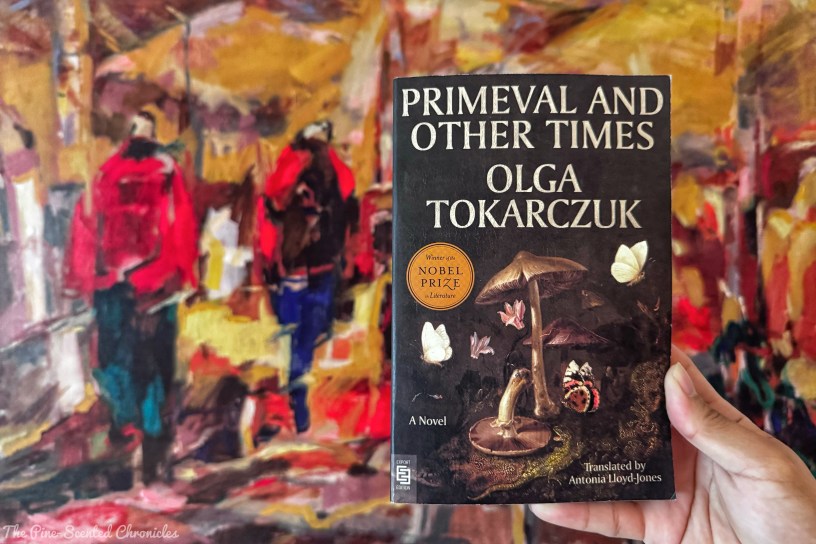
What established Tokarczuk firmly as a rising star in Polish literature, however, was her third novel, Prawiek i inne czasy, published in 1996. It also established her as one of Europe’s most exciting contemporary novelists. In 2010, it was translated into English as Primeval and Other Times, before she had earned global recognition, prompting the novel’s reissue in English in 2026. As has become her trademark, Tokarczuk transports readers to the Polish countryside, to the fictional titular town of Primeval. Described as “the place at the center of the universe,” the village is bounded by two rivers and surrounded by four archangels, each stationed at a cardinal point to serve as its guardian and each acquiring its own symbolic significance. Departing from traditional narrative structures, the novel is divided into “Times,” short chapters that convey the story of a different character or locale—human, animal, vegetable, mineral, or spiritual.
Despite its seemingly fragmented structure, three generations of the Niebieski/Boski family emerge as the novel’s backbone. Their fortunes and misfortunes provide the narrative’s central thread. The story begins in the early twentieth century with Genowefa, the miller’s wife. Her husband, Michał, is conscripted into the Tsar’s army while she is pregnant. During his absence, Genowefa looks after the mill and gives birth to Misia, their daughter. Michał eventually returns, devastatingly scarred by the war, both physically and psychologically. During his absence, however, Genowefa has fallen in love with Eli, a young Jewish man. The realities of the period ultimately drive them apart, and Genowefa remains with Michał. Years later, the couple has a second child, Izydor, a son born with hydrocephalus. Izydor is a kind of idiot savant: a pure soul who sees more than he understands and understands more than he can express.
Misia eventually marries Paweł Boski, the ambitious son of a roofer who dreams of shaping the future. Together, they have four children. Paweł eventually rises to become a Health Inspector under the Communist Party. The family lives through a tumultuous period marked by wars, occupations, and political upheavals. Yet the novel is not a conventional family saga. Each of its “Times” focuses on the perspective of a different character, place, or aspect of existence, encompassing the human, animal, vegetable, mineral, and spiritual worlds. The inhabitants of Primeval consequently exist on two levels: one mythical and one real. Archangels watch over them, while they maintain close relationships with animals and encounter strange phenomena. Although the narrative is fragmented, many of these episodes are interconnected, with some connections more apparent than others.
The story of the Niebieski/Boski family inevitably intersects with the lives of other equally fascinating characters. Cornspike is a refugee whom Genowefa takes in and feeds. To earn a living, she eventually turns to prostitution. When Genowefa gives birth to Misia, Cornspike gives birth to a stillborn child, prompting her to withdraw into the forest. There, she lives a strange, almost mythical existence as a witch and healer who can tame snakes and predict the future. Cornspike and Genowefa’s lives are mystically intertwined. When Genowefa gives birth to Izydor, Cornspike gives birth to her daughter, Ruta. Both Ruta and Izydor are somewhat different from those around them and soon become close. Meanwhile, the village madwoman Florentynka has an adversarial relationship with the moon, to which she hurls curses. The eccentric Squire Popielski, the local landowner, attempts to control nature but ultimately loses himself in a mysterious board game.
There are two kinds of learning, from the inside and from the outside. The fist is regarded as the best, or even the only kind. And so people learn through distant journeys, watching, reading, universities and lectures — they learn from what is happening outside them. Man is a stupid creature who had to learn. So he tacks knowledge onto himself, he gathers it like a bee, gaining more and more of it, putting it to use and processing it. But the thing inside that is “stupid” and needs learning doesn’t change.
Olga Tokarczuk, Primeval and Other Times
In its citation, the Swedish Academy lauded Tokarczuk’s “narrative imagination that, with encyclopedic passion, represents the crossing of boundaries as a form of life.” In classic Tokarczuk fashion, the mythical collides with reality in her third novel. While the village is fictional, Primeval is believed to have been inspired by the village of Zagrody in the Kielce region, where Tokarczuk spent her childhood holidays. Interestingly, despite the handful of characters who provide color to the story, the village itself stands as the novel’s most important character. Through vivid descriptions, Tokarczuk breathes life into Primeval. Its landscape, forests, rivers, houses, objects, and boundaries acquire distinct personalities, histories, and perspectives. Rather than telling the story of one family, the novel becomes a biography of an entire world. Primeval acts as a microcosm of broader human experiences that transcend geographical boundaries.
Primeval, then, is a landscape where the quotidian collides with the supernatural and the extraordinary. The novel’s folkloric quality is unsurprising, bearing many of the hallmarks of Tokarczuk’s distinctive prose. She seamlessly integrates magical realism with philosophical questions about the essence of existence. The short chapters, the novel’s “Times,” reflect the ephemeral nature of life. Brief. Fleeting. Yet they preserve individual stories. The materiality of daily life is evoked in immense detail, while these intimate accounts unfold against Poland’s larger historical backdrop. The country’s turbulent past both contrasts with and complements the novel’s mythical elements, allowing the experiences of Primeval’s inhabitants to resonate beyond their isolated world.
When Michał returns home, he is battered and embittered by war. Trauma continues to displace the villagers as successive conflicts disrupt life in Primeval. The Second World War brings the outside world violently into the village, exposing its inhabitants to occupation, displacement, violence, and the destruction of their familiar surroundings. Amid the chaos, they are forced to grapple with their identities, much as Poland itself struggles to define and redefine its own. Ironically, these upheavals also shape the characters’ development, with love, survival, and loss becoming integral to their lives. Yet while individuals change and generations pass, the village endures. The advent of Communist rule allows its inhabitants to rebuild, even as modernization and political change gradually transform their surroundings.
The “Times” further emphasize the ways in which lives unfold across generations. Time, memory, and forgetting therefore emerge as integral themes. Time, however, is not linear. As mythical, personal, and historical dimensions overlap, the novel acquires a timeless quality. Memory is likewise a leitmotif, with Tokarczuk asking what remains after people and events have disappeared. She explores the reliability and completeness of memory as a record of individual lives. Its fragmentary nature is mirrored by the novel’s structure, while the characters’ encounters with forces beyond their control reveal the limits of human agency. Remembering and forgetting thus become essential to how individuals and communities make sense of what came before.
People – who themselves are in fact a process – are afraid of whatever is impermanent and always changing, which is why they have invented something that doesn’t exist – invariability, and recognised that whatever is eternal and unchanging is perfect. So they have ascribed invariability to God, and that was how they lost the ability to understand Him.
Olga Tokarczuk, Primeval and Other Times
An integral element to the story is nature. The forest, rivers, animals, plants, and landscape of Primeval exist alongside human life, each possessing its own rhythms and histories. This broader ecosystem reminds us that humanity occupies only one part of a much larger world. The forest inhabited by Cornspike becomes both refuge and haunting presence, illustrating the tension between nature’s beauty and its indifference to human suffering. It also deepens the novel’s mythical quality. As she does in her other works, Tokarczuk blurs the boundary between the real and the supernatural, suggesting that certain forms of knowledge and experience cannot be fully captured by rational or historical accounts.
Family and human relationships are central to the story. They are threads that connect the story’s various “Times.” Marriage, parenthood, desire, jealousy, illicit affairs, and abandonment shape the lives of its characters, demonstrating how intimacy can provide both security and suffering. Faith and spirituality raise another set of questions, particularly concerning the purpose of existence. The characters attempt to make sense of their world by interpreting the signs and symbols around them, yet no straightforward answers emerge. Instead, faith and belief offer ways of approaching what remains unknowable. The complexity of the world ultimately exceeds the limits of human understanding, leaving room for curiosity, uncertainty, and wonder.
Containing many of the elements that would become hallmarks of her later works, Primeval and Other Times is remarkable for its refusal to fit neatly into any established category. What begins as the story of a small Polish village gradually expands into something much larger: a meditation on history, memory, nature, mortality, and the mysteries of existence. Tokarczuk shows how individual lives are shaped by forces far beyond their control, yet remain meaningful in the traces they leave behind. The village endures even as external events continue to influence it, becoming a repository for the memories, desires, losses, and stories of those who once inhabited it. By turning one village into a miniature universe, Tokarczuk transforms the seemingly ordinary into something profound. Primeval and Other Times is ultimately a beautifully strange meditation on the passage of time and the persistence of memory—and on our continuing attempt to find meaning in a world we can never fully comprehend
Imagination is essentially creative; it is a bridge reconciling matter and spirit. Especially when it is done intensely and often. Then the image turns into a drop of matter, and joins the currents of life. Sometimes along the way something in it gets distorted and changes. Therefore, if they are strong enough, all human desires come true — but not always entirely as expected.
Olga Tokarczuk, Primeval and Other Times
Book Specs
Author: Olga Tokarczuk
Translator (from Polish): Antonia Lloyd-Jones
Publisher: Riverhead Books
Publishing Date: 2026 (1996)
No. of Pages: 279
Genre: Literary, Historical, Magical Realism
Synopsis
Three generations in the life of a mythical Polish village.
For the denizens of Primeval, the world beyond its fields and forests is but a dream. The outcast Cornspike raises her daughter among the creatures and spirits of the forest. The squire Popielski loses his faith and becomes obsessed with a game where progress is attained only by dreaming the right kind of dream. Nonhuman beings – trees and mushrooms and archangels – have their Times, or stories, too, as do inanimate objects. Yet their Times are buffeted by the feral history of the twentieth century. Bloodshed, betrayal, and the dramas of daily living mark the birth, life, and decline of Primeval, making us consider afresh the stories by which we comprehend our own world and Times.
About the Author
To learn more about the 2018 Nobel Prize in Literature awardee and multi-awarded writer Olga Tokarczuk, click here.
Youth in its intensity, in its full force, tires itself out. One night or one morning a man crosses a boundary, reaches his peak and takes his first step downwards, towards death. Then the question arises: should he descend proudly with his face turned towards the darkness, or should he turn around towards what was, keep up an appearance and pretend it isn’t darkness, but just that the light in the room has been extinguished?
Olga Tokarczuk, Primeval and Other Times

