
First Impression Friday will be a meme where you talk about a book that you JUST STARTED! Maybe you’re only a chapter or two in, maybe a little farther. Based on this sampling of your current read, give a few impressions and predict what you’ll think by the end.
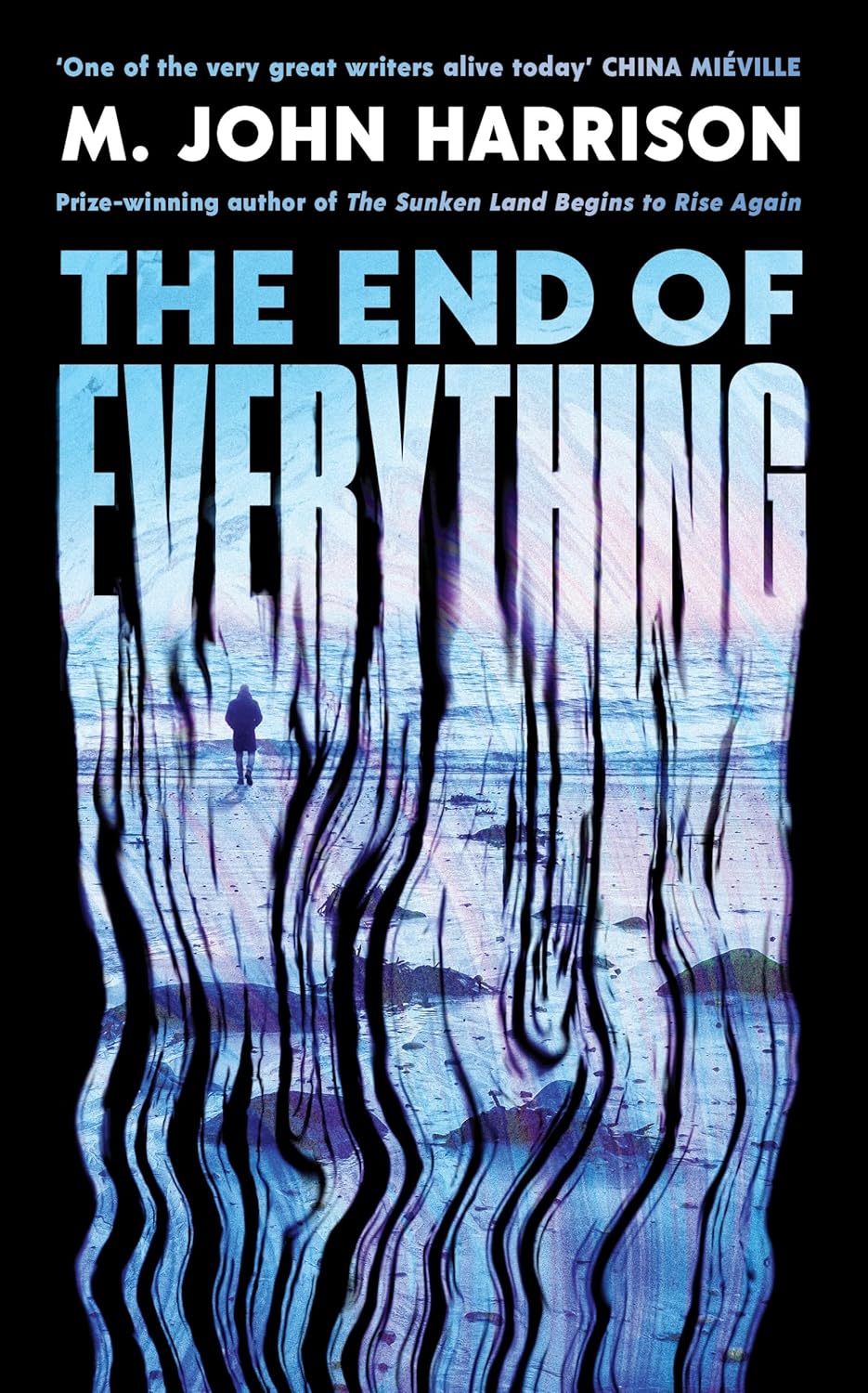
Synopsis:
Phillip Tennent makes his living at the tideline, collecting artefacts that wash up from the Channel. It’s been years since the crisis changed everything, but its exact nature remains obscure. Government barely functions, the seas are full of new creatures, an entire continent has been mislaid. It feels like the end.
Now Phillip has fished out of the water an object he can’t keep. A creature that keeps changing. An artefact he must take inland, before it destroys everything he thinks he knows. The End of Everything is a slyly satirical and unsettling postapocalyptic adventure into the limits of human understanding, from the peerless master of contemporary fiction.
It’s the end of the workweek—yay! I hope the week has been kind to everyone and that you’re all ending it on a high note. Just like that, November is about to conclude, and in a couple of days, we will be welcoming the last month of the year. A new year also beckons. This year has been quite challenging, although things have been looking up over the past few months. A career move led me to a more conducive environment. I do hope that things will keep looking up despite these harrowing times. But how time flies! Time takes its natural course, with little regard for any of us. As the year approaches its inevitable close, I hope everyone is rewarded for their hard work and showered with blessings and good news. With the weekend finally here, I hope everyone has a great one. It’s time to dress down and spend the weekend resting from the rigours of a demanding career, pursuing your passions, completing household chores, spending time with loved ones, or simply relaxing.
The weather has been fine these past few weeks, although it has been uncharacteristically stifling this late in the year. The Philippines should be experiencing breezier days, but with El Niño threatening the country, the days remain hot. Some parts of the country are starting to experience droughts, and forecasts suggest that conditions could worsen over the coming months. I hope these forecasts are off the mark, as such conditions could adversely affect the livelihoods and even the health of many. Still, the winter breeze is making itself felt at night, contrasting with the stifling days. The collision of these contrasting weather phenomena exposes us to various health concerns. Flu has become more prevalent in the past few weeks. Nevertheless, regardless of where you are in the Philippines or elsewhere in the world, I hope you’re all doing well—physically, mentally, and emotionally. With the end of the workweek comes a fresh First Impression Friday update.
In November, I have commenced a more liberal reading journey, but the focus remains on the books that are part of my ongoing challenges. Interestingly, the remaining books were written by African writers, prompting me to embark on a literary journey influenced by African literature. But with the manageable number of books remaining, I have been alternating these books with non-African literary works. Among these books is M. John Harrison’s The End of Everything. Before 2026, I had never heard of the British writer, who, apparently, has had quite a prolific literary career spanning several decades. Had it not been for the Booker Prize, I would not have encountered him. However, I confess that The End of Everything was one of the books I initially overlooked, mainly because it had a very low average rating on Goodreads and because I had never heard of Harrison before.
I eventually changed my mind after the book received recognition from the Prize, much to everyone’s surprise. This recognition made Harrison the oldest writer, at eighty-one, to earn the Booker Prize. The End of Everything is variously referred to as speculative fiction, dystopian fiction, and even satire. I guess this confusion drives its low rating. Anyway, the novel transports readers to Southeast England in the near future. At the heart of the story is Phillip Tennent, who is living in Dalston-on-Sea. Along with other beachcombers, he scavenges the shoreline for “artefacts” that have washed ashore from the English Channel. As the story progresses, we learn that the landscape has been radically altered by a mysterious event simply referred to as “the crisis.” Society has been disrupted by this event, which remains a mystery.
Harrison barely provides any explanation for it; the story, after all, starts in medias res. One thing, however, is evident: the world has become unstable, literally. Society has been dominated by the monstrous and mysterious iGhetti, who have appeared in the City of London. They are enigmatic entities that seemingly arrived from the astral plane. They are large columns with the capability of distorting reality. “We know nothing about their actual intentions,” says one character. “They may not even know we are here.” They cause reality to warp, resulting in what people colloquially refer to as “bad patches” of anomalous and unstable environments. Meanwhile, the central government has seemingly collapsed, and the entire country is in disarray. Britain has been isolated from Europe, which has also become a lost continent. Chapter 12, Coastal Time, vividly describes the environmental decay that transformed the country after the iGhetti’s arrival.
The environmental toll has been extensive. Tourist villages like where Tennent lived started to collapse. Golf courses were flooded with debris from river estuaries, while suburban homes cede land to expanding mudbanks. Still, some features of society remain. The story’s catalyst, however, is the appearance of a significant artefact, a biological gadget the size of a baby that Tennent finds one day. Tennent immediately recognizes its value and decides to sell it. On the way inland, he stops by the home of his elderly aunt, Marnie, a painter who is losing her memory but is adamant about retaining her independence. She is unnerved by the artefact, which mysteriously keeps growing ever since Tennent took it out of the water. While Tennent is in her basement garage checking on his heavily modified car, Marnie takes one of his pistols and sets the artefact free. When Tennent discovers what she has done, he is furious and speeds away in his car to find the creature.
Left alone, Marnie’s precarious life started to unravel. She wakes up one morning to find a neighborhood boy urinating on her through a hole in her roof. He was remorseless and even mocked her. When he tried to flee, one of his legs went through the roof, trapping him. Marnie trapped his leg and severed his femoral artery, leaving him to bleed to death. Her neighbors then demand that she leave the community. As the argument escalates, Marnie fires her stolen pistol into the crowd, causing two neighbors to collapse. As the crowd panics, Marnie flees. After a failed attempt to find Tennent at his home among the beachcombers, she finds refuge in an abandoned contemporary art gallery, where she begins a new artistic project. For a book its length, the novel is quite eventful. It is no wonder some readers find it quite confusing. It is a story that requires one’s full attention.
Still, the dystopian aspect is unsurprising, as the Booker Prize committee has been recognizing more and more works of dystopian literature. Paul Lynch’s Prophet Song and Margaret Atwood’s The Testaments come to mind. There is also much ado about the writing style, which has been described as mysterious and unsettling. Anyway, The End of Everything’s inability to be pigeonholed into any particular literary genre is more than enough to pique my interest. Even before reading it, I surmised that it was going to be a challenging read, much like Anna Burns’s Milkman, another Booker Prize winner. My hypothesis has been proven true. Still, I am looking forward to seeing how the story unfolds. An adventure looms, but this adventure’s consequences fill me with questions. What is the artefact? How will it alter the landscape? There is much ado about the artefact, although the book’s other elements add further layers.
How about you, fellow readers? What are you reading this weekend? I hope you’re enjoying your current book. Have a great weekend ahead!

