
Getting Introduced to a New Name
Before 2015, Kazuo Ishiguro was a name that barely rang a bell. I had no iota about who he is and what he writes about. That was until I saw how book buyers tried to outdo each other in buying his works, especially A Pale View of Hills. I also kept on encountering him and his works on list challenges and must-read lists such as the 1,001 Books You Must Read Before You Die. All of these cemented my resolve to try to read his works; my interest was piqued.
As fate would have it, obtaining copies of his works proved to be a challenge. Luckily I was able to purchase An Artist of the Floating World, The Remains of the Day, and The Buried Giant. Unfortunately, A Pale View of Hills remained elusive until Ishiguro’s declaration as the 2017 Nobel Peace Prize in Literature winner. Publishers have reprinted his works, and I was fortunate enough to purchase the only copy of A Pale View of Hills I saw in a bookstore. For it not to gather more dusts, I read it with relish in the same year that Ishiguro won the Nobel Peace Prize.
Chess is all about maintaining coherent strategies. It’s about not giving up when the enemy destroys one plan but to immediately come up with the next. A game isn’t won and lost at the point when the king is finally cornered. The game’s sealed when a player gives up having any strategy at all. When his soldiers are all scattered, they have no common cause, and they move one piece at a time, that’s when you’ve lost.
Kazuo Ishiguro, A Pale View of Hills
A Masterful Debut
A Pale View of Hills is the nostalgia-laden flashback of Etsuko, a Japanese mother living in England. When we first meet her, she was dealing with the unexpected death of her eldest child, Keiko. Upon seeing a child playing on the swing, she was drawn back to post-war Nagasaki. Back then, she was pregnant with Keiko when she encountered Mariko and her daughter, Etsuko. Mariko moved from Tokyo and was frowned upon by the other locals but Etsuko was able to establish an unusual friendship with her.
Using his signature narrative style of connecting the reader with the characters, Ishiguro was able to relate the story of Etsuko’s motherhood. His grounded writing style is filled with emotions that stirs the reader to a heightened sense of literary appreciation. There is just something about East Asian authors that draws the depth of human emotions. A Pale View of Hills reeked of this, as well.
The depth of the writing style complimented the depth of the story that Etsuko is relating. The reader is gripped to a melancholic yet wonderful story of a budding mother who is caught in the clash of Oriental and Western culture that was instigated by the surrender of Japan during the Second World War. In the advent of changes that was brought about by Japan’s defeat, change was inevitable within the horizon but not everyone was receptive of this change.
The English are fond of their idea that our race has an instinct for suicide, as if further explanations are unnecessary; for that was all they reported, that she was Japanese and that she had hung herself in her room.
Kazuo Ishiguro, A Pale View of Hills
Although the story is mainly about Etsuko and motherhood, there were rich undertones about the shift from Oriental ideologies to Westernized schools of thoughts. At numerous points in the story, the characters were locked in deep thoughts and arguments about their conflicting beliefs. Such an array of subject matters argued upon included Japan’s education system and Japan’s patriarchal structure.
Symbolically, there were three groups of Japanese represented in the story. One group iwascomposed of those who were receptive of these new ideologies such as Sachiko and Shigeo Matsuda. The second group was composed of those who want to preserve the old culture and resist the adaptation of the modernized ideologies. This group included Etsuko’s father-in-law, Mr. Ogata and Mrs. Fujiwara. The last group neither agreed nor disagreed with the Westernization of Japan. This group had the task of maintaining peace and harmony amongst their countrymen and countrywomen. I just admired how subtly yet richly these undertones were weaved into the tapestry of the story.
The thing that has drawn me into the story is its powerful narrative and wonderful pacing. In spite of its heavy themes, it was still a pleasurable read. However, there were some details that were left unresolved; it was left for me, and by extension, the readers to conclude. The dichotomy between the Nagasaki Etsuko and England Etsuko was too stark that some details were left to the imagination of the readers.
The worst days were over by then. American soldiers were as numerous as ever — for there was fighting in Korea — but in Nagasaki, after what had gone before, those were days of calm and relief. The world had a feeling of change about it.
Kazuo Ishiguro, A Pale View of Hills
What happened to Etsuko’s first husband, Jiro? How did Etsuko meet her second husband? What happened to Sachiko and Mariko? These were just among the many unsettled questions that were in want of response. Come to think of it, this was pretty consistent with his fellow East Asian writer’s inclination for unsettled story lines. This, I surmise is their way of involving the readers in the story-telling process.
Nonetheless, I still tip my hats off to Kazuo Ishiguro for his masterful narrative that appealed to the reader’s inner senses on many levels. Through A Pale View of Hills, he clearly established himself as a top caliber writer. It was a masterful debut that was germane in establishing his blueprint as a storyteller. This pattern would then manifest and even polished in his succeeding works. Ishiguro is a wonderful storyteller and his reputation precedes him. His first work, albeit his fifth work that I have read, makes me look forward to reading his other works.
For now, happy reading!
We devoted ourselves to ensuring that proper qualities were handed down, that children grew up with the correct attitude to their country, to their fellows. There was a spirit in Japan once, it bound us all together. Just imagine what it must be like being a young boy today. He’s taught no values at school — except perhaps that he should selfishly demand whatever he wants out of life. He goes home and finds his parents fighting because his mother refuses to vote for his father’s party. What a state of affairs.
Kazuo Ishiguro, A Pale View of Hills
Rating

Recommended for: light readers looking for a leisurely read that appeals to the inner senses; those who like books about nostalgia and flashbacks.
Not recommended for those who find East Asian literature nauseating for its nostalgic themes.
Book Specs
Author: Kazuo Ishiguro
Publisher: Vintage Books
Publishing Date: 2017
Number of Pages: 183
Genre: Historical
Synopsis
The highly acclaimed first novel by the author of The Remains of the Day and Never Let Go, A Pale View of Hills is the story of Etsuko, a Japanese woman, now living alone in England, dwelling on the recent suicide of her eldest daughter. In a story where past and present confuse in a haunting and sometimes macabre way, she relives scenes of Japan’s devastation in the wake of World War II, even as she recounts the weirdness and calamities of her own life.
About the Author
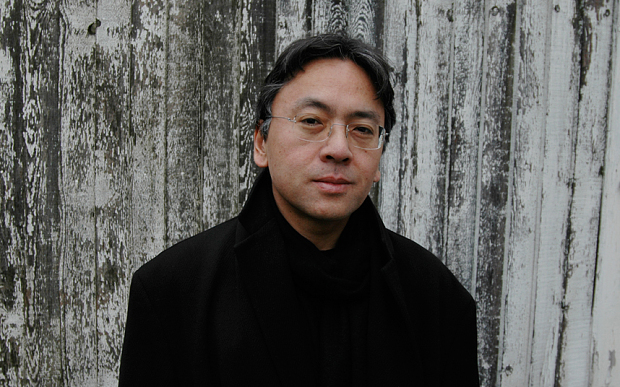
Kazuo Ishiguro was born on November 8, 1954 in post-nuclear bomb Nagasaki, Japan. In 1960, his family moved to Guildford, Surrey, England as his father, a physical oceanographer, was invited for research at the National Institute of Oceanography. In 1978, he graduated with degrees in English and Philosophy from the University of Kent.
At the University of East Anglia, he took his masters and studied with esteemed writers Malcolm Bradbury and Angela Carter. In 1980, he gained a Master of Arts in Creative Writing. His thesis was published as his first novel in 1982, A Pale View of Hills. His succeeding works also earned nominations for the Man Booker Prize Award; he earned a total of four shortlisting and, in 1989, he won one for The Remains of the Day. His 2005 novel, Never Let Me Go, was named by Time Magazine as the best novel of the year. His latest work, Klara and the Sun, was published in 2021.
Ishiguro’s work has been translated into forty languages and has won him many honors, including the Order of the British Empire for service to literature, and the French decoration Chevalier de l’Ordre des Arts et des Lettres. In 2017, Ishiguro was awarded the Nobel Prize in Literature.
He is currently living in London with his wife, Lorna MacDougall and their daughter, Naomi.
 The Pine-Scented Chronicles
“There is just something about East Asian authors that draws the depth of human emotions”. This is true. I don’t know if this is just an Asian thing or it transcends beyond continents. Try reading the “The Gift of Rain” by Tan Twang Eng, “The Little Girl in the Window” authored by Toto-chan, and The Hen who dreamed she could fly by Hwang Sung Mi. 🙂
As usual, enjoyed reading your blog.
LikeLiked by 1 person
Thank you for reading. Thank you for the recommendations as well!
You know, I’ve been trying to step out of the stereotypical reads (Americans, British). I am setting my sights on Asian and Mainland European books. African writers as well. 🙂
Truly, there are so many books to read out there beyond the ones everyone hear about 🙂
LikeLiked by 1 person