Teenage Rebellion and Censorship
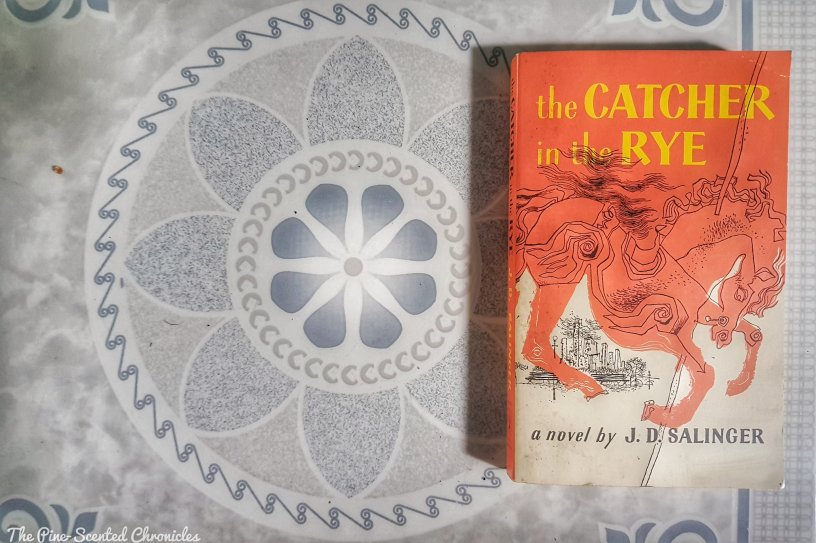
When I picked up J.D. Salinger’s from the “Classics” shelves in the bookstore, I didn’t have an inkling of what it was or the impact it had over the general reading public. The only reason I bought it was that it was tagged as “Classic” and “Award-Winning”, my weakness. Moreover, there’s an enigma wrapped around the book’s title that piqued my interest..
Initially published in serial form from 1945-1946, The Catcher in the Rye was eventually published as a complete novel in 1951. From the moment it was published, the book already shook the literary world, drawing the ire of many a reader. Although the reaction was largely mixed, one thing was clear: the book’s impact is going to extend to generations beyond. The initial uproar only served to further pique the curiosity of the general public.
I had very little expectations (as I always do) when I started reading The Catcher in the Rye. To reiterate, I didn’t have any background on what the story was about or even on the blurb that it was surrounded with. I just simply went with the flow. From the onset, I was introduced to Holden Caulfield, the story’s main protagonist and narrator. So okay, he is a sixteen-year-old teenager, full of spunk and angst.
That’s the whole trouble. You can’t ever find a place that’s nice and peaceful, because there isn’t any. You may think there is, but once you get there, when you’re not looking, somebody’ll sneak up and write “Fuck you” right under your nose. Try it sometime. I think, even, if I ever die, and they stick me in a cemetery, and I have a tombstone and all, it’ll say “Holden Caulfield” on it, and then what year I was born and what year I died, and then right under that it’ll say “Fuck you.” I’m positive, in fact.
J.D. Salinger, The Catcher in the Rye
Holden walks us through his life, starting with his stormy life as a student (he just got expelled, for the the fourth time) before moving on to his family life (which was virtually nonexistent). His actions and language made one thing apparent: he has unsated longings. His anger and frustrations are but natural; he is at the most tumultuous and rebellious phase of his life (so far). Holden is the stereotype of the teenage population.
The charm of the story lies in its ability to connect with the readers. We can all agree that we have been through the phase Holden is in; some had it light while some had it worse. The hormones go flailing on all ends of the spectrum as the gap between childhood and adulthood is being bridged. Development comes at a steep price. Even I had my moments of rebellion and angst.
On the surface, Salinger painted the dubious profile of Holden. But if one looks at the other side of the profile, one can see the real face that hides behind the mask of rebelliousness and angst. Reading deeper into the narrative, I am slowly drawn into Holden’s world, his motivations, and his desires. I wasn’t deceived by Holden’s devious behavior and his steely, exterior. I knew at the onset that there is something deeply emotional about him and his story.
The novel is an insightful exploration of the psyche. There is a very common reference to Holden’s cold façade, which I found was a deception, an armor. A lot has been said about his brand of teenage rebellion and it obscured the fact that his emotions are still taking shape. In his desperate search for companionship, Holden asks a cab driver to join him for a drink. Holden is lazy but he is also very well-read; he exhibits great insights and intelligence when he discusses the books he has read. He is also very generous with his things and his time – he completed an essay for his friend whom he was upset with.
This fall I think you’re riding for—it’s a special kind of fall, a horrible kind. The man falling isn’t permitted to feel or hear himself hit bottom. He just keeps falling and falling. The whole arrangement’s designed for men who, at some time or other in their lives, were looking for something their own environment couldn’t supply them with. Or they thought their own environment couldn’t supply them with. So they gave up looking. They gave it up before they ever really even got started.
J.D. Salinger, The Catcher in the Rye
Far from the mask of indifference, Holden is a very caring and very sensitive individual. For a teenager, his emotions are well formed. Holden is rather sentimental, longing for more emotional commitment rather than a physical one. Holden has the compunctions of a teenager but he has the emotional maturity of an adult. His relationship with his sister, Phoebe, is definitely one of the novel’s biggest accomplishments.
One facet of the novel that one will find overwhelming is Holden’s anger and angst. It arose from a slew of different elements such as the alienation of his parents, his constant search for his identity, and the loss of connections to people around him (he is, after all, desperately lonely).
What I found truly striking is the spectrum of emotions that Holden exhibited. He built a dam to control the ebb of his emotions, trying hard to not let it burst. In the end, it came out in the form of rants, of anger. I found myself empathizing with him (I didn’t mind the invectives as it was an outlet to release parts and parcels of these “pent” emotions). As for the language, I rarely found it distasteful; it merely conforms to the spirit of the story.
Salinger tried to bridge the gap between adolescence and adulthood (Holden criticized the “phoniness” of adulthood). This is one of Holden’s biggest dilemmas – he is an adolescent on the cusp of adulthood. In the background, one can hear an audible noise that communicates Holden’s fears as he enters a new phase.
Holden was a spitfire of a character and Salinger did a great job in developing him. His haunting voice is so riveting that it keeps me hooked. It is very rare that I am drawn into the character narrating the story but Holden’s voice leaves an unmistakable deep impression. Yes, Holden at the start is still Holden in the end but his anger transformed into optimism – an evolution that is confounding but breathtaking nonetheless.
Among other things, you’ll find that you’re not the first person who was ever confused and frightened and even sickened by human behavior. You’re by no means alone on that score, you’ll be excited and stimulated to know. Many, many men have been just as troubled morally and spiritually as you are right now. Happily, some of them kept records of their troubles. You’ll learn from them—if you want to. Just as someday, if you have something to offer, someone will learn something from you. It’s a beautiful reciprocal arrangement. And it isn’t education. It’s history. It’s poetry
J.D. Salinger, The Catcher in the Rye
In a breathtaking tapestry, Salinger weaved a wonderful story. Although The Catcher in the Rye is less about the story, it is more about the character. Many a reader may try to polarize Holden’s story: whether you can relate to it or not. Break out of the bounds of teenage rebellion and mentality and you’ll witness humanity’s infinite desire for love and care. However, Holden’s need took a different form: anger and angst.
The Catcher in the Rye is a wonderfully crafted piece complimented by the haunting voice of a relatable character. Holden is truly a captivating character – enigmatic, and charismatic. He imbibes reality. Rarely is a literary character this memorable and realistic. This book truly belongs to the highest orders of the literary world.
Ratings

Recommended for readers who enjoy first-person perspectives, readers who want to explore the psyche of teenagers and teenage rebellion, and readers who want a haunting voice.
Not recommended for readers who are very conservative and very conscious of and sensitive to very foul language.
Book Specs
Author: J.D. Salinger
Publisher: Little, Brown and Company
Publishing Date: May 1991
Number of Pages: 214 pages
Genre: Bildungsroman, Literary Realism
Synopsis
The hero-narrator of The Catcher in the Rye is an ancient child of sixteen, a native New Yorker named Holden Caulfield. Through circumstances that tend to preclude adult, secondhand description, he leaves his prep school in Pennsylvania and goes underground in New York City for three days. The boy himself is at once too simple and too complex for us to make any final comment about him or his story. Perhaps the safest thing we can say about Holden is that he was born in the world not just strongly attracted to beauty but, almost, hopelessly impaled on it. There are many voices in this novel: children’s voices, adult voices, underground voices-but Holden’s voice is the most eloquent of all. Transcending his own vernacular, yet remaining marvelously faithful to it, he issues a perfectly articulated cry of mixed pain and pleasure. However, like most lovers and clowns and poets of the higher orders, he keeps most of the pain to, and for, himself. The pleasure he gives away, or sets aside, with all his heart. It is there for the reader who can handle it to keep. (Source: Goodreads)
About the Author
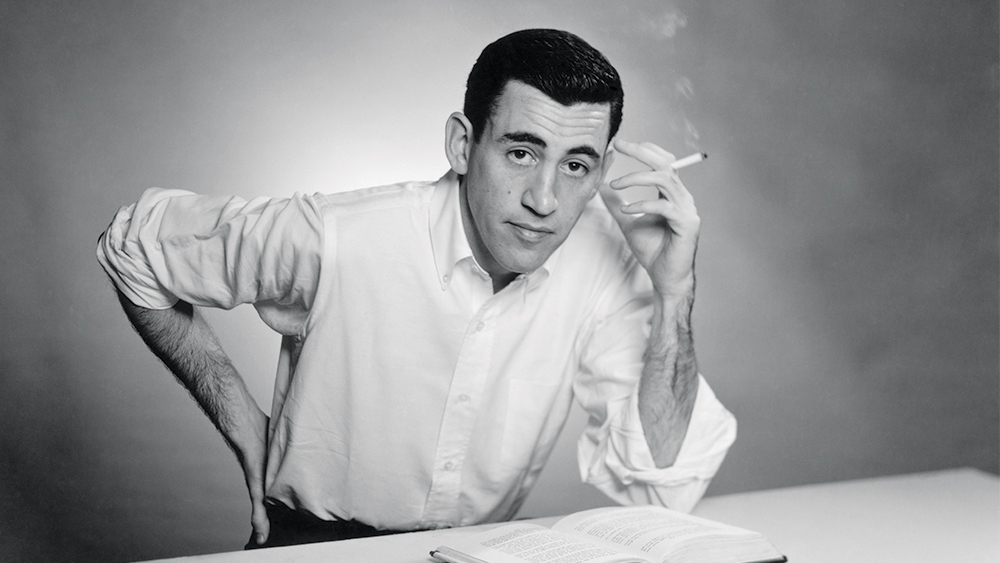
Jerome David Salinger was born on January 1, 1919, in Manhattan, New York, where he was also raised.
Salinger’s storied writing career began when he started composing short stories in secondary school. Some of these short stories were published in Story magazine. In 1938, he attended Ursinus College in Collegeville, Pennsylvania but dropped out after one semester. He then enrolled at the Columbia University School of General Studies. In the spring of 1942, Salinger was drafted into the army, seeming combat with the 12th Infantry Regiment, 4th Infantry Division. During the campaign from Normandy into Germany, Salinger met with Ernest Hemingway, one of his biggest influences.
On July 16, 1951, The Catcher in the Rye was published by Little, Brown and Company. It has become one of the most taught but most censored literary pieces of all time. It is his most recognized work although he did publish a couple more books afterward such as Nine Stories (1953), Franny and Zooey (1961) , and Raise Hight the Roof Beam, Carpenters and Seymour: An Introduction (1963).
J.D. Salinger passed away on January 27, 2010, at the age of 91.
 The Pine-Scented Chronicles
Good Carl that you have discovered it early in your life. There is definitely a kind of beauty that one will discover reading it at certain stage of one’s life. My experience reading it at university days was a unique experience with me reading it when I already have kids. Nevertheless I will recommend this to my teen age children. 😀. Go also for Salinger’s stories particularly “A Perfect Day for Banana fish” or Frankie and Zoey.
LikeLiked by 1 person
Holden just has a voice that lingers and is distinct. Yes, I am lookong forward to his other works as well. 🙂 Thank you for the recommendation though. 🙂
LikeLike