The Politics of Gender
A journey through contemporary American literature would not be complete without encountering the works of John Wallace Blunt, Jr., more popularly known as John Irving. He adopted Irving from his stepfather because he never met his biological father. With a literary career that spanned over half a century, he has produced literary masterpieces such as The World According to Garp (1978), The Cider House Rules (1985), and A Prayer for Owen Meany (1989). The body of his works speaks for itself: Irving is, without a doubt, one of the most celebrated literary novelists of modern America. These books were massive international hits, earning Irignv significant acclaim across the world. His works were also seminal in defining the landscape of contemporary American literary novels.
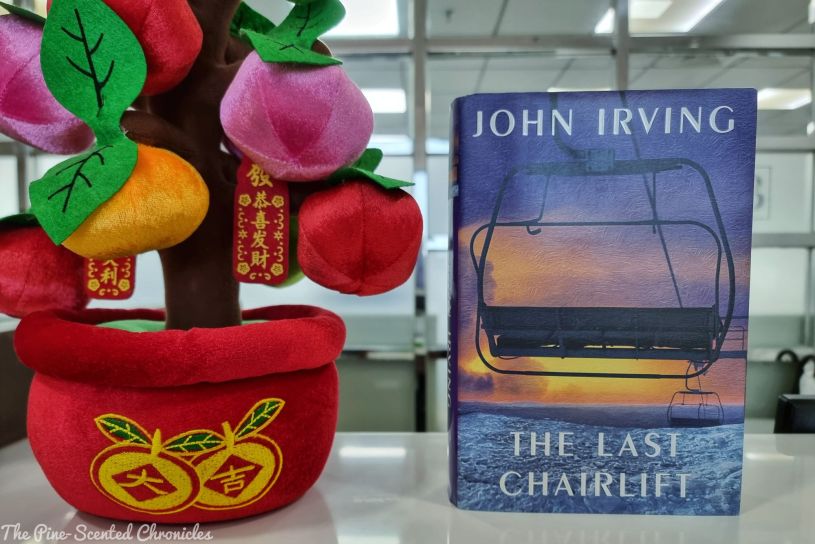
In 2022, now an octogenarian, Irving made his long-awaited literary comeback. Nearly seven years after the publication of his latest novel, Avenue of Mysteries (2015), Irving published his fifteenth novel, The Last Chairlift. For the devout readers of Irving’s oeuvre, reading The Last Chairlift feels like settling into a familiar pair of shoes. The first facet of the book that stands out is its length. At a whopping 912 pages, it is massive and also palpably an Irving novel; this fact no longer surprised literary pundits and consumers of Irving’s works. Since his fourth novel, The World According to Garp, Irving has been renowned for writing extensive stories that charted the fortunes of his characters, from their birth to their eventual death. Irving, however, has resolved that The Last Chairlift would be his last “long novel.”
At the heart of Irving’s last long novel is Adam Brewster. Narrating the novel in the first person, Adam was the illegitimate son of Rachel Brewster. Rachel, or Little Ray as she would fondly be referred to, was athletic despite her diminutive stature. She was a slalom skier who participated in the 1941 National Downhill and Slalom Championships held at Aspen, Colorado. Little Ray’s performance was forgettable but she did not leave Aspen empty-handed; she went home to pregnant with Adam. The identity of the father of her son, however, was wrapped in a veil of enigma. Little Ray refused to talk about what happened in Aspen. She was adamant in her refusal to divulge the identity of Adam’s father to her parents and two older sisters. Little Ray was the last of three daughters, a miracle as their mother would call her as Rachel was conceived during a critical juncture in their parent’s marriage.
“When you write about your life as a screenplay, it’s as if you’re watching someone else’s life; it’s not your life, and you’re not living it. You’re only seeing what the characters do, your character included. And screenplays are written in the present tense — as if nothing has already happened, as if everything is unfolding in the present. I’m only saying this is how it started — how I began to see my life as an unmade movie. The way it began was almost natural.”
~ John Irving, The Last Chairlift
“My life could be a movie,” stated Adam. The Last Chairlift charts the story of Adam from his birth through to late middle age. In Exeter, New Hampshire his childhood was dominated by the presence of his grandmother, grandfather, uncles, and aunts. His grandfather, who was degenerate when the readers first met him, was once a schoolmaster at the Philip Exeter Academy. Meanwhile, Little Ray worked as a ski instructor. She spent months away from her son, carving down mountains in neighboring Vermont, effectively making her an absentee mother. It was a contentious point for the sisters, with Adam’s aunts often resorting to using skiing to criticize their younger sister’s life choices. During these periods of Little Ray’s absence, Adam was raised by his grandmother who read him Moby Dick.
Despite growing up in a tightly-knit family, Adam refused to conform to his family’s expectations. He grew up in a family of competitive individuals who shared a passion, or perhaps obsession with skiing; his mother is a case in point. Skiing was a prominent presence in the story, with Irving detailing the characteristics of various slopes from Aspen to Maine. Pages of the novel were also dedicated to the discussions about skiing finesse and strategies. Viewed from a different lens, the slopes that Little Ray carved were allegorical. They were representations of the crests and troughs that Adam had to deal with as he grew up. Adam, however, refused to excel or even participate in the family pastime. Some things, however, do not change. Imbued in Adam’s gene was his maternal family’s competitiveness. He poured his competitive energy toward a different direction, an unconventional sport: wrestling.
Growing up, Adam was wary of his relationship with his mother. For the most part, their relationship felt ephemeral. Adam felt that his mother neglected him, that he occupied second place in his mother’s mind and heart; she has long been devoted to her first and constant love: skiing. Little Ray was also wrapped in a veil of secrecy. Her bouts of disappearances from her son’s life allowed her to meet different individuals, many of whom remained a secret to her son. Among the many individuals Little Ray became acquainted with was Elliot Barlow, an English teacher whom Little Ray eventually married. However, their union was convenient, and everyone was aware of it. Little Ray felt like Elliot would protect Adam as he navigated school life. This, however, does not necessarily entail that they did not love each other.
There was also a different level of convenience that emanated from Little Ray and Elliot’s union; this element of their relationship was central to the novel. Neither Little Ray nor Elliot were grounded by traditional sexual and gender mores. They refused to conform to social conventions, albeit this was initially clandestine. However, no secret is forever. As the story moved forward, Little Ray was revealed to be in a long and happy relationship with Molly, a trail groomer; Adam uncovered their clandestine relationship when he stumbled upon them in bed together. Meanwhile, Elliot is revealed to be homosexual and transitioned to a female as the story moves forward.
“When you’re a child, you think childhood is taking too long — you can’t wait to grow up. One day, the growing up has happened; you missed it, and you’re trying to seize it after the fact. When you keep secrets from people you love, you don’t sleep as soundly as a child. That’s when you know the growing up has happened, though you still have more growing up ahead of you — I certainly did. That’s when my dreams started, when I stopped sleeping like a child.”
~ John Irving, The Last Chairlift
An Irving novel is never complete without a healthy dose of politics; it is an element prevalent among works of American writers. Irving’s literary lenses magnify the politics of sex, a subject that has recently become prevalent. Discourses such as using correct pronouns have become an integral part of our daily interactions; social media users are encouraged to indicate their preferred pronouns to avoid misgendering. Irving is no stranger to this subject as well, with his earlier works. His works long championed queerness, even at a period when most writers skirted around the subject. Compared to his earlier works, The Last Chairlift is a more direct and more in-depth exploration of sexual intolerance and sexual politics in general.
Irving’s exploration of sexual intolerance doesn’t come at a better time. Recently, there was a spate of discourses on the correct usage of pronouns. Historically, pronouns for people used to be he or she. However, with the recent rise of discourses on political correctness, people started to use other pronouns. Social media users started placing their pronouns in their profiles to stymie the incorrect usage of their chosen pronouns. In an age where the influence of social media is all-reaching, there is a sense of liberation in placing one’s correct pronouns in one’s social media account. For cis genders, this was no issue as they just indicated what everybody already recognized. But as many can attest, gender is fluid in the same manner as color is not restricted to black and white.
It followed that men who identified as women chose to be referred to as “she”. The same applied to women who identified as men. This liberality in one’s preferred pronouns has not escaped the ire of some. Conservatives and purists refused to acknowledge one’s preferred pronoun. They are insistent on the idea that pronouns are determined by one’s birth gender and do not and will not change as one navigates life. It got murkier when nonbinary individuals opted to use they or their as their pronouns. The sexual minorities as they are conveniently referred to. Not only do they have to deal with discrimination in real life but they also have to be discomfited in the virtual space. The “woke” generation, as this generation is referred to, refused to buckle down. They did not let themselves be taunted by the boomer generation. The discourse, however, goes beyond intergenerational discourses and pronouns, as Irving depicted in his latest novel.
Irving introduced an eclectic cast of characters who represented various colors of the rainbow. On top of Little Ray and her lovers, the readers meet homosexual characters who are willing to sacrifice and be martyred for their lifestyles. It is not, however, always a utopia. One union was comprised of a self-hating gay and a self-hating homosexual. Their daughter, Em, was also gay. She eventually became the girlfriend of Adam’s lesbian cousin, Nora. The trauma of her parents’ tumultuous relationship prompted Em to resort to pantomiming as a means to communicate. Nora and Em performed a stand-up gig at the Gallows called Two Dykes, One Who Talks. It was also Nora who gave Adam the eye-opening revelations about their family. The family’s problem, Nora confided to Adam without sugarcoating, emanated from sex.
“Your first loss of a loved one, the first death of someone dear to you — when it happens, the pace of everything changes. In the past, there were times when nothing seemed to be happening. When you lose someone, you’re aware of the earth’s motion; the world is always moving, always ahead of you. For the rest of your life, you know there are other deaths coming — one after another, yours included.”
~ John Irving, The Last Chairlift
Nora’s frank admission also magnifies what was increasingly becoming palpable as the story moved forward: the Brewster family was an allegory. Adam’s family is a microcosm of the intolerance of sexual minorities prevalent amongst the conservatives. Little Ray’s father was puritanical – unironically – and his affliction was said to have been caused by Little Ray’s decision to keep and raise Adam as a single unwed mother. He viewed it as scandalous. Meanwhile, Little Ray’s older sisters were also as conservative as their father. They frowned upon Little Ray’s choice of lifestyle, never missing a beat to voice their disapproval of her choices. Tensions kept breaking the surface but the Brewster family remained close.
To further underline the main subject of The Last Chairlift, Irving takes the readers on a historical class. He revisited the horrors of the 1980s. It was during this decade that the AIDS epidemic started gaining ground. President Ronald Reagan, a Republican and considered one of the most conservative figures in American history, exacerbated the situation by his refusal to admit the deadly disease’s very existence. Parts of the novel permeated with the unmistakable stench of death – both physical and emotional – caused by the disease. As the world gets a grip on this growing concern, many still refuse to acknowledge the existence of AIDS, like how some refused to acknowledge the COVID-19 pandemic. There were also the righteous who said that the rise of AIDS was a Holy punishment for homosexuality.
Cultural touchstones were interspersed in the novel. Adam’s grandmother extensively referred to Herman Melville’s Moby Dick, There were also allusions to Charles Dickens’ Bartleby the Scrivener and Great Expectations and Ludwig Bemelmans’s Madeline. Writers John Updike, Kurt Vonnegut, and Graham Greene were also mentioned. As an adult, Adam pursued writing as a career. He was also a screenwriter; the novel contained two of Adam’s full-length screenplays. Relative to this, the novel explored film noir. As a character, Adam remained mostly a mystery. The readers learn very little about him, including his developing obsession with his father’s identity. While he was the main narrator, he was more of an objective observer whose lenses chronicled the lives of the people around him.
“This gets complicated, because I know that not all ghosts are dead. In certain cases, you can be a ghost and still be half-alive—only a significant part of you has died. I wonder how many of these half-alive ghosts are aware of what has died in them, and — dead or alive — if there are rules for ghosts.”
~ John Irving, The Last Chairlift
Without a doubt, The Last Chairlift is the typical Irving novel. It is not only due to its length. As the story moves forward, the parallels between Irving and Adam emerge. For one, both the writer and his literary creation are illegitimate sons born in 1942. They were both raised by a single mother in the town of Exeter, New Hampshire. Adam, like his creator, was a writer and a screenwriter. In a nutshell, Adam is also the stereotypical Irving hero; he shares similarities with other Irving heroes such as T.S. Garp in The World According to Garp. Politics again figures prominently in the book; a mantra in Irving’s novel is the realization that everything is political. However, the novel’s ambitions were weighed down by its repetitiveness. It was dragged down by its unnecessary details.
Beyond its flaws, The Last Chairlift raises timely questions and discourses vis-a-vis seminal subjects regarding sexuality, sexual politics, and sexual intolerance. It is Irving’s most extensive exploration of sexual politics even though he subtly embedded the subject in his earlier works. He explored the intricacies of homosexual relationships and transgenderism. Homophobia and transphobia were inevitably explored. In a way, the novel was an examination of the current state of American society, with the spate of violence towards homosexuals and transgenders and the scrutiny of the usage of pronouns. It is no surprise that scathing political commentaries were prevalent in the novel. In the end, a realization beyond sexual politics crystallizes. The Last Chairlift astutely underscored how connection between people is more important than sexual connections.
Book Specs
Author: John Irving
Publisher: Simon & Schuster
Publishing Date: 2022
Number of Pages: 889
Genre: Literary
Synopsis
In Aspen, Colorado, in 1941, Rachel Brewster is a slalom skier at the National Downhill and Slalom Championships. Unremembered in the competition, Little Ray, as she is called, finishes “nowhere near the podium,” but she manages to get pregnant. Back home, in New England, Ray becomes a ski instructor. Her son, Adam, grows up in a family that defies conventions and evades questions concerning the eventful past. Years later, looking for answers, Adam will go to Aspen. In the Hotel Jerome, where he was conceived, Adam will meet some ghosts; in The Last Chairlift, they aren’t the only ghosts he sees.
If you’ve never read a John Irving novel, you’ll be captivated by storytelling that is tragic and comic, embodied by characters you’ll remember long after you’ve finished their story. If you have read John Irving before, you’ll rediscover the themes that made him a bard of alternative families – a visionary voice on the subject of sexual freedom. The author’s favorite tropes are here, but this meticulously plotted novel has powerful twists in store for readers. The Last Chairlift breaks new artistic ground for John Irving, who has been called “among the very best storytellers at work today” (The Philadelphia Inquirer), “the American Balzac” (The Nation), “a pop star of literature, beloved by all generations” (Suddeutsche Zeitung, Munich), and “the unsurpassed master of whirling plots, unforgettable characters and sharp satire” (NRC Handelsblad, Amsterdam). With The Last Chairlift, readers will once again be in John Irving’s thrall.
About the Author
To learn more about John Irving, click here.
 The Pine-Scented Chronicles
This sounds like a brilliant novel and one that I really ought to read. I’m just a bit put off by the length so I think that it will have to wait until the Summer when there are more reading hours in the day. Great Review.
LikeLiked by 1 person
I am glad you liked the review. However, I do consider the book one of Irving’s lesser works. I don’t mind if he cut off some parts. Still, his writing capabilities shine through, as always.
LikeLiked by 1 person
📖
LikeLike
I’ve been meaning to read more of John Irving’s novels, as I loved In One Person. This was a fantastic review, and I plan to pick this one up to add to the collection.
LikeLike