
First Impression Friday will be a meme where you talk about a book that you JUST STARTED! Maybe you’re only a chapter or two in, maybe a little farther. Based on this sampling of your current read, give a few impressions and predict what you’ll think by the end.
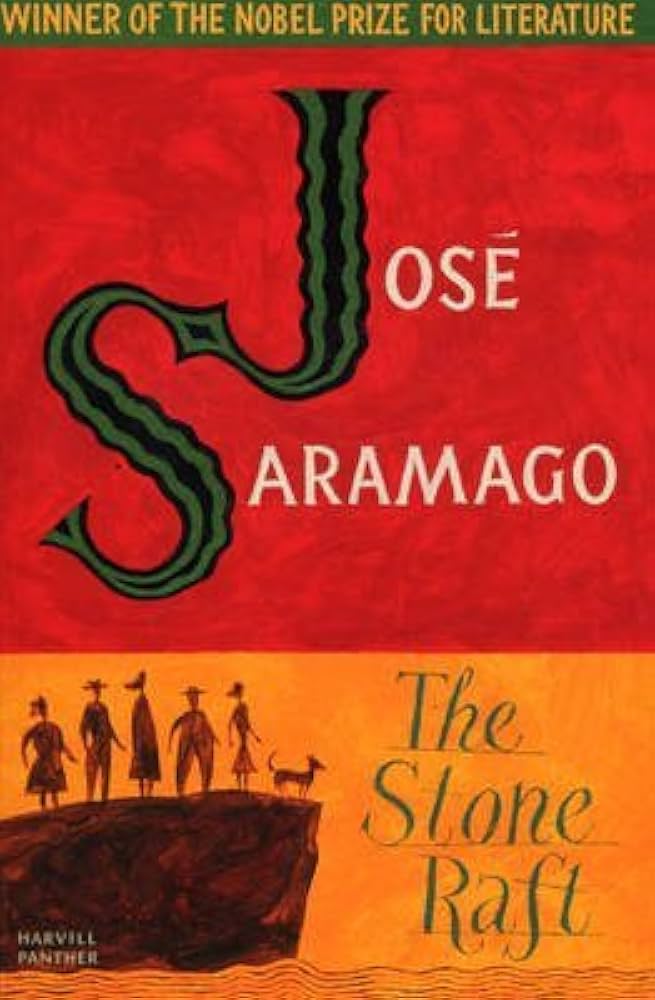
Synopsis:
What if, one day, Europe was to crack along the length of the Pyrenees, separating the Iberian peninsula?
In Saramago’s lovely fable, the new island is sent spinning, like a great stone raft, towards the Azores. While the authorities panic and tourists and investors flee, three men, two women and a dog are drawn together by portents that burden them into a bemusing sense of responsibility. Travelling at first packed into a car, then into a wagon, they take to the road to explore the limits of their now finite land, adrift in a world made new by this radical shift in perspective.
It’s the end of the workweek—yay! Technically, it is already Saturday. Nevertheless, I hope the week has been kind to everyone and that you’re all ending it on a high note. How time flies! We are nearly done with the fourth month of the year. I hope April proves to be a promising one. I hope the conflict in the Middle East will continue to de-escalate—or, better yet, be resolved soon. As the year progresses, I hope everyone is given plenty of opportunities to grow and improve. With the weekend here, I hope everyone has a great one and truly ends the workweek on a high note. It’s time to dress down and wear more comfortable clothes. I hope everyone spends the weekend wisely—whether by resting from the rigors of a demanding career, pursuing passions, completing household chores, spending time with loved ones, or simply relaxing. I hope you’re all doing well—physically, mentally, and emotionally.
My venture into European literature is still in full swing. I commenced this literary journey back in March, after spending the first two months of the year reading the works of Latin American and Caribbean writers. Interestingly, I was not originally planning on reading European literature this early in the year. However, I realized that several works by European writers are included in my reading challenges. I have always been a crammer, although in recent years I have been changing my ways by reading books from my challenges earlier than usual. In March, I read works by European women writers, in line with the month’s major motif. March is Women’s History Month, and International Women’s Day is celebrated on March 8. With March over, it was a no-brainer to extend this literary journey into April. This time around, I am focusing on other works of European literature that are part of my ongoing reading challenges.
Currently, I am reading The Stone Raft by José Saramago. It was through must-read lists that I first encountered the Portuguese writer, and I later learned that he is a Nobel Laureate in Literature. In 2018, I read my first Saramago novel, The Double. Nearly a decade later, I am now reading my sixth Saramago novel. Although I was not originally planning to read it, I included The Stone Raft in my ongoing venture into European literature. This is also partly due to my resolve to read works by Nobel Laureates in Literature; I recently finished my second novel by Russian writer Aleksandr Solzhenitsyn. The Stone Raft was originally published in 1986 as A Jangada de Pedra. In many ways, it is a departure from the typical Saramago works I have read so far, though its vision and imagination are akin to those of Blindness.
The Stone Raft begins intriguingly, referencing the mythological creature Cerberus, the three-headed dog guarding the gates of hell. The story commences in a peculiar town called Cerbère. Joana Carda scratches the ground with an elm branch, arousing the town’s silent dogs from their torpor. As soon as they begin to bark inexplicably, a wave of panic sweeps through the townsfolk. Legend has it that the dogs’ barking signifies the end of the world. Taking matters into their own hands, the villagers resort to old remedies, such as poisoned meat pies, to silence the dogs. Veterinary surgeons even arrive to investigate the phenomenon. Interestingly, the only dog that dies from the poisoned meat pie lacks a vocal cord. All the villagers’ precautions are for naught.
As the story moves forward, Saramago introduces the various characters who form the backbone of the narrative. On the beach, Joaquim Sassa, a bank clerk from Oporto, finds a mysterious stone. It is heavy and irregular, yet he is somehow able to throw it far out into the sea—much to his bewilderment. Meanwhile, Pedro Orce, an elderly Portuguese pharmacist, experiences a tremor while rising from a chair. José Anaiço, a middle-aged bachelor and low-ranking government employee, finds himself walking down a secluded path, accompanied by a flock of starlings that seem to follow him wherever he goes. Maria Guavaira, living on a farm on the northern Spanish coast, becomes absorbed in unraveling an old blue sock in her attic. At first, there appears to be little connection among them—until fate brings them together.
While the characters are occupied with their own lives, the story shifts to the Alberes Mountains, where something even more mysterious—perhaps sinister—is taking place. A crack suddenly appears in a massive stone slab, discovered, ironically, by a dog. Another rupture emerges across the Pyrenees near Roncevalles. These developments create bureaucratic tension between Spain and France, with both countries asserting ownership and access rights over the fissure. Eventually, the Iberian Peninsula dramatically breaks away from Europe—this is the crux of the story. The event leaves its inhabitants in shock, and chaos and panic ensue. As the peninsula drifts away from the continent, the novel’s title begins to make perfect sense.
In this new world, the paths of the five characters converge. The three men arrange to meet after learning about one another through the media and begin traveling in Sassa’s Deux Chevaux, an eccentric car with a canvas roof. They are later joined by Joana, Maria, and a mysterious mastiff. As the story unfolds, the dog appears to have been “sent to guide them” on their journey. But what journey are they truly embarking on? As the Iberian Peninsula drifts across the Atlantic, it becomes clear that the novel is less about cataclysm and more about an exploration of the human condition—much like Blindness. The Stone Raft is shaping into a story of self-discovery in a world inching toward chaos. I am just a couple of pages away from finishing my sixth Saramago novel, and I am eager to see how the characters navigate this new reality and survive.
How about you, reader? What book or books are you taking with you this weekend? I hope you all have a great one—and that whatever you’re reading provides a brief respite.

