Of Connection and Unattainable Love
With a lush history spanning over a millennium, Turkish literature has gradually established itself as one of the world’s most prominent and influential literary traditions. Turkey’s strategic location at the confluence of two continents has greatly shaped its literary landscape, which has been enriched by the integration of multiple languages and cultural influences. Like most literary traditions, the earliest forms of Turkish literature emerged as poetry and heroic epics. The earliest known examples of Turkic poetry originated around the sixth century and were composed in the Uyghur language. This oral tradition was deeply embedded in the community’s social life and entertainment. Meanwhile, Kitab-i Dede Korkut (The Book of Dede Korkut) is a prime example of a heroic epic, surviving in two 16th-century manuscripts, although the actual date of the work remains unknown.
Early Turkish literature predominantly revolved around poetry. In particular, Sufi (mystical) poetry became a prominent branch by the middle of the 13th century. Aşık Paşa’s Gharībnāmeh (The Book of the Stranger) is one of the most recognized works from this period and is considered among the finest mesnevîs of the era; a masnavī consists of a series of couplets in rhymed pairs. The ascent of the Ottoman Empire was pivotal in the recognition and spread of Turkish literature, marking the development of various literary genres. While poetry remained prevalent, divan literature and tekke (mystical) literature flourished across the empire. As literature gained importance in daily Ottoman life, many writers rose to prominence and left lasting legacies. Among them are Ahmet Mithat Efendi, who pioneered Turkish prose, Tevfik Fikret, Evliya Çelebi, and Galib Dede.
Despite the collapse of the Ottoman Empire in the early 20th century, Turkish literature remained influential and began to occupy a prominent place among the world’s distinguished literary traditions. Building on the legacy of earlier writers, figures such as Sabahattin Ali, Yaşar Kemal, and Zülfü Livaneli pushed the boundaries of Turkish storytelling, further elevating its global standing. Their works have become widely known, aided by rapid globalization. Among female Turkish writers, Elif Shafak stands out as one of the most significant. The pinnacle of international recognition came when Orhan Pamuk was awarded the Nobel Prize in Literature by the Swedish Academy—one of the highest honors in a literary career. Nevertheless, Turkish writers have also faced censorship, with both Pamuk and Shafak encountering criticism and even legal challenges in their homeland.
Yet this experience of nearness, doesn’t it too, seem to be losing its cherished place in my heart? Leave aside the early part of my journey, even when I started climbing the mountain, my whole being reeled with the immensity of my task. But now, as I am nearing the peak, about to conclude my ascent, what keeps me on my feet, what carries me forth is not the thought of reaching the peak. Perhaps because one feels pride when recognizing that the destination is near, that one has finally arrived. I have come along so far that I am above everyone!
Bilge Karasu, The Garden of Departed Cats
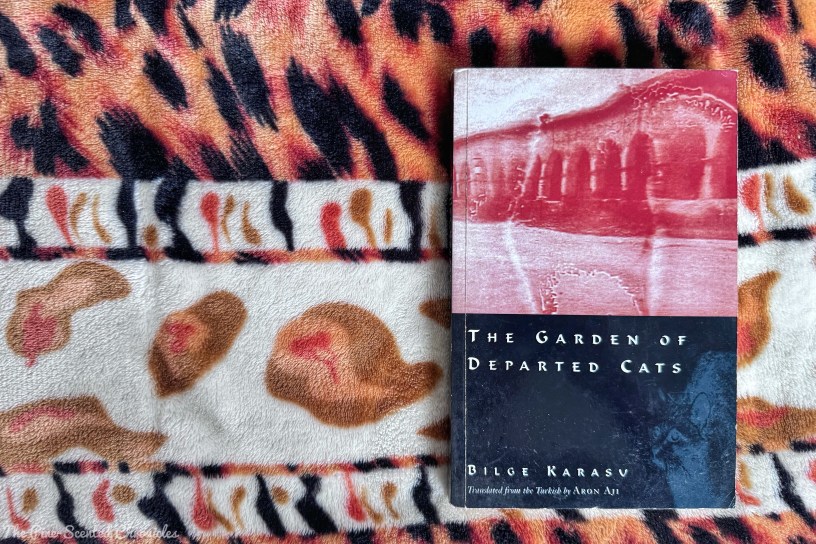
Another pre-eminent name in contemporary Turkish literature is Bilge Karasu. Beginning with Troya’da Ölüm Vardı (1963; Death in Troy), Karasu established himself as a leading Turkish modernist writer. Among his notable works is Göçmüş Kediler Bahçesi, published in 1979 and made available to Anglophone readers in 2003 as The Garden of Departed Cats, a literal translation of the Turkish title. The main framework of the book involves the arrival of an unnamed traveler in a “medieval city located in the center of this narrow peninsula that stretches like an arm into the Mediterranean,” where he becomes the narrative’s spiritual guide. Upon arriving in the city, he is recruited by a dark, mysterious stranger to participate in an archaic, chess-like game involving human participants. The game is part of a long-standing tradition and is staged every ten years, with the city’s inhabitants challenging travelers and tourists.
The rest of the book unfolds as a series of twelve interconnected stories that the narrator attempts to weave together. These tales alternate with the central narrative. The first, titled The Prey, blends two narrative threads—one involving fishing and the other hunting—which interrupt and overlap with one another. A fisherman, depicted in both dreams and reality, catches an otherworldly fish that becomes his destructive “burden.” As the story progresses, it grows increasingly surreal: the fish catches the fisherman, the predator becomes the prey, and vice versa. The narrator then describes him first as a tree and then again as a man in a boat, creating a deliberate lack of logical continuity. This surreal opening sequence sets the tone for the subsequent tales, many of which resemble fables and prominently feature animals.
In the fourth story, In Praise of the Fearless Porcupine, an unnamed narrator recounts his encounter with a porcupine wandering through Ankara, the Turkish capital. Its unusual presence prompts the narrator to reimagine its story: in his version, the porcupine travels the world to understand fear, encountering both allies and adversaries along the way. The tale ultimately develops into a potent metaphor for the narrator’s own withdrawn life. Meanwhile, The Man Who Misses His Ride, Night After Night tells the story of a man obsessed with traveling to the city of Sazandere. Drawn by his love of the sea, he imagines it as an ideal destination, despite having no memory of how he first heard of it. Yet circumstances continually thwart his plans: day after day, he waits for a bus that never arrives.
“Kill Me, Master” introduces a boy trained as a trapeze artist. He both fears and depends on his unpredictable mentor, who was poised to catch him in flight. He has also started having premonitions of when his fellow performers will perish. Meanwhile, in A Medieval Monk, a traveling monk discovered a terrible stoat-like creature attached to his stomach. The creature is a parasite that feeds for years on any person it sinks its claws into. Hurt Me Not relates the story of a strange island country. The country found itself beset by a sudden, unexpected shift in nature that would eventually correct itself. However, in the interim, the event exposed the fault lines beneath the surface. The inhabitants reacted extremely to the event. A group of young, inexperienced autocratic planners tried to overpower the other denizens with their arrogant opinions. They posed their opinions as facts.
The dead know everything. Dying is the path to knowing. The one who dies and disappears among the dead, who descends into the underground or the underwater, and receives their advice; the one who ascends to the sky and beyond, who gathers light, enlightenment, wisdom – as if gathering flowers; the one who restores his mutilated body, brings about his own renewal, rebirth, and who returns to the earth to mix among the living, he is the one who knows everything worth knowing.
Bilge Karasu, The Garden of Departed Cats
Karasu deviates from conventional narrative forms. Rather than presenting a straightforward plot, he constructs a fragmented novel composed of twelve interconnected stories. This approach is reminiscent of other prominent postmodernist works, such as The Book of Laughter and Forgetting by Milan Kundera and If on a winter’s night a traveler by Italo Calvino. Nevertheless, the stories share several common elements. Journeys and odysseys, for instance, recur throughout the collection. Some journeys, however, end before they can even begin—or never begin at all—as in the case of The Man Who Misses His Ride. His story highlights how certain journeys are driven purely by the desire to reach an imagined destination. The overarching narrative itself follows an unnamed traveler arriving in an unnamed Mediterranean city. As is often the case with journeys, detours arise—such as when he becomes engrossed in the life-like chess game.
Through these journeys, Karasu explores a wide range of themes, including the search for truth. This theme is particularly evident in Red Salamander, which centers on a 13th-century herbalist-scientist who identifies a tulip-like flower—the titular red salamander. However, it is no ordinary flower: anyone who consumes it becomes incapable of lying for the rest of their life. The scientist proceeds to experiment on the plant. Hurt Me Not further examines the fluidity of truth, subtly invoking the Dunning-Kruger effect. The autocratic planners attempt to pass off their opinions as facts, overestimating their competence. This adds a political dimension to the story, reflecting patterns observable in real-world discourse. Such dynamics are not limited to politics; the rise of social media has amplified them. Many individuals overestimate their knowledge and participate loudly in online discussions, often compensating for weak arguments with confidence.
Meanwhile, more knowledgeable individuals tend to remain silent, sometimes underestimating themselves. This imbalance allows the less informed but more assertive voices to dominate discussions, often with harmful consequences. It does not help that the broader public can be easily swayed by such confidence, leading to a neglect of fact-checking. Notably, the book was written in the 1970s, a period of political upheaval in Karasu’s homeland. Social and political tensions reverberated across the nation, reflected in the emergence of various movements. Although many of these movements were suppressed by the state, they helped establish a tradition of resistance that contributed to the ongoing development of critical political consciousness—an influence still visible in contemporary movements. Themes of violence, power, and freedom are interwoven throughout several stories.
Despite their strangeness and diversity, the stories maintain a coherent thematic scope. Beyond their surrealist elements, death and loss emerge as recurring motifs. The narratives also capture a deep human yearning for what remains out of reach, as seen in The Man Who Misses His Ride. Another recurring figure is the solitary male intellectual. Karasu’s fascination with the sea is also evident, as it features prominently across multiple stories—sometimes not merely as a setting, but as a presence that takes on a character-like role. Equally significant are the animals that populate the text, including a stoat-like creature, a porcupine, a crab, and a fish. Their ubiquity allows the work to explore the boundaries between humans and animals, while also emphasizing the enduring connection between humanity and nature. Interestingly, despite the book’s title, there are no dead cats.
I learned what fear is. And I experienced enough to know pretty well what to be afraid of. As a consequence I felt a kind of fearlessness. After that journey, I stopped going anywhere. Nor will I ever leave again. On this plot of land, wandering around it, I will await death. If any one is looking for me – friend or enemy – let him come and look for me here, on this soil. This is my homeland, this is where we fight, this is where we shake hands. I feel less lonely here, here I know better, perhaps. . .
Bilge Karasu, The Garden of Departed Cats
On a broader and more universal scale, several stories explore the nature of existence itself. Some reflect the intricacies of human experience, as seen in the narrator’s reimagining of the porcupine’s travails. Each story initially stands on its own, but as the book progresses, thematic connections gradually emerge. Because of this fragmented structure, the work demands an adventurous reader. It is undeniably experimental, and while it occasionally wavers in its meandering, Karasu’s innovation ultimately shines through. His storytelling is compelling, and his prose lyrical. The penultimate chapter, Another Peak, brings together many of the book’s thematic threads. It presents a cathartic account of the rigors of climbing a mountain and the rewards that follow. Its payoff is a hard-earned wisdom: “He realizes that those who climb the mountain never descend.” The line underscores the idea that true accomplishment requires sacrifice—blood, sweat, and tears.
More significantly, Karasu explores the inherent imbalance in the “hunter-prey” dynamic of romantic love. He gradually and deftly weaves the book’s threads together, with each story acting as a piece of a larger puzzle. The resulting portrait is one of the pursuit of unattainable love. The chess-like game itself becomes a metaphor for love’s enduring yet elusive nature. Although the outcome seems predetermined—love often remaining out of reach—the journey retains its value. Each story, while functioning independently, reinforces this central theme in nuanced and sometimes unpredictable ways. Some narratives also suggest that love resists urgency, unfolding only in its own time. There are, too, subtle undertones of homoerotic desire and guilt, which further deepen the narrator’s quest for understanding and connection.
Bilge Karasu has long been regarded as a preeminent modernist figure in Turkish literature, and The Garden of Departed Cats stands as a testament to that reputation. Ultimately, The Garden of Departed Cats resists easy interpretation, much like the elusive truths and desires it seeks to portray. Through its fragmented structure, shifting perspectives, and richly symbolic narratives. What initially appears disjointed gradually reveals itself as a carefully constructed mosaic, where each story contributes to a larger meditation on truth, love, power, and existence. The Garden of Departed Cats is then both a literary experiment and a philosophical inquiry. It lingers long after the final page, urging readers to reflect on the journeys they undertake, the truths they seek, and the connections they strive to understand.
Regardless of the variations, the narrative form always appears headed towards the innermost story, the innermost frame. It intends to lead the reader to a core, a pip, if you will. Whether tasteless or inedible, a pip that one reaches by eating and eating into the flesh of the fruit, a pip that is the harbinger of the next tree.
Bilge Karasu, The Garden of Departed Cats
Book Specs
Author: Bilge Karasu
Translator (from Turkish): Aron Aji
Publisher: New Directions Books
Publishing Date: 2003
No. of Pages: 256
Genre: Literary
Synopsis
In an ancient Mediterranean city, a traditional archaic game of human chess is staged once every ten years. The players (tourists versus locals) bear weapons and the chess game may prove as potentially lethal as the magnetic attraction our narrator feels for the local man who is the Captain of the home team. Each brief interaction between men comprises a chapter of The Garden of Departed Cats; interleafed between those chapters are a dozen fables. One fable features a terrible stoat-like creature that feeds for years on any person it sinks its claws into, like guilt. Another concerns a kind of tulip, a “red salamander,” which dooms anyone who eats it to never tell a lie again. An otherworldly fish “catches” a fisherman. An apprentice acrobat fears his master. These twelve strange fables – parables moving from guilt and denial to truth, and on to desire – work independently of the main narrative but, in unpredictable ways (reminiscent of Primo Levi’s The Periodic Table), echo and double the chief theme of The Garden of Departed Cats which is the nature of love
About the Author
Bilge Karasu was born on January 9, 1930, in Istanbul, Turkey, to parents of Jewish origin; they would eventually convert to Islam. He attended Şişli Terakki High School and studied at the Department of Philosophy of the Faculty of Literature of Istanbul University. Post-University, Karasu went on to study in Europe with the support of a Rockefeller scholarship. In 1964, he started to work as a translator at the General Directorate of Press, Broadcasting, and Tourism, and in the foreign broadcasting service of Ankara Radio. Additionally, he wrote radio plays for Ankara Radio.
He started writing when he was seventeen. While studying in University, he published articles on art criticism in the Forum magazine between 1954 and 1959. In 1963, he published his first story collection, Troya’da Ölüm Vardı (Death in Troy). The experimentation in his debut work highlighted what his literary career would eventually feature: the consistent pursuit of innovation. In 1971, he gained major recognition for Uzun Sürmüş Bir Günün Akşamı (A Long Day’s Evening), which won the Sait Faik Story Award. His third book, Göçmüş Kediler Bahçesi (1980; The Garden of Departed Cats), was also critically acclaimed. His other works include Kısmet Büfesi (1982; Kiosk of Destiny), Gece (1985; Night), and Kilavuz (1990; The Guide). He also published essays. His translation of D. H. Lawrence’s The Man Who Died also earned him the Turkish Language Association Translation Award in 1963
Apart from writing, he worked as a lecturer at Hacettepe University’s Philosophy Department from 1974 until his death. He died on July 14, 1995, at Hacettepe University Hospital, Ankara, where he was being treated for pancreatic cancer.

