Happy Wednesday, everyone! Woah! Just like that, we are already in the fifth month of the year. I hope the year has been kind and great to everyone. I know life isn’t a walk in the park, but it is my fervent prayer that everyone’s year is going well. Regardless, I hope the rest of the workweek goes smoothly.
That said, the middle of the week also brings a fresh WWW Wednesday update. WWW Wednesday is a bookish meme hosted originally by SAM@TAKING ON A WORLD OF WORDS.
The mechanics for WWW Wednesday are quite simple: you just have to answer three questions:
- What are you currently reading?
- What have you finished reading?
- What will you read next?

What are you currently reading?
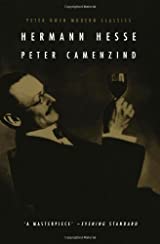
It’s already the middle of the week, which means we have only two more days until the weekend. I hope everyone makes it through the workweek. Anyway, my 2026 reading journey is going as planned. After spending the first two months of the year reading works by Latin American and Caribbean writers, I am now in the midst of a European literary adventure. While I had not originally planned to embark on a journey across European literature this early in the year, realizing that I had listed several works by European writers in my reading challenges prompted me to pivot toward them in March. Because of the number of European works in my reading challenges, I am extending the journey into this month. I believe this is the first time I have read works of European literature for three consecutive months. This shift has reintroduced me to familiar names while also introducing me to writers whose oeuvres I have yet to explore. My current read has taken me to a familiar name.
It was must-read lists that first introduced me to the German writer Hermann Hesse. His works were regularly featured in such lists, including the 1001 Books You Must Read Before You Die list. In particular, Siddhartha is a prominent presence on these lists; it was also the first of his novels that I read. I later learned that he is a Nobel laureate in Literature. Nearly a decade after reading Siddhartha, I am now reading my fifth Hesse novel, Peter Camenzind. Originally published in 1904, Peter Camenzind was Hesse’s debut novel. The story is set in late 19th-century Switzerland, where the titular character grows up in a small village surrounded by nature. As a young boy, Peter is shaped by solitude, surrounded by silent forests and whispering winds. This solitude is further magnified by an apparent lack of parental affection. His father is gruff and an occasional drinker who is passive toward his son. His mother, on the other hand, is more dignified but reserves her strength for necessity rather than tenderness.
Lacking parental guidance, Peter finds a companion in his misfit uncle Konrad, a dreamer whose schemes and projects fail because of their eccentricity. He also finds tranquility in the beauty of the mountains; his connection with the natural world is essential to him. However, as he grows older, he begins to yearn for a deeper understanding of himself and for a stronger connection with the world around him. In a way, Peter reminds me of other Hesse protagonists—dreamers in search of something deeper and more meaningful. His uncle Konrad, it seems, will be the catalyst for this, much like the figures who guide other Hesse protagonists—often unexpected male mentors. The book is rather slim, but I am looking forward to seeing how the story unfolds. The fact that it is Hesse’s debut novel makes it even more meaningful.
What have you finished reading?
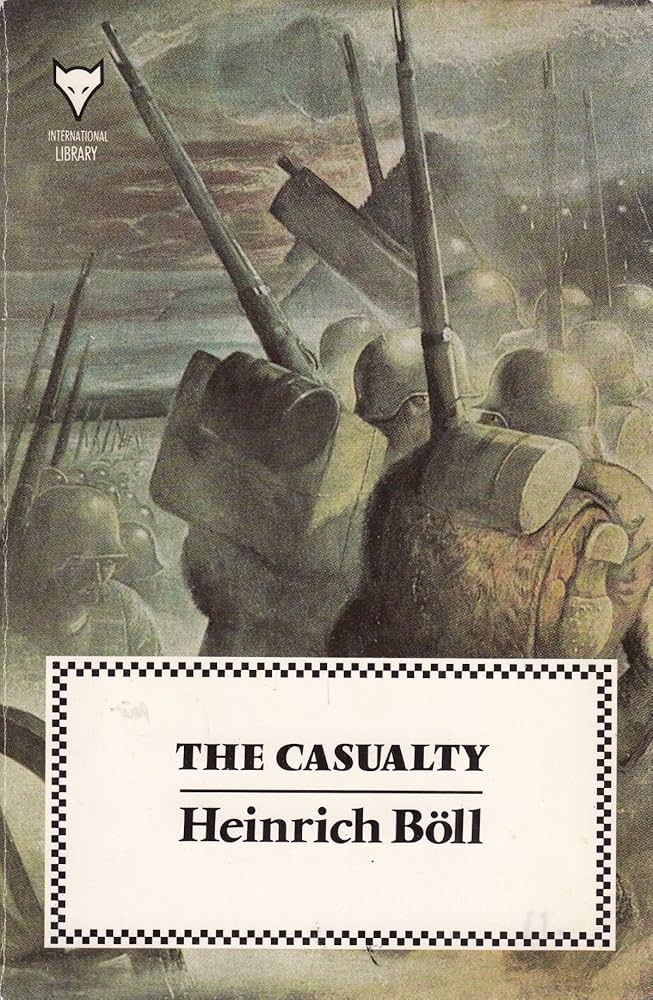
In a way, my April reading month shaped up to be a Nobel Prize in Literature binge-reading month. It was unplanned. It was only when I started reading Russian literary titan Aleksandr Solzhenitsyn’s August 1914 that it dawned on me that I could turn it into one. A couple of books later, I had read my second book by German Nobel laureate Heinrich Theodor Böll. As in the case of Solzhenitsyn, it was must-read lists that first introduced me to Böll. Only later did I learn that both writers had been awarded the most prestigious literary prize in the world. Last year, I read my first Böll novel, The Silent Angel. Less than a year later, I am reading my second. Interestingly, I had no intention of reading The Casualty. However, since I had unintentionally begun a Nobel Prize in Literature reading binge, I decided to pick up the book. I later learned that it is a collection of short stories—a form I am not particularly fond of. Still, having started it, I feel compelled to continue; I rarely DNF a book.
The Casualty, my April reading month closer, is composed of twenty-two short stories written by Böll between 1946 and 1952. However, they were only published together in a single volume in 1983 as Die Verwundung und andere frühe Erzählungen. The collection takes readers to the battlefields of the Second World War. The Silent Angel also grappled with the legacy of the war; after all, Böll is widely recognized as a preeminent voice in postwar literature—and deservedly so. The stories explore familiar themes, not only within the ambit of Böll’s oeuvre but also within the broader literary landscape. They prominently feature German soldiers who fought during the Second World War, delving into their experiences and the horrors they witnessed on the battlefield. Interestingly, Böll himself served in the German Army on both the Eastern and Western Fronts, making this a deeply personal endeavor. Most of the soldiers are portrayed as reluctant participants in the war, forced to take part in a conflict they had no desire to join. They are trapped—both by duty and by their enemies. The conditions on the battlefield are beyond dire. “Those nights were very dark, and fear hung like a thundercloud over the alien, pitch-black earth,” as described in Jak the Tout. The collection’s title story is the longest, following two wounded soldiers: one a hand grenade victim, the other a cynic who paid to be wounded by an obliging gunman. They drink, smoke, and revel in a sense of relative freedom as they move away from the front.
The collection also highlights not only the grim realities of war but the human capacity for survival. Though I am only midway through the book, there still seems to be a great deal of ground to cover. The stories delve into themes such as fear, hope, despair, and the human will to survive amid chaos, while some reflect on the war’s legacy and its physical toll. Overall, The Casualty is a riveting collection from a master storyteller. At the same time, I find myself slowly beginning to appreciate the beauty of short fiction.
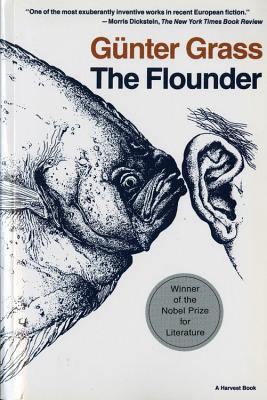
From one German writer to another—well, three German writers in a row. It is a rarity for me, despite nearly two decades of reading. Like the writers featured in this midweek update, it was through must-read lists that I was first introduced to Günter Grass. I later learned that he was a Nobel laureate in Literature. His magnum opus, The Tin Drum, was a prominent presence on such lists; it was even included in 1,001 Books You Must Read Before You Die. I finally got to read the highly heralded novel in 2019. However, what followed was something of a literary dry spell: I was unable to secure any of Grass’s other works and thus could not further explore his oeuvre. Thankfully, I was able to acquire a copy of The Flounder in late 2024. It is the second novel by Grass that I have read, although I was not originally planning to pick it up.
Originally published in 1977 as Der Butt, The Flounder was inspired by the Grimms’ fairy tale “The Fisherman and His Wife.” It opens in the present, with Grass introducing its spiritual guide, Edek. Along with his female companion, Ilsebill, Edek has undergone nine or more reincarnations since the Stone Age. His present-day partner is pregnant, and to entertain her, Edek recounts stories of their previous incarnations—one for each month of her pregnancy. Their story begins in the Neolithic period. The catalyst is the capture of a flounder by a primitive fisherman. However, it is no ordinary flatfish; the flounder is a magical entity that bargains with the fisherman. In exchange for its life, it promises to mentor him, imparting a wealth of knowledge. It teaches him how to count on his fingers and how to explore beyond his local domain. The flounder’s most provocative lesson, however, involves the subjugation of the women in the fisherman’s clan. The prehistoric fisherman lives in a matriarchal society—a stark contrast to our own. Following its overthrow, women begin to transform from three-breasted beings into two-breasted ones. Yes, the prehistoric women in the story have three breasts, but to accommodate men’s desires, the third gradually disappears. This sets the tone for the rest of the narrative, which becomes an extensive rumination on age-old gender divides. As the story progresses, it is revealed that the prehistoric fisherman is one of the many lives of the narrator. Under various guises and occupations, the narrator moves through significant historical events, while the flounder remains his spiritual adviser—one he can summon from the sea whenever he needs guidance. As the narrative unfolds, a central theme emerges: how patriarchy has allowed men to reconstruct history. As its primary scribes, men portray their own gender in a more flattering light, often erasing the contributions of women to elevate themselves. Another intriguing element in the novel is the presence of nine female cooks who cater to Edek and serve as a tribunal to whom he turns for judgment. These cooks belong to different epochs. Awa, for instance, cooks for Edek during the Neolithic period and has three breasts. Metswina lives in sixth-century pagan Europe and is executed for the murder of a dour Christian missionary. Dorothea, on the other hand, is the narrator’s wife during the time of the Crusades; she engages in acts of masochism in the name of Christ in the hope of eventual canonization.
Still, Grass astutely dismantles this male-centered narrative. He depicts women as nurturers and sustainers of humankind, highlighting their contributions in both fact and fiction—a counterpoint to how they have often been muted over time. Men, by contrast, are portrayed as bloodthirsty and innately destructive, driven by a compulsion toward war. History reflects this, from the prehistoric hurling of rocks and spears to the modern deployment of intercontinental missiles. Grass also references female deities from other cultures, such as the Hindu goddess Kali, as well as early goddesses from the matriarchal Stone Age societies along the Vistula River. Altogether, these elements create a rich and intriguing literary experience. The Flounder is starkly different from The Tin Drum, yet I find both fascinating. This contrast adds another dimension through which to appreciate Grass’s oeuvre.
What will you read next?