The Wounds of History
While the Philippines is an archipelago made up of over 7,000 islands, it is geographically divided into three major island groups. To the north is Luzon, the main island and the primary island group. Luzon, the island, is the largest of the islands comprising the nation. It is where the capital, Manila, is located, making it the center of major trade, industrial, agricultural, and financial activities. Luzon is also home to more than half of the country’s population. Meanwhile, the Visayas comprises the middle section of the country. It includes major islands such as Samar, Negros, and Panay, the third-, fourth-, and sixth-largest islands in the country, respectively. These are also major population centers and are home to major industries. Tourism, however, remains the major industry, with the region also boasting some of the world’s best beaches. Boracay, Cebu, and Bohol are often cited among the best islands in the world.
To the south of the country is Mindanao. Mindanao is often referred to as the Land of Promise because of its boundless economic potential. Apart from being home to the country’s highest mountain, Mount Apo, Mindanao hosts major agricultural and mining activities. Its arable lands make it a vital agricultural hub in the country. It is even referred to as the country’s food basket, producing approximately 40% of the country’s food supply. About one-third of the island’s area is devoted to agriculture. Major crops include corn, bananas, cacao, pineapples, and coconuts. Most of the country’s export-grade agricultural produce also comes from the region. All of these highlight the crucial role the region plays in the country’s overall social and economic development. Unfortunately, Mindanao has largely been overlooked. There has been an unequal distribution of wealth and development.
Development has always been focused on Luzon and Mega Manila. The disparity is glaring, as the southern region of the country has taken up arms. Mindanao has become a hotbed of insurgency and terrorist activity. The insurgency in the region, however, dates back over 400 years. When the Spaniards arrived in the 16th century, most of the archipelago had already been largely occupied by the Moro people. They had a thriving society. The Spaniards were able to supplant Islam in Manila and Mindoro. However, they were unsuccessful in their push toward the southern regions of the country. When the Spaniards attempted to colonize the region, the Sultanates of Sulu, Maguindanao, and Lanao mounted strong resistance. Subsequent attempts by the Americans and Japanese were also stymied by Moro forces. This armed struggle, which lasted for centuries, has been considered by Moro Muslim leaders to be part of the “national liberation movement” of the Bangsamoro (Moro Nation).
There were days when, looking at the mountain, the fog hovering the slopes cast a pall of grey which could make the heart suffer; other days the deep purple lines that slashed on the horizon could give you the courage to dare heaven.
Criselda Yabes, Crying Mountain
In her debut novel, Crying Mountain, former journalist Criselda Yabes explores this centuries-old conflict from a more contemporary perspective. She transports readers to Jolo, the capital of the island province of Sulu in the Mindanao region. It was the 1970s. At the heart of the novel are two women. The first is Rosy France Wright, a mestiza, half-American girl from Christian Zamboanga. She was about to marry her fiancé in an arrangement made by her parents. However, she defied their wishes by eloping with a Muslim professor with whom she had fallen in love. Together, Rosy and the professor moved to Jolo, where the rest of the story takes place. In Jolo, Rosy gained attention as the stranger who had eloped with the Professor, who turned out to be the island’s famous intellectual activist.
As is often the case in small towns, Rosy became an object of curiosity. The locals referred to her as the “Milikan,” or American. Soon enough, Rosy earned the locals’ favor. She also began to fall in love with Jolo. She found a friend in Nahla, a feisty Tausug girl who would become the second woman at the heart of the story. Her feistiness earned her the moniker “Ali MacGraw of Jolo,” a name by which she became known on the island. Not only was Nahla feisty, but she was also ambitious, dreaming of escaping Jolo. With her hair parted in the middle and wearing a miniskirt, Nahla dreamed of becoming a movie star. However, she was also cognizant of her own realities. “Who’s going to come here looking for a movie star?” she mused. “Nobody likes us; we belong to a race of pirates and kidnappers — that’s what the world thinks.” Still, Nahla found support in her new friend.
Both young women were romantically entangled. The Professor, with whom Rosy eloped, was no ordinary academic. He was born Omar Hassan, although he was also known as Omar Sharif. Like Nahla, the Professor was an ambitious Tausug. He was brilliant and well educated; he possessed all the qualities needed to become a successful politician or businessman. It was apparent that he could succeed in anything he set his mind to. His brilliance prompted his aunt, Hadja Lu, to support his studies. However, she ultimately became disappointed in her nephew. Instead of pursuing what many considered a stellar career, the Professor had his sights set on “rebellion instead of training his sight on business, money, fortune.” When he returned home, he confided his plans to his aunt, who reacted apprehensively. “What future will that bring you?” she challenged him. She had long believed that there was no future for him — or for anyone — in Jolo.
But the Professor brimmed with ideas. He fervently disagreed with his aunt and her pessimism. He did not let her protests deter him from pursuing his dream. Despite the grim conditions surrounding him, the Professor believed that there was a future in Jolo. He then organized a liberation movement aimed at seceding the Moro region from the rest of the country because of socio-political and religious disparities. It was a call he shared with other Moro Islamic leaders. Toward the end of the 1960s and the beginning of the 1970s, insurgency in the region escalated. This prompted then-President Ferdinand Marcos Sr. to declare Proclamation No. 1081 on September 21, 1972, effectively placing the country under Martial Law. Moro leaders, however, remained relentless. Martial Law and its encroachment into the region only highlighted the dichotomy between Imperial Manila and the country’s southern regions.
Something right must be done, so I had to start with the most basic in the order of daily life even if I were doing it in reverse. This is what women do when they are newly married and starting a home. What kind of a woman buys plats and bed sheets when she is about to leave her marriage?
Criselda Yabes, Crying Mountain
The undertones of romance set the tone for the story. History serves as a backdrop to the budding romance between the Professor and Rosy. The crux of the story is the burning, or siege, of Jolo. It is one of the tragic chapters in the decades-old conflict in Mindanao. The novel was inspired by a declassified copy of the military’s official report on the campaign in Jolo that Yabes obtained. During a visit to Jolo, she met a friend who had served as the battalion commander on the island during the rebellion. For Yabes, writing the novel was also driven by nostalgia. As a journalist, she was deeply exposed to the Mindanao conflict. She spent years covering the Philippine military and even wrote the nonfiction book Peace Warriors: On the Trail with Filipino Soldiers about the military campaign against the Moros. The book also earned Yabes critical acclaim.
For Yabes, Mindanao was not merely a journalistic assignment; it was part of her identity. She spent part of her childhood in Jolo before her family moved to Zamboanga shortly before the Moro uprising. Omar Hassan is also no mere fictional creation. He was inspired by Nur Misuari. Crying Mountain, or Below the Crying Mountain in earlier publications, reimagines Misuari’s rise. To Filipino readers, he is a familiar figure in Moro political circles. He is the founder and leader of the Moro National Liberation Front (MNLF), which was founded on the goal of establishing an independent Bangsamoro homeland. Yabes describes Hassan as follows: “He was a Tausug — the people of the sea current. No other tribe could claim the birthright of a true warrior, fighting the Spanish, then the Americans, century after century. Bloodshed is in their blood.”
And bloodshed it is. Crying Mountain slowly captures the events leading to the burning of Jolo. Yabes explores the various factors that eventually led to the siege. The story underscores the lack of prospects for the Moros, as Omar’s aunt repeatedly emphasizes in her conversations with her nephew. History has shown how the Moros were neglected by the government and subjected to inequitable development. The declaration of Martial Law exacerbated the chaos in the region, as liberation movements were singled out as troublemakers. Unfortunately, these conditions persist today, with the MNLF and other liberation movements continuing to advocate for the separation of the Moro region. It also did not help that the region emerged as a hotbed of terrorist training activities, leading to intensified military offensives and an increased military presence.
The novel vividly captures the events leading to the burning of Jolo. The events depicted in the novel are a microcosm of the tumultuous events that would prevail across the island in the succeeding decades. It underscores how the burning of Jolo became a key early incident in the Moro insurgency. It also highlights the horrors of the Martial Law years, with the characters navigating this dark phase in the country’s history. This insurgency, however, transcended Martial Law, as the call for a separate Bangsamoro republic remains prominent. In 2013, Moro rebels from the Moro National Liberation Front attempted to occupy coastal communities in Zamboanga City as a protest against the government’s failure to implement the 1996 final peace agreement with the MNLF. This has long been the pattern between the government and liberation movements: peace pacts are rarely implemented or honored. If they are, they often disadvantage the other party — in this case, the Moros.
In order to keep his sanity, he decided he would have to stop thinking about waiting. There would be time for everything. And in the meanwhile, he would continue loving her, waking up to his body clock before the break of a new day, before the loudspeakers announced the greatness of Allah, with a persistent ache to scribble down words he never thought existed in the vocabulary of his heart – writing poetry, long and fast, on his prescription pad; after which he would play Bach on his violin.
Criselda Yabes, Crying Mountain
Due to the chaos that reigned over the region during the succeeding decades, Mindanao has become synonymous with disorder and conflict. This, however, is a grave misconception. The island is blessed with natural beauty, much like the Jolo of Yabes’ childhood. Before the tragedy, the town had been the jewel of Sulu, teeming with life. Through the narrator’s lens, Jolo gradually transforms. Its glory days of prestigious parties are slowly replaced by a more fervent observance of religion. The overtones of romance contrast with this transformation. As Rosy and the Professor become romantically entangled, so too does Nahla. Ambitious Nahla has an affair with Captain Rodolfo, a Christian military officer. Nahla was searching for a way to escape Jolo. Her relationship with Captain Rodrigo becomes the opportunity she has long hoped for.
Beyond love and rebellion, the novel explores identity, particularly in Rosy’s case. She undergoes a transformation. She falls in love with Jolo, yet she also struggles to navigate the complexities of her identity and relationships. She embodies the political and personal conflicts that form the backbone of the story. Nahla is equally complex and compelling. She embodies both the struggles and aspirations of the Muslim community in Jolo. While she yearns for escape, she also symbolizes the resilience of her peers. She represents the determination of Muslims in the face of adversity. The Professor, on the other hand, is humanized by Yabes. He is a temperamental leader. Like many leaders, he is driven as much by ego as by ambition. He can also be petty and proves to be a poor military tactician. Under Yabes’ descriptive prose, Jolo emerges as a character in its own right.
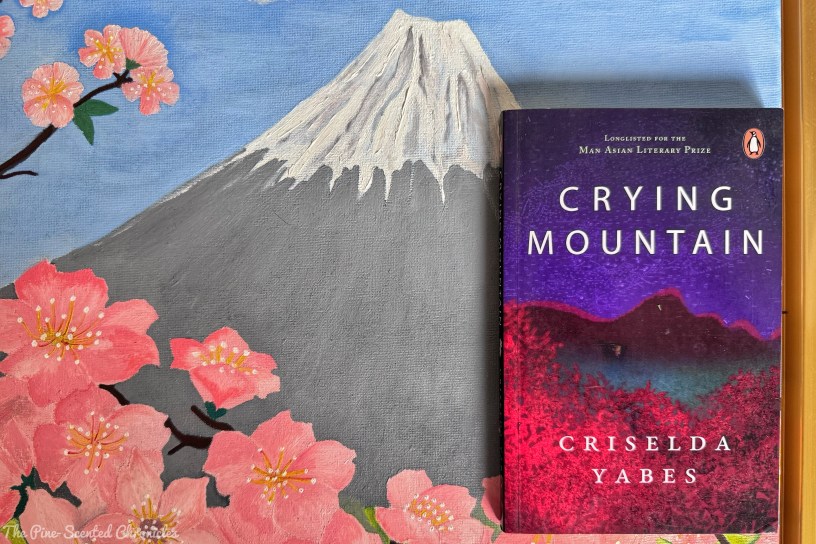
Crying Mountain was a searing debut, a poignant tale about one of the tragic chapters in the country’s history. Locally, it won the Gawad Likhaan. It was also longlisted for the Man Asian Literary Prize in 2010. Yabes’ lyrical and poetic writing elevates the story, standing in stark contrast to the bleak atmosphere that hangs over the narrative as it guides readers through one of the many fractures in the history of the Philippines’ south. “There were days when, looking at the mountain, the fog hovering over the slopes cast a pall of gray that could make the heart suffer; on other days, the deep purple lines slashing the horizon could give you the courage to dare heaven.” Intertwining personal and political narratives, Crying Mountain possesses a potent combination of romance, suspense, and historical insight into the Philippines. These various elements elevate the novel into an unforgettable reading experience.
How much could she give in to him? Was it not enough to invite him to her secret garden on her roof terrace – where they could talk about everything, shooting the breeze, until a wild black crow darts out of nowhere to remind them the sun is about to depart? That was the space they had, a limited place in which their emotions could move around.
Criselda Yabes, Crying Mountain
Book Specs
Author: Criselda Yabes
Publisher: Penguin Books
Publishing Date: 2019
No. of Pages: 179
Genre: Historical
Synopsis
In Crying Mountain, the Moro Rebellion that broke out in the Sulu archipelago in the 1970s, and that continues to wound the nation, is seen vividly through the lives of the mestiza Rosy Wright, the Tausug girl Nahla, the rebel leader Professor Hassan, the soldier Captain Rodolfo as well as in the quest of the book’s narrator.
Follow the transformation of Jolo – from its former glory days of prestigious parties to the ushering in of a new era of more zealous religious observance – through the eyes of the narrator.
About the Author
Criselda Yabes was born and raised in Zamboanga, in the southern part of the Philippines. When she was young, her family moved to Jolo, in the neighboring island province of Sulu. Her father established the first Metrobank in the early 1970s. She attended a Catholic school. However, her family was forced to move back to Zamboanga shortly before the Moro uprising. She pursued a degree in journalism at the University of the Philippines. Post-university, she worked as a journalist, becoming one of the high-profile correspondents for the Associated Press and later Newsweek. She covered the biggest stories in the Philippines, from the fall of Marcos to the Mindanao conflict to the tumultuous Cory Aquino years.
Eventually, Yabes turned to engaging reportage and literature. As a young girl, she has always been a reader, spending her spare time flipping through magazines and romance comics. She also read Nancy Drews. She published her first book, The Boys from the Barracks: The Philippine military after EDSA, in 1991. It is a journalistic chronicle of the post-Martial Law coup attempts spearheaded by Gringo Honasan. After the publication of her first book, she left for France for a year-long journalism fellowship. As part of her fellowship, she wrote on the Balkans, where the Yugoslav Wars were altering the landscape and fragmenting a diverse population. During a three-month sojourn in Greece, she worked on her next book, an essay collection titled A Journey of Scars, which was published in 1994. It was then succeeded by a couple of light travel stories and collaborative book projects, including a book on the baybayin
In 2010, she made a pivot toward full-length prose, with the publication of her debut novel, Below the Crying Mountain. It was alternatively published as Crying Mountain. The book won the Gawad Likhaan: UP Centennial Literary Award for fiction. It was also longlisted for the Man Asia Literary Prize in 2010. In 2019, she published her sophomore novel, Broken Islands. Her first two novels were born out of Yabes’ journalistic endeavors. Her most recent book, Barcelona, was published in 2023.
Yabes is currently residing in France, and still considers Manila a base for her relatives.

