
First Impression Friday will be a meme where you talk about a book that you JUST STARTED! Maybe you’re only a chapter or two in, maybe a little farther. Based on this sampling of your current read, give a few impressions and predict what you’ll think by the end.
Synopsis:
In the archives of a small Hungarian town, the suicidal clerk Korin has discovered an antique manuscript of startling beauty narrating the epic tale of brothers-in-arms returning home from a disastrous war. Korin is determined to kill himself, but first he must commit the precious manuscript to eternity by typing it all out onto the internet. And to do so he must travel to the nexus of the known world: New York. There on the city’s streets, Korin encounters a raft of eccentrics, and as his desperate mind swings from lucidity to lunacy he finds himself lost in a world torn between viciousness and mysterious beauty.
It’s the end of the workweek—yay! Technically, it is already Saturday. Nevertheless, I hope the week has been kind to everyone and that you’re all ending it on a high note. How time flies! We are already in the fifth month of the year, and we are nearly halfway through it. I hope May proves to be a promising one. I also hope the conflict in the Middle East continues to de-escalate—or, better yet, is resolved soon. As the year progresses, I hope everyone is given plenty of opportunities to grow and improve. With the weekend here, I hope everyone has a great one and truly ends the workweek on a high note. It’s time to dress down and wear more comfortable clothes. I hope everyone spends the weekend wisely—whether by resting from the rigors of a demanding career, pursuing passions, completing household chores, spending time with loved ones, or simply relaxing. I hope you’re all doing well—physically, mentally, and emotionally.
My venture into European literature is still in full swing, despite spending the past two months reading works from one of the most extensive literary canons in the world. Interestingly, I was not originally planning to read European literature this early in the year; I usually read such works later in the year. However, I realized that several works by European writers are included in my reading challenges. I have always been a crammer, although in recent years I have been changing my ways by reading books from my challenges earlier than usual. In March, I read works by European women writers, in line with the month’s major motif. March is Women’s History Month, and International Women’s Day is celebrated on March 8. With March and April over, it was a no-brainer to extend this literary journey into May.
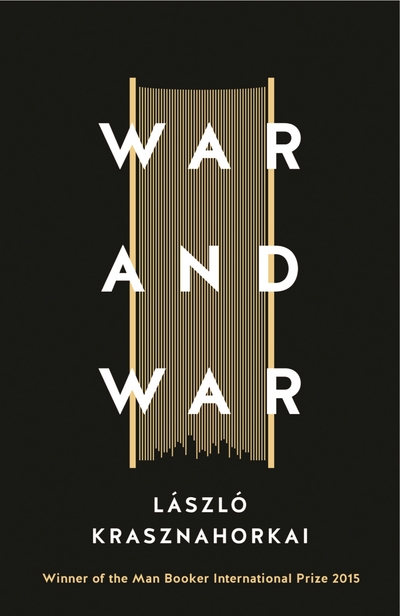
Currently, I am reading War and War by László Krasznahorkai. It was during the lead-up to the announcement of the 2018 Nobel Prize in Literature laureate that I first encountered the Hungarian writer. It was actually the first time I had heard of him and his countryman, Péter Nádas. They were both touted as shoo-ins for the prestigious literary prize. Neither would be awarded in 2019; the 2018 awarding was postponed due to a scandal surrounding the Swedish Academy. However, their names being floated for the Prize naturally piqued my interest. I would then secure and read some of their works. In 2025, Krasznahorkai finally earned the Swedish Academy’s nod, much to everyone’s delight. I actually opened my 2026 reading journey with his highly acclaimed novel Melancholy of Resistance. Meanwhile, War and War is part of my 2026 Top 26 Reading List.
Originally published in 1999 as Háború és háború, War and War is the fifth book by Krasznahorkai that I have read. It also occupies an important place in my reading journey, as it is the 1,400th novel I have read. I have made it a tradition to reserve remarkable books for my milestone reads. Anyway, the novel charts the fortunes of Korin, a middle-aged man with a profound sense of despair and fear. The novel opens with a chapter titled “Like a Burning House.” We first meet the protagonist in the unlikeliest of places: on a railway bridge in Hungary. He finds himself surrounded by seven boys who initially plan to rob him. Believing the boys intend to kill him, Korin begins to deliver a soliloquy. He rambles about his life and his chaotic thoughts and fears. This prompts the boys to abandon their initial plan. They become drawn to Korin’s monologue. The elderly man reveals his deep loneliness and confesses to having lost connection with friends and family.
The heart of Korin’s concern slowly reveals itself as he recounts his journey. On his forty-fourth birthday, Korin is seized by a eureka moment. The realization of life’s absurdities hits him hard. This commences the unraveling of his life, starting with the collapse of his marriage. It is followed by a traumatic love affair that leaves him emotionally scarred. This makes his present situation seem absurd: he is rambling in front of a group of boys. Still, this does not preclude him from being vulnerable toward them. The boys, in turn, are drawn to this seemingly estranged older man. As Korin tries to make sense of the pandemonium his life has become, the boys slowly begin to lose interest in him. Boredom replaces concern. As the atmosphere turns bleaker, they begin plotting to throw stones at the arriving train. The train’s arrival serves as a distraction, allowing Korin to escape.
In the second chapter, “That Intoxicating Feeling,” we meet Korin in November 1997 as he is about to embark on a journey from Hungary to New York City. At the airport, he is detained owing to his lack of luggage. Further, money and a document are found sewn into his coat. He is soon released after his papers and hotel plans are found to be in order. Out on the streets of the Big Apple, Korin is both mesmerized and daunted. He is also alert to the dangers lurking around him. Overwhelmed by this new environment, he stays in his room for days. Hunger finally prompts him to go out. When he realizes that he can no longer afford to stay at the hotel, he contacts Sárváry, the translator who helped him at the immigration office. Sárváry agrees to Korin’s proposition, allowing him to stay with him and his partner at their apartment in exchange for rent.
Yet another string of monologues commences as Korin relates the story of his life to Sárváry and Maria. His monologues, however, are mostly ignored. At one point, he confesses to the translator that he arrived in New York not to begin a new life but to end his old one. He also reveals that he found a manuscript in a records office in Hungary, one he believes must be preserved. When he hears about the internet, he decides to use it for this purpose. Sárváry helps him buy a laptop, and Korin begins typing the manuscript. He relates the contents of the manuscript to Maria; she, however, is barely interested. The story is episodic, but at the same time, it is a step away from the typical Krasznahorkai work I have read so far. Still, there is a chaos that subtly reverberates throughout the story; chaos is a trademark of the Hungarian writer’s oeuvre.
As the story moves forward, and as Korin embarks on a seemingly picaresque journey, certain themes begin to emerge. On the surface, the search for identity and meaning are the overarching themes. Korin is drawn to his new journey by the prospect of a new beginning. However, his past looms over him. This provides moments of introspection while also grappling with existentialism. Memory, despair, and hope permeate the story. I am nearly halfway through Korin’s journey, and I am looking forward to seeing how Krasznahorkai will steer it. I also look forward to how the Nobel laureate will unspool these threads and to the insights he ultimately seeks to impart. How about you, reader? What book or books are you taking with you this weekend? I hope you all have a great one—and that whatever you’re reading provides a brief respite.

