
First Impression Friday will be a meme where you talk about a book that you JUST STARTED! Maybe you’re only a chapter or two in, maybe a little farther. Based on this sampling of your current read, give a few impressions and predict what you’ll think by the end.
Synopsis:
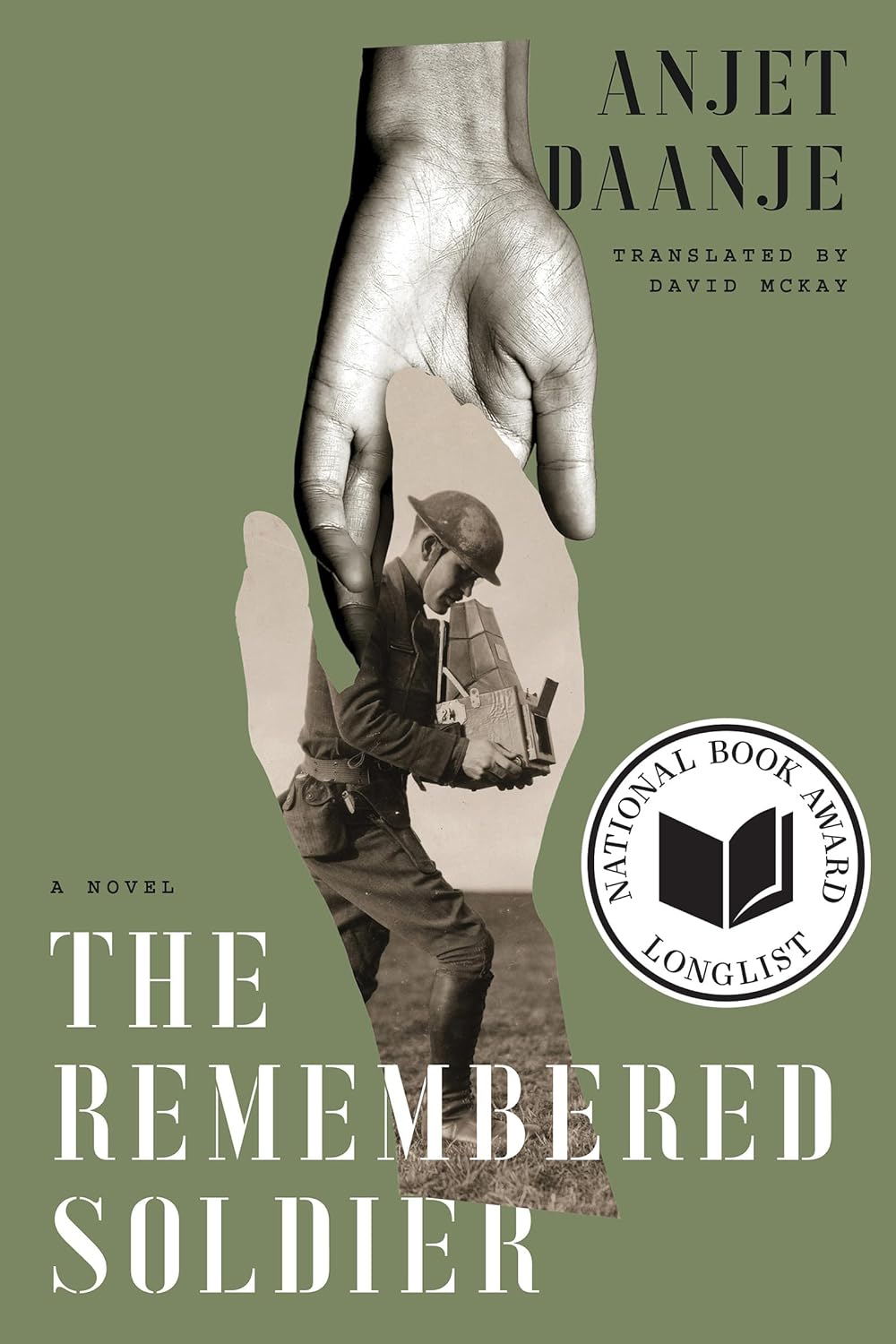
Flanders 1922. After serving as a soldier in the Great War, Noon Merckem has lost his memory and lives in a psychiatric asylum. Countless women, responding to a newspaper ad, visit him there in the hope of finding their spouse who vanished in battle. One day a woman, Julienne, appears and recognizes Noon as her husband, the photographer Amand Coppens, and takes him home against medical advice. But their miraculous reunion doesn’t turn out the way that Julienne wants her envious friends to believe. Only gradually do the two grow close, and Amand’s biography is pieced together on the basis of Julienne’s stories about him. But how can he be certain that she’s telling the truth? In The Remembered Soldier, Anjet Daanje immerses us in the psyche of a war-traumatized man who has lost his identity. When Amand comes to doubt Julienne’s word, the reader is caught up in a riveting spiral of confusion that only the greatest of literature can achieve.
It’s the end of the workweek—yay! Technically, it is already Saturday. Nevertheless, I hope the week has been kind to everyone and that you’re all ending it on a high note. How time flies! We are already in the fifth month of the year and halfway through it. I hope May proves to be a promising one. I also hope the conflict in the Middle East continues to de-escalate—or, better yet, is resolved soon. As the year progresses, I hope everyone is given plenty of opportunities to grow and improve. With the weekend here, I hope everyone has a great one and truly ends the workweek on a high note. It’s time to dress down and wear more comfortable clothes. I hope everyone spends the weekend wisely—whether by resting from the rigors of a demanding career, pursuing passions, completing household chores, spending time with loved ones, or simply relaxing. I hope you’re all doing well—physically, mentally, and emotionally.
My venture into European literature is still in full swing, despite spending the past two months reading works from one of the most extensive literary canons in the world. Interestingly, I was not originally planning to read European literature this early in the year; I usually read such works later in the year. However, I realized that several works by European writers are included in my reading challenges. I have always been a crammer, although in recent years I have been changing my ways by reading books from my challenges earlier than usual. In March, I read works by European women writers, in line with the month’s major motif. March is Women’s History Month, and International Women’s Day is celebrated on March 8. April, on the other hand, was dedicated primarily to European Nobel Prize in Literature laureates. With March and April over, it was a no-brainer to extend this literary journey into May.
Currently, I am reading The Remembered Soldier by Anjet Daanje. Before this year, I had never heard of the Dutch writer. Personally, Dutch literature is a part of the literary world that I have scarcely explored. Among the books I have read, the only title that comes to mind is The Safekeep by Yael van der Wouden. Furthermore, I have yet to read a book originally written in Dutch. Had it not been for the International Booker Prize, I would not have encountered Daanje. Her novel was nominated for the prestigious literary prize. Apparently, Anjet Daanje is the pseudonym of Anjet den Boer. Her most renowned work is De herinnerde soldaat, which was published in 2019. It earned her several accolades. In 2025, it was made available to Anglophone readers as The Remembered Soldier.
As the title suggests, The Remembered Soldier grapples with the legacy of war, particularly the Great War. The Great War is the name commonly used for the First World War. Interestingly, my 2026 reading journey has been filled with books dealing with the First World War. Personally, this is a win, considering how prevalent the Second World War is in the literary world. Anyway, the story commences in a psychiatric asylum in Belgium in 1922. There, we meet Noon Merckem, a World War I veteran. He is patiently waiting to be introduced to several women searching for their husbands. Five years earlier, following the conclusion of the First World War, he was discovered wandering in a field. Unfortunately, his memory had been wiped clean. He could not recall who he was or anything about his former life. The name given to him refers to the time and place where he was found. He has since become accustomed to life in the asylum.
However, Noon Merckem’s life has been continuously disrupted by visits from women searching for spouses who vanished in battle. He finds the visits disturbing, especially because he is crushed by the women’s disappointment upon learning that he is not the husband they are looking for. One day, a woman named Julienne appears and recognizes Noon as her husband, Amand Coppens. Amand has been missing and is already presumed dead. However, Julienne remains resolute, relentlessly searching for her husband. For years, she visited hospitals and asylums, refusing to abandon her search. Finally meeting Noon is a cathartic moment—a reward for her refusal to give up. Against medical advice, she whisks him home. Initially, it is meant to be for one month, but it eventually becomes permanent.
Despite the unfamiliar environment, Noon—now Amand—slowly grows accustomed to his new life. He helps Julienne with the business; Amand was a photographer. Slowly but surely, he settles into the rhythm of domestic life. He begins to feel safe and even cherished. However, at the back of his mind lingers the fear that Julienne might return him to the asylum. Despite finding comfort with Julienne and their children, Gus and Rosa, he still cannot remember anything. Julienne, on the other hand, is determined to make the reunion work. Amand, however, remains unconvinced that he is who she claims he is. For one thing, he does not seem to possess the photographic knowledge Julienne insists he once had. Instead, he discovers that he is skilled at carpentry—a skill she claims he never possessed.
Is Amand really who Julienne claims he is? This mystery haunts Noon/Amand. Naturally, it also piques the readers’ curiosity. I learned that the novel was inspired by the true story of Anthelme Mangin, a French soldier who suffered amnesia after the First World War. As is common in war-related literature, The Remembered Soldier captures the cost of war and the trauma it leaves behind, particularly its psychological toll. It reminds me of Regeneration by Pat Barker, which also grapples with the legacy of the First World War. The Remembered Soldier is rather lengthy, and it will take me some time to complete it. Nevertheless, I am looking forward to the literary adventure. I also noticed that the story is written without quotation marks. This makes the narrative lean more toward telling rather than showing, resulting in long paragraphs. Still, this does not diminish my appreciation of the story.
How about you, reader? What book or books are you taking with you this weekend? I hope you all have a great one—and that whatever you’re reading provides a brief respite.

