Happy Wednesday, everyone! Woah! Just like that, we are already in the sixth month of the year. I hope the year has been kind and great to everyone. I know life isn’t a walk in the park, but it is my fervent prayer that everyone’s year is going well. Regardless, I hope the rest of the workweek goes smoothly.
That said, the middle of the week also brings a fresh WWW Wednesday update. WWW Wednesday is a bookish meme hosted originally by SAM@TAKING ON A WORLD OF WORDS.
The mechanics for WWW Wednesday are quite simple: you just have to answer three questions:
- What are you currently reading?
- What have you finished reading?
- What will you read next?

What are you currently reading?
It’s already the middle of the week, which means we have only two more days until the weekend. I hope everyone makes it through the workweek. Anyway, my 2026 reading journey is going as planned. After spending the first two months of the year reading works by Latin American and Caribbean writers, I am now in the midst of a European literary adventure. While I had not originally planned to embark on a journey through European literature this early in the year, realizing that I had listed several works by European writers in my reading challenges prompted me to pivot toward them in March. Because of the number of European works included in these challenges, I am extending the journey slightly into this month. I just need to finish the books in my reading challenges, which is ironic. The reason I started a European Literature Month was to read the books in these challenges, and yet I am barely done with them.
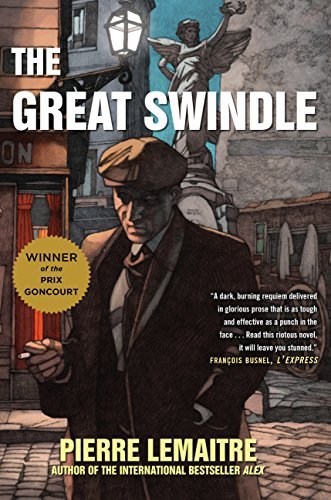
This brings me to my current read, which is part of these reading challenges. It was online booksellers that introduced me to Pierre Lemaitre; before the pandemic, I had never heard of the French writer. I came across his novel The Great Swindle, and it immediately piqued my interest, prompting me to purchase it. However, it was left to gather dust on my bookshelf, a fate it shares with many of my other books. It is for this reason that I included it in my 2026 Top 26 Reading List. Besides, I had not read any works by French writers in 2025. Originally published in 2013 as Au revoir là-haut, the novel takes us to post–World War I France. It is interesting to note that most of the historical fiction I have read this year deals with the First World War. This is a departure from the usual historical novels centered on the Second World War. I am not complaining, though, because I admit that my understanding of the First World War is quite limited.
Anyway, The Great Swindle commences on the French-German front as the Great War is about to conclude. On a fateful day in November, the lives of enlisted men Albert Maillard and Édouard Péricourt, along with their commanding officer, Lieutenant Henri d’Aulnay-Pradelle, become tragically intertwined. The Lieutenant is ambitious and seeks promotion. At the front, he creates an opportunity for himself by plotting the deaths of two of his subordinates to incite the rest of the troops under his command. Amid the outrage among his men, he orchestrates a victory against the German troops. It is a last-ditch effort on the Lieutenant’s part, as news of an armistice has already reached him. Albert and Édouard survive, although the latter is severely injured. We meet them again after the war. All three men struggle to adjust to civilian life, grappling with the horrors of war as well as questions of identity and self-worth.
The two soldiers, nevertheless, become close friends, seemingly bonded by the trauma of their experiences. Albert looks after Édouard. Beyond friendship, however, The Great Swindle, like most war novels I have read, examines the horrors of warfare. It also explores the psychological and emotional toll borne by those who survive. It reminds me of Pat Barker’s Regeneration and the other World War I novels I read earlier this year. As always, it is quite a difficult read because it deals with a heavy subject. I am halfway through the novel, and if I do not finish it on or before Friday, I will share more of my impressions in this week’s First Impression Friday.
What have you finished reading?

Apparently, I had quite a slow reading week. I was able to finish just one book, just when I thought I was gaining some momentum. Nevertheless, I am still glad that I managed to complete a book. Interestingly, I was not planning to read Karl Ove Knausgård’s The Morning Star this year. However, I felt that my venture into European literature was not diversified enough; it has been dominated by French and English writers. As such, I decided to include The Morning Star in my ongoing reading adventure. It was through various must-read lists that I first encountered the Norwegian writer. I kept coming across his autobiographical series Min Kamp (My Struggle). However, the first novel of his that I read was The Wolves of Eternity (2022). For the third consecutive year, I am reading one of Knausgård’s novels. Interestingly, The Wolves of Eternity is the sequel to The Morning Star.
Originally published in 2020 as Morgenstjernen, The Morning Star is Knausgård’s first major novel since his My Struggle series. The novel is primarily set in Bergen, Norway’s second-largest city, and unfolds over two days in late August. Its chapters are narrated by different characters who are introduced as the story progresses. Apart from living in the same city, they appear to have very few connections. Nevertheless, their lives are linked by the appearance of a new star in the sky. The novel opens with Arne, a university literature professor married to Tove, an artist. They are spending the final days of summer at a coastal resort with their children. Tove has been grappling with manic episodes, and her condition has been worsening for days. A note Arne discovers hidden in her studio reads, “I want to fuck Egil.” Egil, a former documentary filmmaker, is their neighbor. He later narrates his own story, particularly on the second day, and the novel ultimately concludes with his perspective. The second chapter introduces Kathrine, a priest in the Church of Norway. She has just returned home after attending a seminar in Oslo. A sudden moment of clarity has convinced her that she wants to separate from her husband, Gaute, and their children. When she tells her husband that she wants a divorce, he accuses her of being unfaithful, a charge she neither confirms nor denies. Meanwhile, a funeral service she is invited to conduct makes little sense to her. She recognizes the deceased as the same man who spoke to her at the airport. Strangely, his death had been registered ten days earlier. Emil, on the other hand, is a young nursery school worker and aspiring musician. After band practice, he sees a terrified man crash out of the woods behind his house, only for the stranger to disappear after they stare at each other. Meanwhile, nineteen-year-old Iselin, a university dropout working at a supermarket checkout, encounters a mysterious man who declares, “I am the Lord.” Solveig is a nurse managing a hospital ward while also caring for her mother, who has Parkinson’s disease. At work, she develops a quiet connection with Inge, a patient whose brain tumor causes vivid hallucinations. Interestingly, Iselin suspects that she has also encountered him.
As the day unfolds, each of the characters experiences strange and unsettling events. Ramsvik, one of Solveig’s patients, is declared brain-dead, but when a transplant team begins harvesting his organs, he opens his eyes and his heart resumes beating. Meanwhile, three members of the band Kvitekrist are found murdered at the Svartediket reservoir. Jostein, a crime reporter who has been demoted to the arts section of a Bergen newspaper, is contacted by the police. The band members have been skinned and mutilated. The band’s fourth member, drummer Jesper, is missing. Yet another strange connection emerges: Jesper is the son of Iselin’s landlord. On the same night his bandmates are found murdered, Jesper pounds on Iselin’s door in terror. However, when the police arrive, they are unable to find him. We also meet Jostein’s wife, Turid, who works at a care facility for residents with intellectual disabilities. Vibeke, meanwhile, is a museum curator married to the renowned architect Helge Bråthen. While preparing for his surprise sixtieth birthday party, she witnesses thousands of ladybugs swarming their terrace.
Strange events permeate the novel, and the recurring appearance of animals at the most inopportune moments seems to underscore the growing sense of unease. Various cultures around the world regard unusual animal behavior as a harbinger of catastrophe. I am reminded of José Saramago’s The Stone Raft, in which the dogs of a silent village are suddenly awakened from their silence and begin barking, signaling the tectonic shifts—literally—that drive the story forward. Still, the appearance of the new star remains the novel’s catalytic event. Every chapter concludes with a reference to the “new” star, as if to remind us that it serves as the thread connecting everything together. At the same time, we witness the characters’ personal struggles. Each is grappling with a crisis and searching for a way to resolve it. The novel explores the nature of existence, and this existential dimension is reinforced by the appearance of the star. With strong philosophical undertones, it also engages with questions of free will, destiny, and faith. Overall, The Morning Star is precisely the kind of novel I have come to expect from Knausgård: unusual, insightful, and deeply thought-provoking.
What will you read next?