The Bedlam in the Countryside
The People’s Republic of China is the world’s third-largest country; only Russia and Canada are larger. It also used to be the world’s most populous nation; India has recently overtaken it. It is politically subdivided into twenty-three provinces, five autonomous regions – each region with a designated minority group – and four direct-administered municipalities. They are collectively referred to as “mainland China”. The special administrative regions (SARs) of Hong Kong and Macau are also part of China. It is a country of superlatives, from vast industrial cities to towering mountains to vast deserts. It is also a country teeming with diversity. With the power it has wielded over the decades, China has become a superpower, nearly on par with the United States of America in economic power and even political influence. Its name is spoken with both fear and reverence, underscoring its place in global political and economic dynamics.
The astronomical rise of China as a superpower was catalyzed by the emergence and eventual rise of the Chinese Communist Party (CCP) after the Second World War. The CCP and its drastic and radical reforms greatly helped shape the landscape of modern China. China as we know it today is a product of the CCP’s vision; this came after millennia of Chinese imperial and dynastic rule. The CCP was initially founded on the ideologies espoused by the Union of Soviet Socialist Republics (USSR). However, the CCP broke ties with the USSR due to glaring differences in foreign policy and ideology. While the USSR was effectively dissolved between the late 1980s and the early 1990s, the CCP remains the ruling power in what is increasingly becoming a single-party-ruled China. However, it is this authoritarian regime that has also obscured the plights of the country, subtly cloaking them under a veil of state secrets. Those who dare speak up and expose the Party and its mishaps are censored.
The intense level of censorship in China has adversely affected Chinese literature. Censorship has long been a significant aspect of the country’s literary landscape. While it is influenced by moral and technological factors, it has increasingly been driven by ideological and political considerations. Globally renowned works of fiction, such as Charlotte Brontë’s Jane Eyre and Lewis Carroll’s Alice’s Adventures in Wonderland, have been banned in China. Censorship has been even more prevalent among local dissident writers. One notable example is Gao Xingjian, whose works were banned for containing content critical of the Chinese Communist Party (CCP). His writings were openly condemned by Communist Party officials, prompting him to go into exile. In 1997, he was granted French citizenship. Three years later, Gao was awarded the Nobel Prize in Literature by the Swedish Academy “for an oeuvre of universal validity, bitter insights and linguistic ingenuity.”
The dead would litter the ground like fallen leaves. In time, most of the villagers would die, and Ding Village would vanish for ever. Like leaves upon a dying tree, the villagers would wither and fall to the ground, to be swept away by the wind. Death settled over Ding Village like a deep, black night.
Yan Lianke, Dream of Ding Village
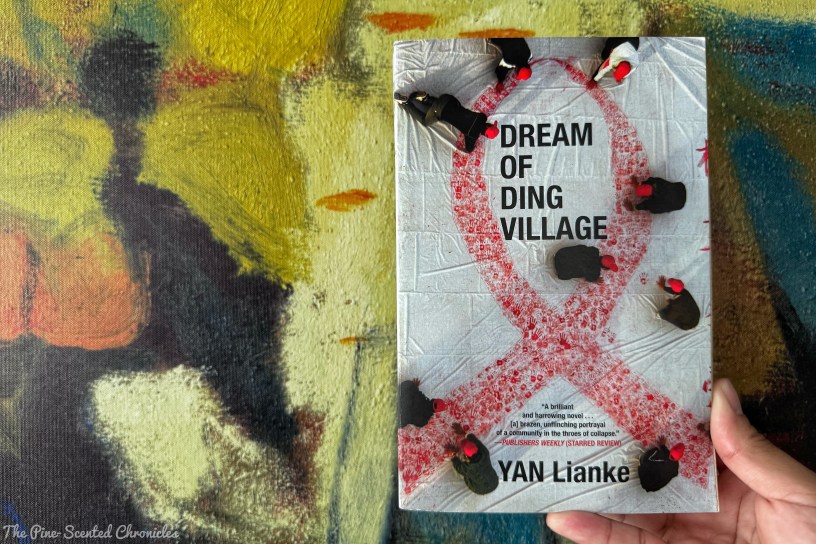
Gao’s case, along with those of other prominent Chinese writers who eventually went into exile, underscores the CCP’s sensitivity to criticism and the lengths to which it will go to suppress exposés that reveal the Party’s failures. Such is the case with Yan Lianke and his novel Dream of Ding Village. Originally published in Chinese in 2006 as 丁庄梦 (Dīng zhuāng mèng), the novel immediately acquaints readers with the tragic events that unfold in the fictional village of Ding in Henan Province during the early 1990s. Serving as a spiritual guide throughout the narrative is the ghost of twelve-year-old Ding Qiang. At the beginning of the novel, Qiang has already been poisoned and killed. Although the perpetrator is not immediately revealed, the motive behind the murder is clear. The villagers harbor deep resentment toward Qiang’s family, particularly his father, Ding Hui. This immediately raises an important question: why? As the novel gradually reveals, the answer lies in the past.
More than a decade earlier, Hui rose to prominence by introducing a plasma-selling scheme to the village. During a visit to another Chinese city, he was inspired by residents who had grown wealthy by selling blood. The scheme was even supported by county officials. Within a short period, Hui became the village’s blood kingpin. He paid villagers more money than they had ever seen before, dramatically improving their standard of living. What no one anticipated, however, was that the reckless handling of blood donations would result in widespread contamination. Health and safety standards were virtually nonexistent, and the villagers possessed little knowledge of HIV and AIDS. Those who participated in the blood trade eventually contracted the disease. One by one, they began to exhibit symptoms of AIDS, which they simply referred to as the “fever.” As deaths mounted in a village of only 800 people, anger toward the Ding family intensified.
The resentment simmering beneath the surface gradually approached a breaking point. It was only a matter of time before everything came to a head. When it finally did, the mighty fell. Amid the chaos, however, there remained voices of reason. Chief among them was Ding Shuiyang, Hui’s father and Qiang’s grandfather. As Qiang’s favorite person, Shuiyang occupies a central place in the young narrator’s reflections. He was a teacher and the caretaker of the village school, and he was among the most respected members of the community. It was for this reason that government officials initially approached him when they sought to encourage villagers to sell their blood. Unlike many others, Shuiyang opposed the blood trade and never participated in it himself. Nevertheless, he felt a profound sense of guilt over the suffering that befell his fellow villagers, even though the tragedy was largely the result of his son’s actions. With no officially appointed village chairman, Shuiyang effectively became the community’s de facto leader and advocate.
Dream of Ding Village is rooted in real historical events. During the late 1980s and early 1990s, the Chinese government implemented a “blood donation planning” policy in response to growing demand for blood in urban hospitals and medical enterprises. Under what became known as the “plasma economy,” the Henan provincial government promoted an aggressive program in which blood plasma was extracted in exchange for money. Although some collection sites operated legitimately, many did not. Unscrupulous operators cut costs by reusing needles and other medical equipment, resulting in widespread contamination. The campaign attracted approximately three million donors, most of whom came from rural China. These individuals were among the country’s most vulnerable populations and were often willing to sell their blood in hopes of escaping poverty. By 2003, more than 1.2 million people had reportedly contracted HIV/AIDS in Henan Province alone.
Death had become so commonplace, such an everyday event, that people couldn’t be bothered to go around pasting up funeral scrolls, buying fancy caskets, or planning elaborate funerals. Some people stopped going to funerals altogether. When a person died, it was like turning out a light. Like extinguishing a lamp, or watching a leaf drop from a tree in Autumn.
Yan Lianke, Dream of Ding Village
Beyond its historical foundation, the novel vividly illustrates how people can lose their sense of humanity in the face of catastrophe. Despite Shuiyang’s efforts to reassure the villagers, the community slowly descended into chaos. The pervasive presence of illness and death transformed everyday life. As more villagers became sick and died, blame spread throughout the community. Human beings instinctively seek someone to hold responsible during times of crisis. Confusion and anger clouded the villagers’ judgment, while their lack of understanding about AIDS only worsened the situation. They did not know what the disease was; all they knew was that they were sick and dying. Fear led many villagers to abandon loved ones and isolate themselves from others. Their revulsion toward the disease reveals how easily fear and mortality can erode compassion and dignity.
While the novel examines the collapse of an entire village, it is equally an exploration of society’s most fundamental unit: the family. This theme is embodied in the Ding family. Qiang’s death crystallizes the consequences of everything that has transpired in the village. Shuiyang finds himself trapped in an impossible position. He understands his son’s role in introducing the blood trade, yet he also bears responsibility as the village’s moral leader. Everyone turns to him for guidance and wisdom. He must reconcile his duties as both a father to Hui and a father figure to the community. The burden of guilt weighs heavily upon him. As the story progresses, it explores the unraveling of familial ethics and the complexities of bloodlines. Blood emerges as a powerful symbol throughout the novel. It binds members of the Ding family together through kinship, yet it also takes on a broader significance. For the villagers, blood is not merely a familial bond but an economic commodity. This dual symbolism deepens the novel’s exploration of both family and society.
As tensions continue to escalate, the novel exposes the darker aspects of human nature. Amid the chaos created by the “fever,” friends betray one another, and long-standing relationships deteriorate. Nevertheless, many of the villagers’ reactions are understandable given the desperate circumstances in which they find themselves. Fear often drives people toward irrational and self-preserving behavior. We naturally fear what we do not understand. Yet the novel’s clearest embodiment of human corruption remains Ding Hui. He represents the destructive consequences of unchecked greed. Intelligent and resourceful, he is nevertheless profoundly opportunistic. His greed knows no bounds, and his appetite for wealth is insatiable. Morally bankrupt, he exploits others without hesitation whenever doing so benefits him financially.
Although tragedy permeates the narrative, hope persists amid the bleakness. Shuiyang emerges as the novel’s moral center and greatest hero. He consistently works to defuse conflict, serving as both the voice of reason and the conscience of the village. While many villagers succumb to selfishness and despair, Shuiyang remains committed to compassion and responsibility. Meanwhile, his other son, Ding Yuejin, contracts the disease and quarantines himself at the village school. There, he meets Lingling, another infected villager. Their relationship develops into a moving and deeply human love story. Even as the community disintegrates, Yan allows moments of tenderness, dignity, and beauty to endure. Through characters such as the local storyteller and those who continue helping others despite the circumstances, the novel suggests that humanity can survive even in the darkest moments.
Staring at the smoke rising from the school, which now seemed not so white but tinged with silver and gold, it had dawned on him, that with so many deaths in the village, with so many people sick and dying, the higher-ups would have to take action, do something to show their concern. The government would have to do something for the people of Ding Village. It couldn’t just ignore them. It couldn’t stay silent, blindly doing nothing. Because who ever heard of a government that saw and heard nothing, said and did nothing, took no action and showed no concern?
Yan Lianke, Dream of Ding Village
Yan vividly portrays rural life, including the customs, rituals, and traditions that shape the region’s culture. As the narrative unfolds, it becomes a powerful examination of economic inequality in rural China. This is particularly ironic for a nation founded upon ideals of common prosperity and social equality. These ideals have often been undermined in practice. Rural communities remain deeply impoverished, prompting many residents to migrate to cities in search of opportunity. Yan’s personal experiences inform this portrayal. Born into poverty, he was encouraged by his parents to join the army, a decision that ultimately became a stepping stone toward his literary career. Rural communities were governed by corrupt officials who actively promoted the blood trade. The government targeted impoverished villages because their residents were often poorly educated and particularly vulnerable to promises of quick wealth. Yet when the blood-selling program evolved into a public health scandal, authorities largely turned a blind eye.
As a result, Dream of Ding Village functions as a subtle yet scathing critique of China’s social and political structures. Through the disintegration of both the Ding family and the village itself, Yan illustrates the devastating effects of state negligence and corruption on rural communities. The family and the village become microcosms of broader political and social realities. The state’s influence extends even to the novel’s creation. For three years, Yan reportedly traveled from village to village, posing as an assistant to an anthropologist in order to document the effects of the epidemic. Unsurprisingly, the novel was banned following its publication. In this sense, the act of writing becomes an act of resistance. Despite his prominence within Chinese literary circles, Yan was forced to practice self-censorship in order to navigate China’s restrictive cultural environment.
Ultimately, Dream of Ding Village is more than a fictional retelling of the Henan blood-selling scandal. Through the tragedy that befalls the Ding family and their village, Yan Lianke exposes the devastating consequences of greed, institutional negligence, and political silence. The AIDS epidemic serves as a potent metaphor for the moral and social decay that emerges when human lives are reduced by profit and ideology. The convergence of historical contexts and poignant human drama revealed how large-scale political failures are experienced most intimately within families and local communities. Despite its bleak subject matter, the novel remains deeply humane, capturing compassion, love, and moral responsibility in the face of suffering. In doing so, Dream of Ding Village stands as both a powerful work of literature and a courageous act of social criticism.
A day in late autumn, a late autumn dusk, the dusk of a late autumn day. Because of the autumn, because of the dusk, the sun that sets above the East Henan plain bloods up into a ball, making red of earth and sky. As red unfurls, so follows autumn, so comes the spreading dusk. Autumn grows deeper; the cold more intense. Because of the cold, the streets of the village are empty, devoid of passers-by.
Yan Lianke, Dream of Ding Village
Book Specs
Author: Yan Lianke
Translator (from Chinese): Cindy Carter
Publisher: Grove Press
Publishing Date: 2011 (2005)
No. of Pages: 341
Genre: Literary, Historical
Synopsis
Officially censored in China, and long-listed for the Man Asian Literary Prize, Yan Lianke’s Dream of Ding Village is a deeply moving and beautifully written novel, his most important work yet. Based on a real-life scandal in eastern China and drawing on three years of undercover work, it is a tale of one family in a poor village decimated by HIV/AIDS as a result of unregulated blood banks. While one son rises to the top of the Party by exploiting the situation, another is infected. Dream of Ding Village is an extraordinary critique of China’s ruthless path to development and what happens to those who get in the way.
About the Author
Yan Lianke (阎连科) was born on August 24, 1958, into a peasant family in Tianhu Yaogou, Song County, Luoyang, Henan Province. He entered the army in 1978, with the encouragement of his parents. While in the army, he rose in the ranks to become a propaganda writer. He graduated from Henan University in 1985 with a degree in politics and education. In 1991, he graduated from the Department of Literature of the People’s Liberation Army Art Institute. He joined the China Writers Association (CWA) in 1992. He is recognized by the CWA as a writer of “first-rank literary creation”, the highest official recognition the body provides to writers of literature.
Yan published his first short story, The Story of Tianma, in 1979. In 1991, he published 情感獄 (Qínggǎn yù; The Hell of Feelings), his first novel. He followed it up with 最後一名女知青 (1993, Zuìhòu yī míng nǚ zhīqīng; The Last Female Educated Youth), 生死晶黃 (1995, Shēngsǐ jīng huáng; Crystal Yellow in Life and Death), and 金蓮,你好 (1997, Jīnlián, nǐ hǎo jīng huáng; How are You, Pan Jinlian). While his earlier works earned a modicum of recognition, it was his 1997 novella collection 年月日 (Nian Yue Ri; Days, Months, Years) that started gaining him attention in Chinese literary circles. It earned Yan his second Lu Xun Literary Prize in 2000; he won his first in 1997 for 黄金洞 (1997, Huang Jin Dong; The Golden Cave). His 2003 novel 受活 (Shòu huó; Lenin’s Kiss) further established him as a major literary force. It won the 2004 Lao She Literary Award. Yan also published short story, novella, and essay collections.
For Yan, there was no way but up. However, his works have also been the subject of the CCP’s censorship. His 2005 novel, 为人民服务 (Wei Renmin Fuwu; Serve the People), and 2006 novel, 丁庄梦 (Ding Zhuang Meng; Dream of Ding Village), were both censored in China. To avoid censorship, Yan admitted to self-censorship. His most recent novel is 她们 (Women), which was published in 2022. Yan’s oeuvre and works have also gained various accolades across the world. In 2014, he became the first Chinese writer to win the Franz Kafka Award. In 2016, The Four Books (四书, Si Shu; 2011) was shortlisted for the International Booker Prize. A year later, The Explosion Chronicles (炸裂志, Zhalie Zhi; 2013) was longlisted for the same Prize. Yan was also the recipient of the 2021 Newman Prize for Chinese Literature. In November 2021, he received the Royal Society of Literature International Writer Lifetime Honor Award, making Yan the first recipient of the award.

