The Scars of History and Oppressive Systems
The landscape of contemporary South African history has been irreversibly altered by apartheid. It is undoubtedly one of the most important and controversial historical phenomena that shaped post-colonial Africa. Apartheid is an Afrikaans word meaning “separateness” or “the state of being apart.” It refers to South Africa’s official policy of racial segregation. The term was first recorded in 1929. Interestingly, apartheid stemmed from the racism of the colonial establishment, exacerbated by South Africa’s unique process of industrialization. The country’s industrialization policies, particularly in the mining industry, led to the segregation and classification of people. For over four decades, the white minority set itself apart from the non-white majority. Whites occupied the highest rungs of society, followed by Indians and Coloureds, while Black Africans occupied the lowest rung.
Apartheid, in effect, ensured that the highest political, social, and economic power was granted to and controlled by whites. However, even before apartheid was institutionalized by the National Party in 1948, legally sanctioned racial segregation already existed, underscoring the racial tensions that permeated twentieth-century South African society and, by extension, African society. Like most historical events of great significance, apartheid has been widely chronicled in contemporary literature. The realities of apartheid were vividly depicted in several novels. One of the earliest and most notable examples is Alan Paton’s Cry, the Beloved Country. The legacy of apartheid is also reflected in Nobel Laureate J.M. Coetzee’s Disgrace and Damon Galgut’s The Promise. One of the key figures of the anti-apartheid movement, Nelson Mandela, likewise provided an intimate account of his experiences during incarceration through his autobiography, Long Walk to Freedom.
Joining this body of apartheid literature is Mewa Ramgobin. Like Paton and Mandela, he was a vocal opponent of apartheid. Born on November 10, 1932, in Inanda in the former Natal Province, Ramgobin was the son of a successful farmer. His paternal grandparents were Indian immigrants who had arrived in Natal as indentured laborers. Growing up in Inanda shaped his political outlook; it was one of the few regions in Natal where Black and Indian people owned property as neighbors. He was also influenced by early anti-apartheid campaigns, such as the Freedom Charter campaign and the 1959 potato boycott. It was while studying at the University of Natal that he met his first wife, Ela Gandhi, the granddaughter of Mahatma Gandhi. This relationship further deepened his political involvement.
The huts were methodically grouped together. The groups were neatly spaced and protected a whole family of families. They were a community. They belonged together. Their cows and their goats, their chickens and their pigs, their horses and their mules were nearby in separate areas. These were very important possessions of the household. Beautiful tropical trees abounded. The tilled areas provided mealies and sweet potatoes
Mewa Ramgobin, Waiting to Live
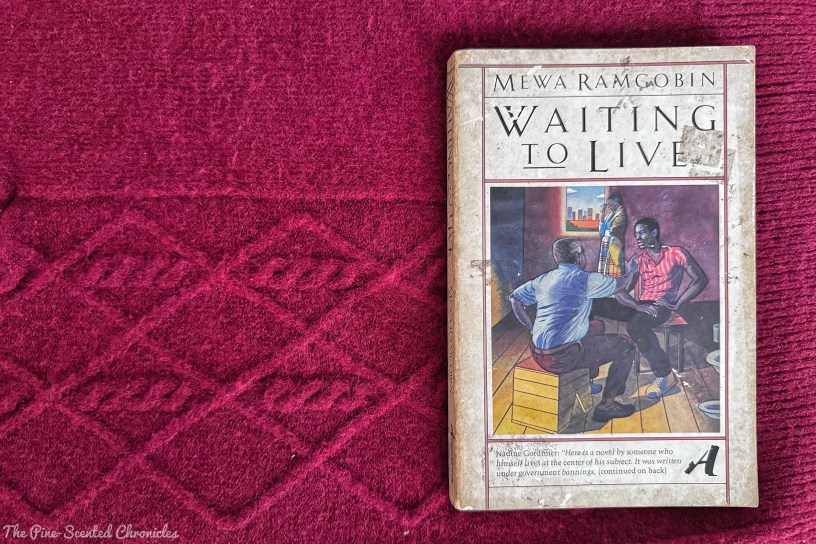
Apart from being an activist and politician, Ramgobin also published several literary works. A former vice-president of the Congress of South African Writers, he is best known for Waiting to Live, which he worked on while in prison awaiting trial on charges of treason for his resistance to apartheid. Following his acquittal in late 1985, Ramgobin published the novel in 1986. Waiting to Live charts the fortunes of Elias Mzimande, a young Black African born and raised in the tribal village of Umzinyathi in the South African countryside. The village remained virtually untouched by colonialism until missionaries arrived. They beguiled the villagers with a feast and introduced them to a religion that promised hope and a world where people could live together in peace and harmony. Because the tribe’s beliefs closely resembled the missionaries’ vision, conversion proved relatively seamless.
Following the missionaries’ successful efforts, the villagers simply incorporated Christian values into their existing traditions. Soon afterward, a group of white men arrived in the village to recruit laborers for the railroad. The village’s young men eagerly volunteered, among them Elias. He was driven by dreams of a better life, even if achieving it meant temporary separation from his betrothed, Nomsa. From Umzinyathi, he moved to the city of Durban, where he quickly adapted to his new surroundings. An idealist and an optimist, he accepted his circumstances, convinced that the pick-and-shovel work and the lonely nights in the noisy dormitory were merely stepping-stones toward his ultimate goal. He viewed his hardships as temporary—a brief interlude intended to prepare him for his transformation from a simple tribesman into a successful city dweller. Even after a short visit home to see his parents and Nomsa, he willingly and eagerly returned to the labor camp.
During a disastrous fire, Elias’s heroic conduct caught the attention of the white architect Peter Evenmore. The two became friends, and Peter eventually invited Elias to his home to meet his wife, Mary. When the couple learned about Nomsa, they arranged for her to marry Elias. They also offered her employment as a domestic helper so that she could live closer to her husband. Without hesitation, Nomsa accepted the offer. Unfortunately, she and Elias could not live together in Durban. The Group Areas Act and the Pass Laws Act prohibited Black married couples from living together in urban centers such as Durban. Apartheid policies also classified Black men as temporary workers who were required to live in single-sex hostels provided by employers or municipal authorities. Nevertheless, Elias and Nomsa remained hopeful about the future.
Tragedy struck when Nomsa died during childbirth. Ramgobin takes pains to assure readers that her death was not the result of mistreatment or neglect. Rather, she died from eclampsia shortly after delivering their son. On the same day, Lucy, the Evenmores’ other maid, had borne a stillborn child. Lucy subsequently became the wet nurse for Elias’s son. As the saying goes, when it rains, it pours. A second tragedy soon followed. A railroad accident left Elias crippled, causing him to lose his job. The small family he had formed with Lucy—who eventually became his common-law wife—was evicted from its home and forced to relocate to a miserable shantytown. Faced with this series of misfortunes, Elias was compelled to reconsider his son’s future. Keeping the child with them was no longer viable, prompting him to send his son to more fortunate relatives.
Standing in the dust, and beaten by the angry wind, the kinsfolk were full of pain and misgivings. They prayed, they waved and they cried their farewells. The men, too, sobbed unashamedly. They were the pillars and protectors of their people. Their numbers in the home villages were decreasing as more and more able-bodied men were taken or lured to the city.
Mewa Ramgobin, Waiting to Live
Ironically, Elias had left Umzinyathi in search of a better future for himself and his family. He was ambitious and hopeful. He worked diligently, believing that hard work would enable him to realize the future he had envisioned. Yet once in Durban, his aspirations were gradually dismantled by the larger systems that governed life. He discovered that the path toward his vision was riddled with obstacles that he had to overcome. The opportunities he sought were unavailable to him simply because of the color of his skin. Even so, these barriers did not prevent him from striving for a better life, as demonstrated by his heroic actions during the disastrous fire. His bravery earned the respect of Peter Evenmore, with whom he developed an unlikely friendship. Their relationship was, for all intents and purposes, socially taboo.
Looming over the narrative is apartheid itself. Its constraints kept Elias grounded, unable to transcend the limitations imposed by society and fulfill his dreams. The novel vividly explores the human cost of apartheid. It was a system that expanded and institutionalized racial segregation practices already prevalent before 1948. Apartheid laws systematically stripped non-white South Africans of their freedoms. Subjected to discrimination, they were treated as second-class citizens in their own country. In many ways, apartheid was a product of colonialism and white supremacy. Non-white South Africans were oppressed in their own land by people who had arrived from overseas and established systems designed to exploit both resources and labor. Such was the fate of much of Africa during the twentieth century.
Apartheid emerged as the most enduring symbol of this era of oppression. It was not until the end of the twentieth century that the system was dismantled. Waiting to Live also captures the social inequities that widened the divide between the countryside and the city. In rural areas, people depended primarily on the produce of the land. Yet young men such as Elias were filled with aspirations. They desired opportunities beyond what village life could offer. Ironically, these aspirations were shaped in part by the arrival of missionaries—white men in robes sent to remote regions to preach religion. While the countryside may have appeared idyllic, it was in decline because the land could no longer provide a reliable livelihood. The unequal distribution of development between rural and urban areas hindered the countryside’s ability to achieve sustainability and stability. In search of better opportunities, many villagers migrated to the cities.
Individuals like Elias were captivated by the emerging lights of Durban and other urban centers. They were drawn by the promises these places seemed to offer. As more people migrated to the cities, traditional community life gradually began to disintegrate. However, many who made the move soon became disillusioned. The promise of progress proved largely illusory. Advancement was obstructed by the arbitrary restrictions on opportunity and mobility imposed by apartheid. Non-white South Africans also suffered a profound loss of dignity as they struggled with poverty and social exclusion. Township life—created by the cultural and socio-economic segregation that forced non-white South Africans to live on the outskirts of cities—provided a profoundly different and often disorienting experience. Systemic barriers prevented fulfillment and upward mobility.
No. We do not want that. We don’t want to destroy them, or their cities or their inventions. We want a bigger share in them, yes. I want this boy here to be educated, so that he can move up in the world. I think the whites have a big start on us, that’s all. While our children tend cattle and herd goats and listen to the elders, their children are at school. It’s always been like that. We must learn to be more like the white men, and live more like them.
Mewa Ramgobin, Waiting to Live
Interestingly, apartheid is never directly named in the novel. Nevertheless, its consequences and effects are woven throughout the narrative and the daily lives of the characters. Although apartheid’s impact fell primarily on non-white South Africans, it also affected white South Africans in significant ways. Ramgobin subtly illustrates how they, too, were constrained by the same oppressive system. Yet white South Africans were also complicit in sustaining apartheid. Many hid behind a mask of sympathy while remaining passive in the face of injustice, thereby perpetuating the system. Just as Elias and Lucy became disillusioned with the promises of urban life, the Evenmores also grew disillusioned with life in South Africa. Once they overcame the barriers that had constrained their perspective, they chose to leave the country.
Despite the bleakness that overshadowed their lives, Elias and Lucy demonstrated remarkable resilience and courage. They were never able to transcend the limitations imposed upon them, yet they refused to abandon hope. They remained steadfast in the face of adversity and retained the optimism necessary to move forward. They were patiently waiting to live, believing that the future would usher in a more just and prosperous society that looked beyond the color of one’s skin. In telling their story, Ramgobin employed a plain and economical style. The narrative is straightforward, and the plot is relatively simple. Nevertheless, the novel effectively conveys a profound sense of urgency. Character development is limited because the work focuses primarily on apartheid’s impact on the lives of its characters.
Waiting to Live is a powerful portrayal of one of the darkest chapters in modern South African history. Through the experiences of Elias and Lucy, Mewa Ramgobin exposes the devastating human consequences of apartheid, revealing how an oppressive political system could shape, restrict, and ultimately determine the lives of ordinary people. Ramgobin demonstrated that apartheid’s greatest tragedy lay not only in its institutionalized discrimination but also in its denial of dignity, freedom, and hope to millions of South Africans. The novel’s enduring strength lies in its humanization of history. Despite the hardships endured by its characters, Waiting to Live remains a testament to resilience and perseverance. Elias and Lucy’s determination to endure reflects the courage of countless South Africans who lived under apartheid while continuing to hope for a more just and equitable future. Ultimately, the novel serves as a poignant reminder of the profound human cost of racial injustice and the enduring desire for a life defined by dignity, opportunity, and belonging.
I think my father never forgave me for that. It was disregard of his authority, and it is worse: it was a rupture in our family, in our traditions, in our links between generations. But that was what I wanted. I wanted you to be different, not like me. I wanted you to be wiser than me, better than me, richer than me, happier than me. I did not want you to grow up in those forgotten valleys, listening to your elders, learning only from the past.
Mewa Ramgobin, Waiting to Live
Book Specs
Author: Mewa Ramgobin
Publisher: Aventura
Publishing Date: May 1986
No. of Pages: 240
Genre: Political, Historical
Synopsis
Nadine Gordimer: “Here is a novel by someone who himself lives at the center of his subject. It was written under government bannings, detention in prison and on trial for political resistance against apartheid. In this moving story by a new South African black writer, Mewa Ramgobin, the growth of the struggle against oppression and the growth of a strange family love fuse in strength. To get to know Ramgobin’s characters is to understand – through people so real one can feel their warm breath and hear their voices – how the will to freedom was germinated in South Africa and become invincible.”
A strong-willed, young South African black man, Elis Mzimande – seduced by technology and the ways of the whites – abandons his people and his traditional settlement to make a better life for himself in the city. The fate of his ambition dramatizes the frightening tensions and ambiguities of apartheid in South Africa. Powerful for the depth of its human drama, Waiting to Live is an astounding political act of literary imagination.”
About the Author
Mewa Ramgobin was born on November 10, 1932, in Inanda in the former Natal Province. His father was a successful farmer while his paternal grandparents were Indian immigrants who arrived in Natal as indentured laborers. He attended school in Inanda and later in Greyville, Durban. His family was not political, but Ramgobin was affected by his upbringing in Inanda, then one of the only regions of Natal in which black and Indian people owned property as neighbors, as well as by early campaigns of the anti-apartheid movement. As a student in the non-white section of the University of Natal, Ramgobin was president of the student representative council and a member of the executive of the National Union of South African Students.
He was active in NUSAS, headed the non-European SRC. In 1960, after his marriage to Ela Gandhi, the granddaughter of Mahatma Gandhi, he joined the fast at the Phoenix Settlement, a settlement on the outskirts of Inanda that had been established by Gandhi’s grandfather. In 1965, he received his first banning order. Still, he remained politically involved. When his banning order expired in 1970, he founded the South African Committee for the release of Political Prisoners and began to work towards a revival in the Natal Indian Congress (NIC). He also served as a founding co-treasurer of the United Democratic Front in 1983. He was involved in major events such as the Pietermaritzburg Treason Trial (1984–1985) and served as an African National Congress Member of Parliament from 1994 to 2009.
Ramgobin also once served as a vice-president of the Congress of South African Writers. In 1986, he published his political novel, Waiting to Live. In 2009, Ramgobin’s memoir, Prisms of Light: Within My Memory was launched. On 17 October 2016, Ramgobin passed away in Cape Town.

