Happy Wednesday, everyone! Woah! Just like that, we are already midway through the seventh month of the year. How time flies! I hope the year has been kind and great to everyone. I know life isn’t a walk in the park, but it is my fervent prayer that everyone’s year is going well. Regardless, I hope the rest of the workweek goes smoothly.
That said, the middle of the week also brings a fresh WWW Wednesday update. WWW Wednesday is a bookish meme hosted originally by SAM@TAKING ON A WORLD OF WORDS.
The mechanics for WWW Wednesday are quite simple: you just have to answer three questions:
- What are you currently reading?
- What have you finished reading?
- What will you read next?

What are you currently reading?

It’s already the middle of the week, which means we have only two more days until the weekend. I hope everyone makes it through the workweek. Anyway, my 2026 reading journey is going as planned. I spent the first two months of the year reading works by Latin American and Caribbean writers. I then followed that with a venture into European literature, a journey that lasted four months. I think this is the longest time I have spent immersed in European literature in a single year. I am just glad I was finally able to complete all the works by European writers in my reading challenges. Ironically, I first ventured into European literature because of these books, yet they were the last ones I read. In any case, I am glad I was finally able to conclude that journey. Nevertheless, it was one that I truly relished. Still, I am happy to begin a new literary adventure. With July being my birth month, I have decided to venture into the works of Asian writers.
My current read takes me to a place close to home. I can’t recall how I first came across Elaine Castillo’s America Is Not the Heart. When I first discovered it, I held back. However, I eventually relented and secured a copy of the book. I even included it in my 2026 Top 26 Reading List. Originally published in 2018, America Is Not the Heart is set in the late twentieth-century United States. The novel begins with a prologue in which a narrator addresses Pacita, or Paz, a girl who grows up destitute in Pangasinan as the second daughter in a family of six children. Paz dreams of moving to America. She studies to become a nurse, and while working at her first hospital job, she falls in love with Dr. Apolonio de Vera, or Pol, a surgeon from an affluent family in Ilocos Sur. They work hard to move to America. Paz moves first, and Pol later joins her. Shortly afterward, they have a daughter, Geronima—Roni for short. Pol names her after his niece, whom he mistakenly believes to be dead.
The novel then shifts perspective as Pol’s niece, Geronima, locates her uncle and moves in with his family in suburban California. Roni christens her cousin “Hero” for accomplishing a remarkable feat, the details of which are known to no one except Hero. The answer to this, as always, lies in the past. As the story returns to the Philippines, we learn about Hero’s affiliation with the communist New People’s Army (NPA). She serves as a doctor for the NPA, tending to peasants, farmers, laborers, and her fellow militants in the countryside. We also learn about her conflicted sexuality. In the present, Hero serves as an “ate” (older sister) to Roni. We then follow Hero as she assimilates into life in the early 1990s in the Bay Area. America Is Not the Heart is, then, an exploration of the Philippines’ recent past and the Philippine diaspora. Furthermore, it is fascinating how Castillo ties the Philippine immigrant experience to the characters’ cultural and geographical roots.
America Is Not the Heart, interestingly, is a play on the renowned Filipino novel America Is in the Heart by Carlos Bulosan. I was actually reminded of this only recently, although I have yet to read Bulosan’s novel. In any case, America Is Not the Heart also explores identity, gender, and the rampant corruption and abuses that have undermined the Philippines. I am nearly done with the novel. I must say, I am quite impressed, both by the novel’s scope and by the quality of its prose. The occasional interjections of dialects, particularly Ilocano, lend the novel an added layer of authenticity. I am looking forward to seeing how Hero’s story unfolds.
What have you finished reading?
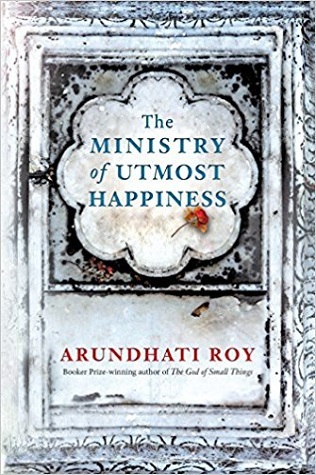
The past week has been quite hectic. As such, I was able to complete only one book. To be fair, all the books I have been reading are quite hefty. Anyway, the only book I managed to finish this past week takes me to India. It has been nearly a decade since I last read a work by Arundhati Roy. Her Booker Prize-winning masterpiece, The God of Small Things, was my introduction to her oeuvre. It was a book worthy of all the accolades it has received. It also made me look forward to reading Roy’s other works. Ironically, I wasn’t able to read any of them until now. Nearly a decade after reading The God of Small Things, I have finally completed my second Roy novel, The Ministry of Utmost Happiness. I first encountered it years ago. However, its relatively low Goodreads rating kept me from picking it up. Still, I kept coming across the book. Eventually, I relented and decided to give it a chance.
Originally published in 2017, The Ministry of Utmost Happiness is Roy’s sophomore novel. It follows the interwoven lives of an eclectic cast of characters. The novel opens with Anjum, a Muslim Hijra (a traditional third gender in India), whom we first meet as she sets up her home in a graveyard behind a government hospital. She is friendless, but the blind old Imam Ziauddin soon becomes her frequent companion. Through their conversations, we learn that Anjum was born intersex and was initially raised as a boy named Aftab. Rejecting her assigned male identity, she joins the Khwabgah, or “House of Dreams,” a local community of Hijras. After spending decades as an entertainer, Anjum decides to leave the Khwabgah and adopt Zainab, an abandoned toddler. Her plans, however, are disrupted by the rise of anti-Muslim sentiment in the early 2000s. The second major storyline takes us to Delhi, although it primarily concerns events that unfold in Kashmir during the 1990s. The narrative gradually takes shape through the perspectives of different characters. At the heart of these narratives is S. Tilottama, or “Tilo,” the illegitimate daughter of a well-to-do Syrian Indian woman who “adopts” her. As she grows up, Tilo attends architecture school in Delhi, where she meets three men who fall in love with her. Biplab Dasgupta is a pragmatic man who works for the Indian government. Nagaraj Hariharan, or Naga, is the passionate son of Hindu bureaucrats who becomes a radical journalist and eventually a security analyst. Musa Yeswi is a Muslim Kashmiri who also studies architecture. The four are college friends who meet in the mid-1980s. However, after college, they lose touch, only for their lives to intersect again years later in Kashmir, where each plays a different role. Tilo, however, remains shrouded in mystery. Biplab is involved in the Kashmir conflict, serving primarily to cover up the atrocities committed by the Indian Army in the region. Naga, on the other hand, is a journalist with leftist leanings. He does not see himself as corrupt, but Biplab views him as a puppet of the government, revealing only as much as the authorities want him to reveal. Both are posted in Kashmir.
While on assignment in Kashmir in 1996, Biplab receives a phone call from an interrogation center in Srinagar informing him that the army has captured Tilo along with a dreaded militant named Musa. Biplab sends Naga to collect her from the jail, and soon afterward, Naga and Tilo marry. The marriage does not last long, and when Tilo finally leaves Naga, she asks Biplab if she can rent one of his apartments. She then disappears. Following her disappearance, Biplab discovers photographs of people tortured during the insurgency, along with a collection of files on the officer who interrogated Tilo and killed Musa. It is also revealed that Tilo is being sought by the police for allegedly kidnapping a baby. Anjum and Saddam Hussain (Dayachand) offer Tilo refuge at Jannat Guest House. So where do these interlinked stories ultimately lead?
The Ministry of Utmost Happiness is a remarkably eventful novel that chronicles several of the darkest and most violent episodes in modern Indian history, making its title deeply ironic. Spanning decades, the novel encompasses events ranging from land reforms that dispossessed poor farmers to the Bhopal disaster, the 2002 Godhra train burning, and the Kashmir insurgency. Along the way, Roy introduces a fascinating cast of compelling characters from different walks of life, each representing a different facet of Indian society. The novel vividly captures the socio-political maladies that continue to undermine contemporary India, including corruption, political violence, social divisions, and even the excesses of capitalism. It is a bleak portrait of the country. Yet, what ultimately emerges is resilience and hope. Amid the darkness that envelops the nation, hope springs eternal. With her sophomore novel, Roy further consolidates her status as a master storyteller.
What will you read next?