Happy Wednesday, everyone! Woah! Just like that, we are nearly through the seventh month of the year. How time flies! I hope the year has been kind and great to everyone. I know life isn’t a walk in the park, but it is my fervent prayer that everyone’s year is going well. Regardless, I hope the rest of the workweek goes smoothly.
That said, the middle of the week also brings a fresh WWW Wednesday update. WWW Wednesday is a bookish meme hosted originally by SAM@TAKING ON A WORLD OF WORDS.
The mechanics for WWW Wednesday are quite simple: you just have to answer three questions:
- What are you currently reading?
- What have you finished reading?
- What will you read next?

What are you currently reading?
It’s already the middle of the week, which means we have only two more days until the weekend. I hope everyone makes it through the workweek. Anyway, my 2026 reading journey is going as planned. I spent the first two months of the year reading works by Latin American and Caribbean writers. I then followed that with a venture into European literature, a journey that lasted four months. I think this is the longest time I have spent immersed in European literature in a single year. I am just glad I was finally able to complete all the works by European writers in my reading challenges. Ironically, I first ventured into European literature because of these books, yet they were the last ones I read. In any case, I am glad I was finally able to conclude that journey. Nevertheless, it was one that I truly relished. Still, I am happy to begin a new literary adventure. With July being my birth month, I have decided to venture into the works of Asian writers.
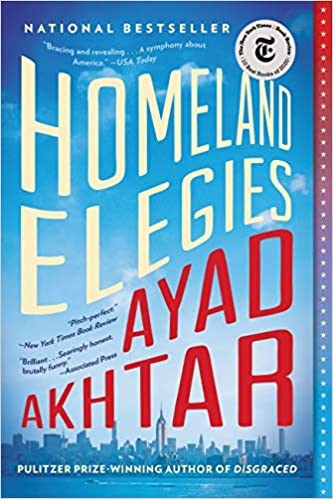
The book I am currently reading, however, takes me to the United States. Nevertheless, Ayad Akhtar was born to Pakistani parents. His novel Homeland Elegies first piqued my interest during the pandemic. Shortly after its release, it was listed by several literary publications as one of the best books of the year. Half a decade later, I am finally reading the book, which I also included on my 2026 Top 26 Reading List. Akhtar’s sophomore novel, Homeland Elegies, begins with an overture dedicated “To America.” Akhtar himself serves as the spiritual guide, and the novel integrates elements of autobiographical memoir. In the overture, Akhtar recalls Professor Moroni, a memorable college professor. He is reminded of his professor, who instilled in him the idea that America is not what it claims to be. This sets the tone for the story, or at least from what I can surmise so far, as I have just started reading the novel. We learn that Akhtar’s parents were doctors who emigrated from Pakistan to the United States in their younger years, drawn by America’s promise of opportunity for physicians.
Interestingly, Akhtar’s parents were the antithesis of each other, at least in terms of how they viewed America. Sikander adored America, including Donald Trump. His wife, Fatima, yearned to return to the country of her birth. She did not feel that she belonged in America. The novel’s first section, titled “Family Politics,” begins with Donald Trump’s first year in office. Due to a medical emergency, the Akhtar family became acquainted with Trump. It was through him that Sikander developed an obsession with the American Dream. Sikander even tried to emulate Trump’s success. It was, however, all for naught, although their lives share certain parallels. At one point, Sikander was forced to sell his private practice and declare bankruptcy. This is where the story becomes more interesting, as Akhtar fuses family history with contemporary American politics. As mentioned, I have just started reading the novel, which means I still have quite a long way to go. I will be sharing more of my impressions of the book in this week’s First Impression Friday update.
What have you finished reading?

After a couple of slow reading weeks, I was finally able to regain some badly needed reading momentum over the past week. I was able to complete three novels. It has been a while since I had such a productive reading week. The slow reading weeks were due to a hectic workload. Thankfully, things are starting to look up. The first of the three books I read was Elaine Castillo’s America Is Not the Heart. This also brought me closer to home, as it is the first book by a Filipino writer that I have read this year. I can’t recall exactly how or when I first came across Elaine Castillo’s America Is Not the Heart. I do, however, remember hesitating when I first encountered it. Sometimes I have reservations about reading the works of my fellow Filipinos. This is, however, a mindset I have been dismantling over the years, as evidenced by the number of books by Filipino writers that I have read in recent years. That was certainly the case with America Is Not the Heart. I eventually relented and secured a copy of the book. Like Homeland Elegies, I included it on my 2026 Top 26 Reading List.
Originally published in 2018, America Is Not the Heart is set in the late twentieth-century United States. The novel begins with a prologue in which a narrator addresses Pacita, or Paz, a girl who grows up in poverty in Pangasinan as the second of six children. Paz dreams of moving to America. Working toward this dream, she studies to become a nurse, and while working at her first hospital job, she falls in love with Dr. Apolonio de Vera, or Pol, a surgeon from an affluent family in Ilocos Sur. They work hard to make their way to America. Paz moves first, and Pol later joins her. Shortly afterward, they have a daughter, Geronima—Roni for short. Pol names her after his niece, whom he mistakenly believes to be dead. The novel then shifts perspective as Pol’s niece, Geronima, locates her uncle and moves in with his family in suburban California. Roni christens her cousin “Hero” for accomplishing a remarkable feat, the details of which are known only to Hero. They befriend Adela and Rosalyn, a grandmother and granddaughter, and the two families gradually grow close. As Hero and Rosalyn become closer, Hero opens up to Rosalyn while revealing little about herself to her own family. Hero’s former life slowly comes into focus. Before moving to the United States, she was affiliated with the communist New People’s Army (NPA). She served as a doctor for the NPA, tending to peasants, farmers, laborers, and fellow militants in the countryside. She also worked as an agent for the organization. These memories are a source of trauma, as Hero was imprisoned for two years. During her incarceration, she was tortured, and many of her bones were broken. We also learn about her conflicted sexuality. While she was with the NPA, she had relationships with both men and women, and she had long been uncertain about her sexuality, even as a teenager. Rosalyn develops feelings for Hero. However, Hero avoids responding to Rosalyn’s affection. She is wary of becoming vulnerable, preferring casual relationships with multiple partners. In the present, Hero serves as an “ate” (older sister) to Roni. We then follow Hero as she assimilates into life in the Bay Area during the early 1990s. She becomes Roni’s full-time caregiver, picking her up from school and accompanying her to appointments and playdates. The past and the present converge as Hero grapples with her trauma while learning to adapt to her new environment.
America Is Not the Heart is, above all, an exploration of the Philippines’ recent past and the Philippine diaspora. Castillo also does a remarkable job of connecting the Philippine immigrant experience to her characters’ cultural and geographical roots. Like many immigrants, Filipinos are drawn by the promise of the proverbial American Dream. But is it really all that it promises to be? Details of contemporary Philippine politics also add nuance to the story. America Is Not the Heart, interestingly, is a play on the renowned Filipino novel America Is in the Heart by Carlos Bulosan. I was reminded of this only recently, although I have yet to read Bulosan’s novel. In any case, America Is Not the Heart also explores identity, gender, and the corruption and abuses that have long undermined the Philippines. I must say, I am quite impressed, both by the novel’s scope and by the quality of Castillo’s prose. The occasional use of Philippine languages, particularly Ilocano, lends the novel an added layer of authenticity. America Is Not the Heart is a compelling and thought-provoking novel.

After reading America Is Not the Heart, I realized how emotionally heavy the books I had been reading over the past few weeks were. Some even dealt with violence and crime. This made me decide to look for a lighter read. A casual browse through my bookshelf led me to an unsuspecting book. Singaporean writer Kevin Kwan made headlines with his novel Crazy Rich Asians, a satire of the upper crust of Singaporean—and, by extension, Asian—society. I read the book back in 2019. It was a light and entertaining read, punctuated by moments of tenderness as Kwan exposed the hypocrisy that permeates high society. Although I finished the first book, I did not plan to read the rest of the trilogy, at least not until several years later. Seven years after reading the first book in the trilogy, I am finally continuing this literary journey with its sequel, China Rich Girlfriend.
Originally published in 2015, China Rich Girlfriend picks up where its predecessor left off. The novel, however, opens with a newspaper article about a horrific Ferrari crash in London. The Ferrari was driven by Carlton Bao, the only son of an immensely wealthy Mainland Chinese family. He was studying in the United Kingdom. Carlton and another passenger were seriously injured when the car crashed into the front of an expensive shop. Upon hearing the news of the accident, Carlton’s mother, Shaoyen Bao, hurried to London along with her banker, Edison Cheng, a financial consultant based in Hong Kong. During her trip to London, Shaoyen met Edison’s aunt, Eleanor Young, the mother of Nicholas “Nick” Young. During their lunch, Shaoyen showed Eleanor a picture of her son. Eleanor immediately noticed the uncanny resemblance between Carlton and Rachel Chu, the woman engaged to marry Nick. Nick and Eleanor’s relationship had soured after Eleanor attempted to end her son’s relationship with Rachel three years earlier. Eleanor insisted that her son could not marry a woman who had never known her father and had been raised by a single mother with no prominent family name. Nick and Rachel have since rebuilt their relationship and now live in Manhattan, away from the expectations and prying eyes of Nick’s family. Although Nick was at risk of losing his inheritance, he remained steadfast, willing to give it up in exchange for a life in New York with the woman he loved and a career he enjoyed. Eleanor later learned that her son was set to marry Rachel in California, but the results of her investigations prompted her to attend her son’s wedding even though she had not been invited. Apparently, Carlton’s father, Bao Gaoliang, was Rachel’s biological father, and Eleanor now saw the value of having Rachel as a daughter-in-law. She even orchestrated a reunion between father and long-lost daughter. Things, however, were more complicated than they initially appeared. As the story unfolds, we once again meet familiar characters, such as Nick’s cousin, Astrid Leong. She has reunited with her husband, Michael, and their marriage has become more stable after Michael’s tech company achieved a measure of success. Alongside the returning characters are new ones, such as Kitty Pong, the former actress whose marriage to Bernard Tai brought her into Singapore’s elite. She attempts to buy her way into Hong Kong’s high society by appearing in gossip magazines and purchasing high-profile works of art.
Like its predecessor, China Rich Girlfriend satirizes Asia’s ultra-rich. Kwan delves deeply into the dynamics of wealthy Asian families. Nick and Eleanor’s relationship remains strained, as Nick continues to distrust his mother. Eleanor, on the other hand, remains determined to secure what she believes is her son’s future—namely, his inheritance. The Bao family offers a different dimension to the story. Ironically, they live in extraordinary luxury, a stark contrast to the poverty that persists in much of the Chinese countryside. For a country that advocates social equity, the upper echelons of Chinese society enjoy lives of immense privilege, detached from the realities around them. China Rich Girlfriend continues to contrast Rachel’s humble upbringing with the extravagant lifestyle of the “China rich.” As always, the novel examines the absurdities of extreme wealth. Kwan’s satire is sharp and humorous while exposing the hypocrisy of the ultra-rich. He also subtly explores themes of social status, family loyalty, and identity. I enjoyed this book even more than its predecessor, although I remain a little apprehensive about Nick’s character. Nevertheless, I am looking forward to reading the final book in the trilogy.

My three-book venture concluded in familiar territory. By now, I have established how much I adore Japanese literature. It is one of my favorite literary traditions in the world; I even used to dedicate my birth month exclusively to reading works by Japanese writers. Anyway, the third book I read was another heartwarming story. Kiyoshi Shigematsu’s The Blanket Cats joins a long list of Japanese novels featuring cats. It has not escaped my attention how prevalent they are in Japanese literature. Even literary titan Haruki Murakami frequently incorporates cats into his novels. Beginning with Natsume Sōseki’s I Am a Cat, Japanese writers have produced numerous works centered on felines. In fact, one of my all-time favorite reads is Hiro Arikawa’s The Travelling Cat Chronicles. Other notable examples include Genki Kawamura’s If Cats Disappeared from the World, Takashi Hiraide’s The Guest Cat, and Sōsuke Natsukawa’s The Cat Who Saved Books. With The Blanket Cats, I was about to add another “cat book” to my ever-growing list.
Originally published in 2008 as ブランケット・キャッツ (Buranketto Kyattsu), The Blanket Cats is a collection of seven loosely connected short stories; I had always assumed it was a novel. The collection is built around the intriguing concept of a shop where cats can be rented. This premise, however, feels familiar within the landscape of Japanese literature. I was reminded of Funiculi Funicula, the café in Toshikazu Kawaguchi’s Before the Coffee Gets Cold. In any case, The Blanket Cats also joins the growing list of Japanese “healing novels.” Shigematsu not only introduces us to seven extraordinary cats but also offers a glimpse into everyday life in Japan beyond what most tourists see. We encounter ordinary people facing ordinary yet deeply personal struggles. The cats serve as plot devices that allow Shigematsu to connect seven stories about people at crossroads in their lives. Whenever the characters temporarily adopt one of the blanket cats, they find themselves at a pivotal moment, uncertain about how to move forward. While the cats cannot solve their problems or make decisions for them, the comfort of their warm presence provides reassurance. As the stories unfold, we encounter familiar concerns in Japanese society. The opening story, “The Cat Who Sneezed,” introduces a childless couple wondering whether a feline companion can fill the void in their lives. “The Cat Dreams Were Made Of” follows a family forced to move after the patriarch suddenly loses his job, prompting them to create a few final memories before leaving their home. Meanwhile, “The Cat With No Tail” grapples with the issue of school bullying. In “The Cat Who Knew How to Pretend,” a family’s beloved cat, Ron-ron, has died. Before their grandmother arrives for a visit prior to entering a nursing home, they scramble to find a cat that resembles Ron-ron. Although they succeed in deceiving their grandmother, the cat is not the only impostor, as one family member is also hiding a secret. “The Cat No-One Liked” deals with exploitative landlords and rising rents, and it contains one of the collection’s stronger storylines, thanks largely to Etsuko’s ingenious plan. “The Cat Who Went on a Journey” is narrated by Tabby, one of the shop’s more dependable cats, making it the story that feels most like a traditional cat tale. Finally, “The Cat in the Passenger Seat” follows a repeat customer taking an old friend on one final journey.
The Blanket Cats has an intriguing premise. Given how popular cat stories have become in recent years, its English translation feels especially timely. Japanese slice-of-life fiction is, after all, often heartwarming, comforting, and quietly insightful. Unfortunately, many of the human characters in this collection are difficult to like. More disappointingly, the cats are often treated as afterthoughts, functioning merely as narrative devices rather than active participants in the stories. This feels like a missed opportunity. Although the cats symbolize companionship and the transient nature of human relationships, most of the stories could have unfolded in much the same way without them. I had been looking forward to reading this collection, especially after mistakenly believing it was a novel. Although there are moments of genuine brilliance, too many of the stories ultimately fall flat. Nevertheless, The Blanket Cats remains an interesting addition to the growing body of Japanese cat literature.
What will you read next?