
First Impression Friday will be a meme where you talk about a book that you JUST STARTED! Maybe you’re only a chapter or two in, maybe a little farther. Based on this sampling of your current read, give a few impressions and predict what you’ll think by the end.
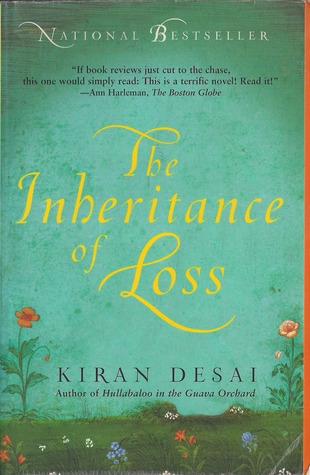
Synopsis:
In a crumbling, isolated house at the foot of Mount Kanchenjunga in the Himalayas lives an embittered judge who wants only to retire in peace, when his orphaned granddaughter, Sai, arrives on his doorstep. The judge’s cook watches over her distractedly, for his thoughts are often on his son, Biju, who is hopscotching from one gritty New York restaurant to another. Kiran Desai’s brilliant novel, published to huge acclaim, is a story of joy and despair. Her characters face numerous choices that majestically illuminate the consequences of colonialism as it collides with the modern world.
It’s the end of the workweek—yay! Technically, it is already Saturday. Still, I hope the week has been kind to everyone, although the past few weeks have been quite hectic for me personally. I am still trying to resolve a lot of issues, but more keep floating to the surface. I am basically the only one keeping my unit afloat. I certainly hope some kind of reprieve arrives in the coming weeks. Also, I can’t believe how quickly time flies! We are already in the eighth month of the year. Time takes its natural course, with little regard for us. Nevertheless, I hope the first seven months of the year have been promising. As the year progresses, I hope everyone is given plenty of opportunities to grow and improve. With the weekend finally here, I hope everyone has a great one. It’s time to dress down and spend it resting from the rigors of a demanding career, pursuing your passions, completing household chores, spending time with loved ones, or simply relaxing. It is going to be a damp weekend here in the Philippines. I hope you’re all doing well—physically, mentally, and emotionally.
After four months of exploring European literature, I was finally able to conclude the journey, which I had originally planned to complete in just two months. It was just enough time to finish all the works by European writers in my reading challenges. Ironically, it was these very books that ultimately extended my literary adventure into a four-month journey. With my European literary adventure this year officially complete—the longest I have spent immersed in European literature in a single year—I have now commenced a new literary journey. With July being my birth month, I decided to embark on a literary adventure into a territory closer to home: Asian literature. Apart from being part of the region, I have often dedicated July to the works of Japanese writers, as Japanese literature is one of my favorite literary traditions. As always, I have several works of Asian literature on my reading list. It was therefore a foregone conclusion that I would extend this journey into August.
With my insatiable appetite for Japanese literature, I have actually run out of books by Japanese writers—at least those on my bookshelf. Still, a few are waiting to be read, and there are others that I am looking forward to acquiring. I am particularly excited about the news of Haruki Murakami’s latest novel. I am eagerly awaiting its English translation, as it promises to offer a different dimension of Murakami’s prose. My current read, however, takes me beyond Japan to a literary tradition that has been steadily growing on me. Over the past decade, my exploration of Indian literature has expanded exponentially. I owe much of this to Salman Rushdie. While he was among the first writers to introduce me to Indian literature, I have since discovered many new-to-me voices. Among them is Kiran Desai, whom I first encountered through various must-read lists. In particular, her sophomore novel, The Inheritance of Loss, was a constant presence on those lists.
Over the past few years, I have repeatedly come across the book. However, for reasons I cannot recall, I had been apprehensive about reading it. I eventually relented and acquired a copy; I even included it in my 2026 Top 26 Reading List. Originally published in 2006, The Inheritance of Loss is primarily set in 1986 and opens with the judge—later identified as Jemubhai Patel—and his granddaughter, Sai, sitting on the veranda of their home, Cho Oyu, a dilapidated mansion in the Himalayan town of Kalimpong at the foot of Mount Kanchenjunga. Meanwhile, their cook prepares tea while the judge’s dog, Mutt, sleeps on the porch. Their quiet reverie is disrupted by the arrival of a group of boys from the Gorkha National Liberation Front (GNLF), an insurgent movement of Nepalis demanding statehood in India. They demand that the judge surrender his guns, threaten him with a rifle, and steal anything of value they can find in the house.
The judge then sends the cook to the police station. However, when the police return to the house, they accuse the cook of having a hand in the robbery. As the policemen tear apart the cook’s meager hut, they uncover letters from his son, Biju, the third major character in the novel. Biju works at Gray’s Papaya in the heart of Manhattan. However, he has been living illegally in New York City after overstaying his tourist visa. As a result, he is forced to leave the restaurant when its manager is instructed to conduct a green-card check. To survive, he searches for work at other restaurants, even if the pay is meager. Unfortunately, he continues to face the same rejection. Ironically, the letters he sends to his father depict a life that starkly contrasts with his reality. Biju exaggerates and idealizes his life in the United States. In turn, his father’s responses vehemently deny the rumors of political unrest in Darjeeling. His father also boasts about Biju’s “successful” American Dream to his friends, family, and neighbors.
Meanwhile, the story flashes back to the time Sai arrived at Cho Oyu nine years earlier. She had left St. Augustine’s Convent, where she had grown up immersed in English customs, after her parents were killed in a bus accident. The nuns found her grandfather’s address and sent her to live with him. Upon her arrival, Sai and her grandfather exchange only a few words, but the judge is pleased to discover that they seem accustomed to similar cultural sensibilities. Raised in convent schools, Sai is introverted and disconnected from her Indian heritage. She grows up in isolation under her grandfather’s care. Reading National Geographic magazines and colonial travelogues becomes her only means of escape. The cook serves as a surrogate father, although she constantly yearns for her parents. To continue her education, the judge hires two elderly anglophiles, Noni and Lola, to tutor Sai. When Sai eventually surpasses Noni’s abilities, the judge hires a recent university graduate, a Nepali man named Gyan, to tutor her in mathematics and physics.
We also learn about the judge’s own past. He was born into poverty, to a family belonging to the peasant caste. As a young man, he became devoted to colonial England. During the British Raj, the twenty-year-old Jemubhai left India to study for the Indian Civil Service at Cambridge University. He left behind his fourteen-year-old wife, Nimi Patel, using the dowry he had received from their marriage to finance the trip. In Cambridge, however, he becomes deeply disillusioned, treated as an outcast and a second-class citizen. After his attempts to assimilate are rejected by his English classmates, professors, and neighbors, he barely speaks to anyone. He tries to adopt English speech and customs, eventually finding his own skin color odd and his accent strange. By the time he returns home, he has grown contemptuous of both his homeland and his wife. Upon his retirement, he embraces a life of isolation. Isolation is, in fact, one of the novel’s recurring themes, as Biju experiences much the same alienation in New York. Even the novel’s setting reflects this profound sense of isolation.
This lays out the landscape of the story as Desai masterfully weaves together the lives of her characters. It is eventful, to say the least, as she explores a wide array of themes and subjects. The judge and Biju, for instance, grapple with their sense of belonging and the gradual loss of their cultural identities. The very definition of home is carefully examined. At the same time, the novel explores the stark contrast between privilege and poverty through characters from vastly different walks of life. Some can ascend the socioeconomic ladder, while others remain trapped in the quagmire of poverty. As the title suggests, the novel is a poignant examination of loss, tempered by moments of romance and love. These emotional currents are juxtaposed with political unrest and ethnic tensions. Desai astutely weaves these disparate elements into a rich literary tapestry. Through her evocative prose, the India of the 1980s and its prevailing concerns come vividly to life.
Winner of the 2006 Booker Prize, The Inheritance of Loss has been a delightful surprise. I now find myself lamenting that it took me this long to finally read it. I have to say that I am thoroughly impressed. Desai’s writing is immersive and propulsive, constantly making me eager to discover where the story will lead next. I am taking the book with me over the weekend, and I hope to finish it. How about you, fellow reader? What book or books are you taking with you this weekend? I certainly hope you enjoy them. For now, I wish everyone a wonderful, restful weekend!

