
First Impression Friday will be a meme where you talk about a book that you JUST STARTED! Maybe you’re only a chapter or two in, maybe a little farther. Based on this sampling of your current read, give a few impressions and predict what you’ll think by the end.
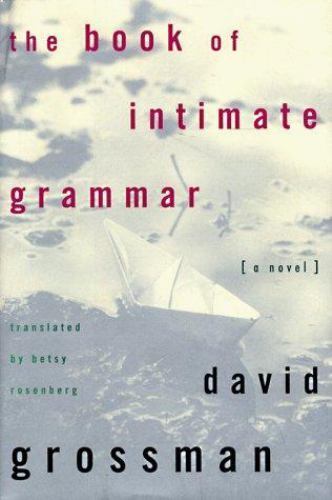
Synopsis:
David Grossman, the leading Israeli novelist of his generation, showed himself in his internationally acclaimed novel, See Under: LOVE, to be a consummate artist of the inner life of the child. Now, in his most moving and accessible novel yet, he gives us the story of the greatest and most universal tragedy, the loss of that childhood world. At twelve, Aron Kleinfeld is the ringleader among the boys in his Jerusalem neighborhood, their inspiration in dreaming up games and adventures. But as his friends begin to mature, Aron remains imprisoned for three long years in the body of a child. While Israel inches toward the Six-Day War, and while the voices of his friends change and become strange to him, Aron lives in his child body as though in a nightmare. Like a spy in enemy territory, he learns to decipher the internal codes of sexuality and desire, to understand the unyielding bureaucracy of the human body. Hurled between childhood and adulthood, between the pure and the profane, he is like a volcano of emotions and impulses. But, like his hero Houdini, Aron still struggles to escape from the trap of growing up.
His Native Coast gives the reader a provocative and moving story of two “pilgrimages,” one ending outside of the seeker’s geographical context, and the other in a return to it: one resulting in a glimpse of self-recognition, the other in what turns out to be a refusal of it.
The Book of Intimate Grammar is about the alchemy of childhood, which transforms loneliness and fear into creation, and about the struggle to emerge as an artist. Funny, painful, and passionate, it is a work of enormous intensity and beauty.
It’s the end of the workweek—yay! I hope the week has been kind to everyone, though the past few weeks have been quite hectic for me. I am still resolving a lot of issues at work. I am basically the only one keeping my unit afloat. I hope we receive a reprieve in the coming weeks. Also, I can’t believe how quickly time flies! We are nearly midway through the eighth month of the year. Time takes its natural course, with little regard for us. Nevertheless, I hope the first seven months of the year have been promising. As the year progresses, I hope everyone is given plenty of opportunities to grow and improve. With the weekend finally here, I hope everyone has a great one. It’s time to dress down and spend it resting from the rigors of a demanding career, pursuing your passions, completing household chores, spending time with loved ones, or simply relaxing. It is going to be another damp weekend here in the Philippines. I hope you’re all doing well—physically, mentally, and emotionally.
After four months of exploring European literature, I was finally able to conclude the journey, which I had originally planned to complete in just two months. It was just enough time to finish all the works by European writers in my reading challenges. Ironically, it was these very books that ultimately extended my literary adventure into a four-month journey. With my European literary adventure this year officially complete—the longest I have spent immersed in European literature in a single year—I have commenced a new literary journey. With July being my birth month, I decided to embark on a literary adventure into a territory closer to home: Asian literature. Apart from being part of the region, I have often dedicated July to the works of Japanese writers, as Japanese literature is one of my favorite literary traditions. As always, I have several works of Asian literature on my reading list. It was therefore a foregone conclusion that I would extend this journey into August.
Speaking of Japanese literature, I am quite excited about the news of Haruki Murakami’s latest novel. I am eagerly awaiting its English translation, as it promises to offer a different dimension of Murakami’s prose. My current read, however, takes me beyond Japan to a literary tradition that I have been trying to explore further. Over the past few years, I have also been venturing into the works of Israeli writers. It has not escaped my attention that my foray into Israeli and Hebrew literature remains quite sparse. In the past few years, I have come across several Israeli writers. Amos Oz was among them, and his body of work has since piqued my interest. Another Israeli writer whom I recently discovered is David Grossman. In 2023, I read his International Booker Prize-winning novel, A Horse Walks Into a Bar. It was quite an interesting work and a primer to Grossman’s oeuvre. However, I gained a better and deeper appreciation of Grossman’s prose with More Than My Life.
Three years since the first Grossman novel I read, I am now reading my third Grossman novel, The Book of Intimate Grammar. Interestingly, I was not planning on reading this novel. However, my Asian literary adventure has been too focused on the works of Japanese, Indian, and Filipino writers. With this in mind, I decided to read The Book of Intimate Grammar, a book I recently acquired, although I was not originally planning on reading it this year. Originally published in 1991 as ספר הדקדוק הפנימי (Sefer HaDikduk HaPenimi), the novel was made available to Anglophone readers in 1994 in a translation by Betsy Rosenberg. The story takes place in the neighborhood of Beit HaKerem, Jerusalem, in the 1960s, in the years leading up to the Six-Day War. Beit HaKerem was a poor housing project that housed scores of Eastern European refugees.
At the heart of the story is Aron Kleinfeld, who is eleven years old when the novel begins. He is the son of a Polish refugee father. He lives with his working-class parents and older sister. Aron is a sensitive and imaginative young boy. He is a great dreamer and the ringleader of escapades among his circle of friends, comprised primarily of neighborhood boys. His closest friend is Gideon, and together, they invent elaborate games and fantasies. It is through these games that they transform their ordinary surroundings into something mysterious and exciting. In particular, Aron is especially fascinated by Houdini. But Aron is approaching a stage of life that terrifies him: puberty. All around him, his friends are beginning to grow taller. Their voices are changing, and their bodies are developing.
As his friends physically develop, Aron remains physically small and childlike. His situation is exacerbated by his impending bar mitzvah, making him even more uncomfortable. A bar mitzvah marks the formal passage into Jewish adulthood. His mother, anxious about his apparent lack of physical development, tries to convince herself—and Aron—that he is growing. However, it is becoming increasingly palpable that he is not. Slowly, he is becoming a source of enduring shame for his parents. He is short, myopic, and scrawny and is incapable of growing into the seemly shape of manhood. However, Aron’s case is more complex than it seems. He is deeply resistant to the entire concept of growing up. He regards adults with a mixture of fascination, disgust, and incomprehension. The more he observes adults, the less attractive adulthood becomes.
Aron’s inability to mature mentally is also a source of shame among his friends. His school friends have also grown tired of his childish imagination. Will Aron mature? The Book of Intimate Grammar has an interesting premise. On the surface, it is a coming-of-age story. However, it is a coming-of-age story in reverse, as Aron is resistant to the idea of maturing, both physically and mentally. Still, his development and growth are among the facets of the book that I am looking forward to. Like his other works, the novel is rather dense, with long paragraphs. Nevertheless, I am looking forward to seeing how Aron develops. Houdini, it seems, is more than just a random childhood interest. It seems that the master of escapology is going to develop into a potent metaphor for Aron’s story. With the weekend here in the Philippines still expected to be damp, I am going to immerse myself in Aron’s story over a warm cup of coffee, perhaps. I am taking the book with me over the weekend, and I hope to finish it.
How about you, fellow reader? What book or books are you taking with you this weekend? I certainly hope you enjoy them. For now, I wish everyone a wonderful, restful weekend!

