Finding Her Voice: A Personal and Political Awakening
Forming the western third of the island of Hispaniola in the Caribbean Sea is a country with a colorful history. However, for most of us, the name Haiti rings a bell of familiarity mainly because of the adjective “poverty” that has come to define the nation. Starvation and destitution have led locals to consume mud cakes (Haitian Creole: bonbon tè), particularly during the 2008 financial crisis. Further, Haiti reached global consciousness because of the powerful 2010 earthquake that devastated the nation. While Haiti’s history is indeed riddled with several earthquakes, the 2010 earthquake was the most severe to strike the nation in two centuries. The earthquake resulted in the deaths of between 160,000 and 316,000 people. Around 1.6 million residents were also left homeless. This makes it one of the deadliest natural disasters ever recorded. But there is more to Haiti beyond this devastation and its reputation as the poster child for global poverty.
Before being charted by the renowned Italian navigator Christopher Columbus, the region was first called Quisqueya. The island was occupied by the Arawak and other Indigenous peoples. The Taíno, an Arawak group, became dominant, while the Ciboney were also prominent. Before being colonized, roughly a million Taíno and Ciboney people populated the island. When Columbus sighted Quisqueya on December 6, 1492, he named it La Isla Española (“The Spanish Island”), later Anglicized as Hispaniola. The arrival of the Spaniards was an ominous sign that marked the decline of the island’s Indigenous population. By the end of the 16th century, the group had virtually vanished. They were soon replaced by enslaved Africans. Tired of the exploitation and abuse inflicted by plantation owners, the enslaved fought for independence, and in 1804, Haiti separated from France, making it only the second country in the Americas to win independence from colonial rule; only the United States had gained its independence earlier.
Capturing the events that have characterized and shaped the nation’s contemporary history was the country’s arsenal of writers. Among them is Marie Vieux-Chauvet, a prominent voice in the realm of Haitian literature. Translator Myriam J. A. Chancy even considered her works to be “by far the best-known works by a Haitian woman novelist.” She is, however, relatively unknown outside the Caribbean. Born in Port-au-Prince to a father who was a Haitian ambassador and senator, Chauvet began writing at the age of ten. In the 1940s, Chauvet commenced her literary career by writing plays. While she was a prominent playwright, Chauvet was better known for her novels, some of which were controversial. In 1968, the publication of Amour, Colère et Folie (Love, Anger, Madness), a collected trilogy of short novels, sparked controversy. The book was censored, prompting Chauvet to go into exile in New York City.
Everywhere you looked, breasts barely covered by flimsy, see-through bodices attracted the delighted gaze of the men who, despite the horrendous heat of that summer morning, were dressed in velvet, with ruffled blouses, fitted coats, and vests. Beneath their curly wigs they were seating more than the slaves. What bliss for them, then, whenever the ladies played flirtatiously with their fans! The jewels adorning the toes of the mulatto women – whom a new law had banned from wearing proper shoes – just made them all the more fascinating and fascinating,
Marie Vieux-Chauvet, Dance on the Volcano
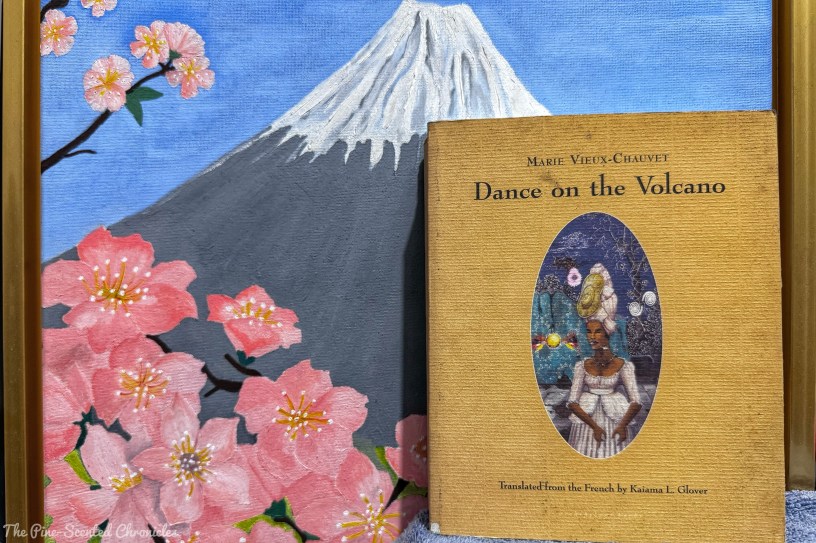
Among her renowned works is La Danse sur le volcan. Originally published in 1957, it is Chauvet’s sophomore novel and was translated into English in 2017. The novel is set in 1770s Haiti (then called Saint-Domingue) and follows a mulatto (mixed-race) girl named Minette, the novel’s pièce de résistance. She has a younger sister named Lise and a foster brother, Joseph. Their mother, Jasmine, a formerly enslaved woman, raised them. Despite being born into the lowest rungs of society, Minette is blessed with an exquisite and captivating singing talent; her sister is also gifted with a beautiful voice, although to a lesser extent. While on the streets of Port-au-Prince, Minette and Lise’s talent is discovered by their white Creole neighbor, Mademoiselle Acquaire. A music teacher, Mme Acquaire is awed by their raw talent and captivated by their voices.
Going against the prevailing taboos of the period, Mme Acquaire resolves to take on the sisters, becoming their mentor. Under the veil of secrecy, she mentors them in the early mornings. As Minette’s talent is trained and molded, it becomes increasingly evident that she belongs on the stage. After years of clandestine training, Minette and her mentor take a risky gamble. They trick the director of Port-au-Prince’s Comédie Theater into casting her in a production. Social laws bar people of color from performing on stage. Despite being only fourteen, Minette captivates the audience. She is a sensation, and her performance is an enormous success. The white audience applauds her and celebrates her talent. She cements her status as the first “colored” woman to sing on the white stage. An outright phenomenon, her initial success opens more opportunities for her to perform on stage.
Her apparent success on stage opens several doors. However, there are still doors that are not afforded to her. The novel then captures Minette’s numerous struggles as she seeks to become an accepted and successful stage singer. While she can entertain white society onstage with her voice, she remains excluded from many aspects of that same society once the performance is over and she steps down from the stage. She is admired, yet banned from the post-opera celebratory balls hosted by the same white patrons who have just given her standing ovations. She is continually exploited and often not paid for her performances. She is also barred from participating in certain concerts. There is no denying her talent. However, her color influences the entire conversation surrounding her art. Despite still being a teenager, her experiences as a performer illuminate the racial prejudices and social cruelties surrounding her. She becomes increasingly cognizant of the injustices surrounding her, particularly those rooted in race and skin color.
Minette’s social awakening is underscored by the revelation of the secrets of her mother’s past, marking a pivotal point in the story. Jasmine had been enslaved and had suffered beatings, branding, and sexual violence. This revelation makes Minette understand that her relative privilege is built upon a social system founded on slavery and racial exploitation, the vestiges of which persist in her time. The revelation profoundly changes her understanding of the world. Before learning about her mother’s past, Minette is preoccupied with her singing career and her ability to move within elite society. As she begins to understand the legacy underlying the society in which she moves, she begins to wish for a world that is more just. She begins to fight for her own rights, using her immense talent as leverage against the oppressive system. From being merely a singer, she transforms into a revolutionary, becoming involved in efforts to rescue enslaved people.
She looked at him. Despite his violent attitude there was something charming – both infantile and cruel – emanating from him. In pronouncing those last words, he had bitten his lip and his beautiful teeth were like a white stain on his dark mouth. “I hate the Whites as much as the Blacks. The former despise me and the latter debase me. I hate the female slave that was my mother –
Marie Vieux-Chauvet, Dance on the Volcano
Minette’s meteoric rise to opera stardom is juxtaposed against the titular volcano. Her mother’s past is a testament to Haiti’s cruel history. As it is slowly peeled back, Jasmine’s story reveals the fault lines beneath the surface. Beneath the apparent calm, tensions simmer. Her story also underscores Saint-Domingue’s colonial history. Hispaniola, the island on which Saint-Domingue was located, was among the earliest sites of European colonization in the Americas. The Spanish subjected the Indigenous population to forced labor, while diseases introduced by Europeans decimated communities that had no immunity to them. As the Indigenous population dwindled, the Spanish began importing enslaved Africans during the sixteenth century, initiating Hispaniola’s long and brutal history of African slavery. By the eighteenth century, Saint-Domingue had developed into a plantation slave society in which enslaved Africans constituted the overwhelming majority of the population.
Slavery is thus the fundamental social institution underlying the novel. Chauvet exposes how the institution dehumanized people by reducing them to property. They are denied basic dignity and autonomy. It was brutal for men and even more so for women. In Dance on the Volcano, Chauvet vividly examines the female experience during colonial oppression. Jasmine’s history of enslavement illustrates this intersection of racial and gender oppression. It has left deep scars on her, memories she kept from her daughters. The sexual violence she experienced captures the covert yet intrinsic sexual relationships between masters and enslaved women. This, interestingly, created Haiti’s mixed-race population and, consequently, led to the development of its color-based caste system. Through her mother’s story, Minette begins to confront the realities underlying the society in which she was raised.
Race and color are equally central to that society. Saint-Domingue’s rigid hierarchy placed white planters at the top, followed by poor whites and free people of color, while enslaved Africans occupied the lowest rung. Enormous inequities separated each level. Yet even this hierarchy was more complicated than a simple division between whites and Blacks. While free people of color and people of mixed race were afforded certain privileges, they were still barred from accessing certain spheres of white society. They were often treated worse than poor white people. Minette’s own experiences as a performer expose these contradictions. Jean-Baptiste Lapointe, Minette’s romantic interest, embodies another contradiction within this system. A wealthy free Black man, he is himself constrained by racial prejudice. He was also a slave owner who used violence to maintain his authority. Lapointe’s position demonstrates how people who suffered under colonial racial hierarchies could nevertheless participate in the exploitation of others.
Minette’s opposition to his treatment of his slaves introduces a moral and political conflict into their relationship. Their romance is consequently more than a love story; it becomes a confrontation between personal affection and opposing views of justice. Minette’s success further exposes the hypocrisy of the society around her. The governor protects her because of her exceptional talent, yet that protection does not translate into broader acceptance for people of color. Her privileged position is therefore both remarkable and precarious. She can cross boundaries that remain firmly closed to others, but only because those in power have chosen to make an exception for her. Through Minette’s experiences, Chauvet demonstrates how colonial society could celebrate Black and mixed-race talent while simultaneously maintaining the structures that oppressed the people from whom that talent emerged.
Don’t I know it… But I’m not so keen on exposing you… Your talent in the eyes of the white world is useful to us, in a sense. You don’t think so, huh? Well, it’s true. There are lot of things – both big and small – that can lead to the same goals… If I’ve never thanked you for singing so beautifully, let me do that here today.
Marie Vieux-Chauvet, Dance on the Volcano
These contradictions gradually transform Minette. Her awakening is personal, sexual, and political, as her growing awareness of racial inequality forces her to reconsider the world she once knew. From a young girl fascinated by music and performance, her prodigious success exposed her to the realities of her race, piercing the veil of innocence that had enveloped her. The more she learns about the lives of enslaved people and the restrictions imposed on people of color, the less willing she becomes to accept the status quo. Her artistic success then provides her a vantage point from which to recognize the realities surrounding her. She begins helping those seeking freedom and becomes increasingly committed to emancipation. Her journey from a gifted young performer to a politically conscious woman mirrors the broader unrest building throughout Saint-Domingue.
The novel’s title is aptly derived from the French idiom danser sur un volcan, an expression describing the act of remaining oblivious to imminent danger. It was the position that Minette started from. The metaphor also captures the atmosphere of Saint-Domingue perfectly. Beneath its apparent order were simmering grievances over slavery, race, class, and political power. Yet Chauvet extends this examination beyond the colonial racial hierarchy to the position of women. Lise and the other women in the novel have limited control over their lives, while women of color contend with the additional burden of racial discrimination. Their experiences reveal how oppression operated along several intersecting lines, making gender inseparable from questions of race and class. Minette’s story consequently serves as a precursor to the Haitian Revolution. The personal awakening of a young woman unfolds alongside the growing unrest of an entire society, culminating in the collapse of the colonial order.
This is what gives Dance on the Volcano much of its enduring power. Written and published on the eve of François “Papa Doc” Duvalier’s dictatorship, the novel looks backward to colonial Haiti while quietly reflecting the political anxieties of Chauvet’s own time. History, in her hands, is not safely confined to the past. The structures of domination may change, but the inequalities and abuses they produce can persist in new forms. Minette’s journey therefore transcends time and place. She refuses to remain silent, confronting the world around her with an increasingly critical eye. The novel vividly captures her transformation from a gifted performer into a figure of resistance. Like the volcano beneath the novel’s title, her awakening begins beneath the surface—quietly, gradually, and with increasing force—until remaining still is no longer possible. Chauvet’s novel reminds us that every revolution begins long before the moment of eruption: it begins when people dare to question why the world must remain the way it is.
Once the curtain had fallen, she applauded along with the others, her face impassive and very dignified. She, too, had performed in that play. She, too, had sung those melodies, made those gestures, worn those costumes. That same public had cheered her, raised her up, and called her “Mademoiselle” – and recently, at that. They had forgotten her already – already replaced her, relegated her to the shadows out of which she had emerged only by unhoped-for luck. She finally understood: never again would she climb back up the hill, get back on that pedestal where the most randbom providence had placed her.
Marie Vieux-Chauvet, Dance on the Volcano
Book Specs
Author: Marie Vieux-Chauvet
Translator (From French): Kaiama L. Glover
Publisher: Archipelago Books
Publishing Date: 2016 (1957)
No. of Pages: 492
Genre: Historical, Literary
Synopsis
Set in late 18th-century Haiti, Dance on the Volcano follows the extraordinary career of Minette, a singer whose prodigious voice enables her to cross racial barriers. Her talent brings her an opportunity to perform at the Theater of Port-au-Prince, an honor previously reserved for Whites. Once the curtain falls, however, she finds herself back to life as normal. Torn between her passion for the stage, her horror at the racial discrimination she faces, and her love for a free black man who treats his slaves as cruelly as white landholders, Minette’s tumult mirrors the volatile condition of the colony. Praised but unpaid, applauded but shut out, Minette develops a political and racial conscience that will not let her rest as long as slavery exists on the island and which fuels her relationship with Rigaud, Pétion, and Beauvais, the future heroes of the revolution. Kaiama L. Grover’s masterful translation brings to light this stunning novel of the Haitian revolution.
About the Author
Marie Vieux-Chauvet was born on September 16, 1916, in Port-au-Prince, Haiti. Her father was a Haitian ambassador and senator, while her mother was of Jewish West Indian descent. Her early years were spent under the United States occupation of Haiti. Her father, a member of the Haitian anti-occupation group Union Patriotique and editor of the anti-occupation periodical Le Courier Haitien, provided her with a political education. At the age of ten, Chauvet began writing, and by twelve, she had started writing plays. She eventually attended the Annexe de l’École normale d’institutrices (Annex of the Upper School for Teachers), an institution that trained primary school teachers. After earning her teaching certificate, she married physician Aymon Charlier. They later divorced after having two daughters. She subsequently married travel agent Pierre Chauvet, with whom she had a son, Pierre.
The 1940s marked a pivotal period in Chauvet’s literary career. She wrote two plays, La Légende des fleurs (The Flowers’ Tale) and Samba. The former was published under the pseudonym Colibri (Hummingbird) sometime between 1947 and 1949, while the latter remained unpublished but was first staged in 1948. In 1954, she wrote the short story Ti-Moune nan bois (Child in the Woods). That same year, she published her first novel, Fille d’Haiti (Daughter of Haiti), which won the 1954 Alliance Française Prize. Her sophomore novel, La Danse sur le volcan (Dance on the Volcano), followed in 1957. Her third novel, Fonds-des-Nègres (1960; Negro Bottom), won the France-Antilles Prize that same year. Chauvet was also actively involved in Haiti’s literary circles as a member of the literary group Haïti Littéraire. She later joined the collective les araignées du soir (The Spiders of the Night). During this period, she wrote fiercely against the oppression of François “Papa Doc” Duvalier’s regime.
In the Anglophone literary context, Vieux-Chauvet is perhaps best known for her trilogy of novellas, Amour, colère et folie (Love, Anger, Madness), originally published in 1968. The trilogy was published by the French publishing house Gallimard with the support of Simone de Beauvoir, with whom Vieux-Chauvet maintained a friendship and correspondence for years. The work, however, sparked controversy in her native Haiti. Haitian critics met it with disdain, although the reasons for their reaction were ambiguous. The trilogy was subsequently censored and withdrawn from circulation. Following its suppression, Vieux-Chauvet faced threats from Duvalier’s regime, prompting her to go into exile in New York City. She eventually died there on June 19, 1973, from a brain tumor. Her fifth book, Les Rapaces (Birds of Prey), was published posthumously in 1986.

