The Burden of Being the One Who Remains
Nestled on the eastern section of the geopolitically critical Balkan Peninsula is the Republic of Bulgaria. Founded in the seventh century, Bulgaria is one of Europe’s oldest states. Present-day Bulgaria was settled as early as 6,500 BC, with the Karanovo culture among the earliest societies occupying the area. Before achieving stability under the Roman Empire, the region was a battleground for ancient Thracians, Persians, Celts, and Macedonians. It was conquered by the Roman Empire in 45 AD. However, following the division of the Roman Empire, tribal invasions resumed. Around the sixth century, these territories were settled by the early Slavs. From the lands of Old Great Bulgaria, the Asparuh-led Bulgars invaded the region, then the Balkans in the late 7th century. They established the First Bulgarian Empire. Significantly influencing Slavic cultures by developing the Cyrillic script, the Empire dominated most of the Balkans until it was conquered and dismantled by the Byzantine Empire.
Bulgarian statehood was restored in 1185 following a successful revolt against Byzantine rule, which established the Second Bulgarian Empire. Despite periods of prosperity, internal strife and prolonged warfare weakened the empire, leaving it vulnerable to Ottoman expansion. By 1396, Bulgaria had fallen under Ottoman rule, which lasted nearly five centuries. The decline of Ottoman power in the nineteenth century paved the way for Bulgarian independence. Following the Russo-Turkish War of 1877–1878, a Bulgarian state was reestablished, and the country declared full independence in 1908. However, territorial disputes and irredentist ambitions fueled conflicts with neighboring states. Bulgaria’s political trajectory shifted again in 1946, when it became a socialist republic aligned with the Soviet Union. The revolutions of 1989 brought an end to Communist Party rule and ushered in a transition to democracy. Bulgaria subsequently joined the European Union in 2007.
Bulgarian literature emerged during the First Bulgarian Empire, building on centuries of oral storytelling and epic singing. The development of Slavic literacy fostered a written literary tradition, although Ottoman rule later disrupted its growth and shaped a distinct cultural trajectory. Despite these challenges, literary activity gradually revived. In the seventeenth century, Petar Bogdan Bakshev contributed to this resurgence through his historical writings. The eighteenth century brought renewed momentum through works such as Paisius of Hilendar’s Istoriya Slavyanobolgarskaya and Sophronius of Vratsa’s Life and Sufferings of Sinful Sophronius. These writings helped strengthen Bulgarian cultural identity and laid the groundwork for the National Revival, during which literature became an important vehicle for national consciousness and cultural preservation.
Truth or dare? Back then, we thought the weaker always chose truth because they were afraid of being bold. I realize now that picking truth was always the braver choice. Dare was for the liars, the cowards who masked themselves behind their bravery…I thought that if I changed my name I’d be able to somehow change the past. But this is yet another delusion people have about life, and I fell into that trap. We remain еnslaved by our real names and actions. To the very end.
Rene Karabash, She Who Remains
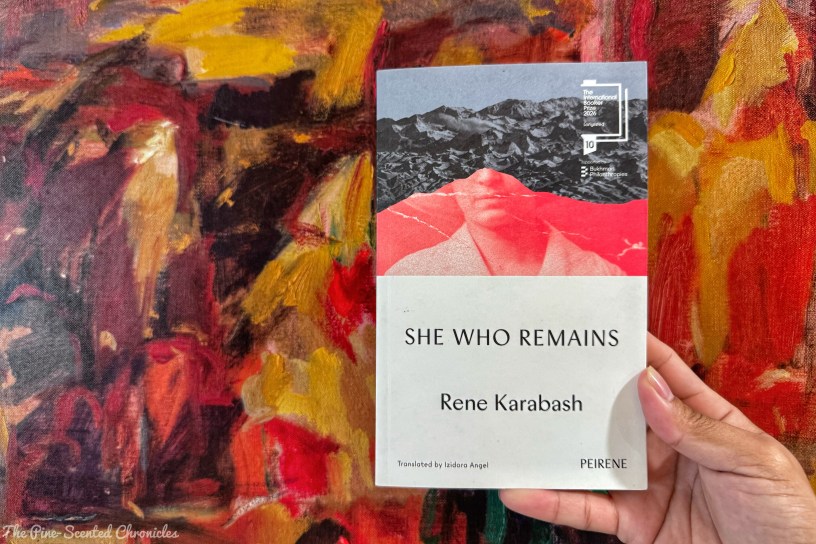
The emergence of a new generation of Bulgarian writers has helped secure the future of Bulgarian literature. Among them is René Karabash. Born Irena Hristova Ivanova (Ирена Христова Иванова), Karabash is a prolific writer whose work has earned acclaim in Bulgaria. She made her fiction debut in 2018 with Остайница (Ostaynitsa), which was later translated into English as She Who Remains. The novel, however, is set in a different Balkan country: Albania. At the heart of the story is Bekija, a young girl born and raised in a remote village in the Accursed Mountains. She lives with her parents and younger brother, Sále. Their father, Murash, is a pigeon keeper. Bekija was originally one half of a pair of twins, a boy and a girl, carried by her mother. However, as the birth approached, the male fetus mysteriously disappeared. Murash, who desperately wanted a son, was disappointed and barely acknowledged his daughter.
A year after Bekija’s birth, Murash’s wife gave birth to Sále. However, he failed to live up to their father’s expectations, as he was considered weak and effeminate. Murash’s disappointment only fueled Bekija’s determination to excel at men’s work. Yearning for her father’s approval, she behaved like a tomboy, earning the nickname “daddy’s boy.” This led Murash to favor her over his son. Nevertheless, Bekija lived under the constant threat of her father’s volatile temper. Her predicament was compounded by his adherence to the Kanun of Lekë Dukagjini, a customary legal code that governed much of the region. Traditionally attributed to the fifteenth-century Albanian prince Lekë Dukagjini, the Kanun developed into a system of customary laws that held particular sway in the mountainous north, where state authority was often limited. Despite the passage of time, some rural communities continue to observe its traditions.
Bekija’s life began to unravel when she entered adolescence. One summer, she fell in love with Dhana, the granddaughter of a neighbor who had come to visit from Bulgaria. Their bond deepened in the seclusion of the local water mill, where Dhana read books to Bekija, who was illiterate. What began as an innocent friendship eventually blossomed into an intimate relationship. However, adolescence also meant that Bekija had reached marrying age. Without consulting his daughter or wife, Murash arranged her marriage to Nemanja, the son of another neighbor. Neither Bekija nor her mother had a say in the arrangement, and their objections would have carried little weight even if they had been consulted. Beyond Bekija’s horror at the prospect of the marriage, the arrangement presented a potentially fatal danger. Under the custom described in the novel, a bride carries a bullet in the pocket of her wedding dress when she goes to live with her husband. If she is found not to be a virgin, the groom is expected to kill her with the bullet.
The betrothal thus becomes a virtual death sentence for Bekija, leaving her with an impossible choice. With no apparent alternative, she turns to the Kanun itself, seeking an escape from a loveless arranged marriage that threatens her life. The customary code allows a woman to become a burrnesha, or sworn virgin, assuming a socially recognized male identity and the rights and responsibilities associated with it. This entails a lifelong vow of celibacy and a renunciation of the conventional social role assigned to women. Although this decision cancels the wedding, it comes at a steep price. Bekija’s choice sets in motion a series of extraordinary events that threaten to tear her family apart. By breaking the marriage arrangement, she also brings dishonor upon Nemanja’s family, triggering a blood feud.
around here a woman’s worth is measured in oxen, don’t look men in the eye, don’t go to the pub, mind the children, wash the clothes, cook, the most a woman can hope for is to bring the milk to the dairy, Bekija’s murder is the smartest thing I ever did, they gave me a shotgun and a watch, now I can smoke and drink and move with the men, go to the pub and visit the men’s social clubs, they teach me to stand like them, legs apart
Rene Karabash, She Who Remains
In writing her debut novel, Karabash drew inspiration from renowned Albanian writer Ismail Kadare’s Broken April. She also conducted interviews with sworn virgins to inform her work. Interestingly, the novel itself is framed as a story within a story. Following her invocation of the Kanun, Bekija embraces a male social identity, cutting her hair, burning her dresses, and taking an oath before the village elders. She also adopts a new name, Matija, and assumes a new identity. After the blood feud is settled, Matija spends the next sixteen years living in isolation at the family home. His only companions are his cow, Nura, and his father’s pigeons. This solitary existence is disrupted by the arrival of a journalist carrying a tape recorder. The journalist has come to interview the person believed to be the last surviving sworn virgin. As Matija recounts his story, he is forced to confront his past.
She Who Remains explores the forces that shape Bekija’s development from childhood to adolescence and adulthood. Through her story, Karabash exposes the harsh realities women face in deeply patriarchal societies, where their voices are often silenced and their lives dictated by men. Bekija grows up under the weight of her father’s expectations, compounded by his disappointment at not having a suitable male heir. In a society where sons are expected to carry on the family name, she learns that earning her father’s approval means excelling at tasks traditionally reserved for men. Yet, despite her efforts, she can never fully meet his expectations. In her father’s eyes, she remains a woman, a status that limits her worth in a world that privileges men.
Gender roles and societal expectations are thus central to Bekija’s story. The norms instilled in her from childhood shape her understanding of herself, restricting not only who she can become but also whom she can love. Her family reinforces these limitations, with the domineering Murash embodying the patriarchal authority that governs their household. The novel also examines how trauma shapes one’s sense of self, often exposing uncomfortable truths about both personal identity and the world one inhabits. Equally significant is the question of bodily autonomy. Raised in a society that dictates her future, Bekija has little control over her choices, her relationships, or even her own body.
Karabash further explores the complexities of love, desire, and forbidden relationships in a community where personal feelings clash with established customs. The relationship between Bekija and Dhana illustrates how genuine emotional connections can be constrained by social conventions. Tradition, meanwhile, permeates every aspect of Bekija’s life. The Kanun dictates expectations surrounding gender, family obligations, honor, and social conduct, shaping her fate from an early age. Under such a system, tradition becomes an instrument of control, with conformity prized over personal autonomy. Those who challenge established norms risk rejection, punishment, and even violence.
a little boy who’s worth more than twenty oxen, which is how much I’m worth, because he is a man, a real man now, whom would they believe, him or me, what do you think, there’s no point in telling anyone, I stand up and lean over the milk, I splash my face with it, splash where the red is too, pink runs down my thighs, I tighten my braid, smooth my hair back
Rene Karabash, She Who Remains
As Bekija and Dhana’s relationship deepens, their love becomes an act of defiance against a system that has long suppressed women’s desires. For Bekija, it represents an assertion of her right to love and to claim ownership of her own life. Ironically, she must invoke the very tradition that constrains her to escape its restrictions. Yet her choice comes at a steep price, and the consequences gradually unfold as the story progresses. As the people around her disappear, Bekija becomes the one who remains. Figuratively, however, she also disappears, having to erase parts of herself to assume a new identity. Her transformation raises a fundamental question: in adopting a male social role, does Bekija achieve the liberation she longs for, or does her experience merely expose how severely a patriarchal society restricts women’s choices?
She Who Remains, however, is more than a condemnation of the Kanun. Karabash’s critique extends beyond Albania, exposing patriarchal structures that constrain women’s lives across cultures. Having grown up in Aleksandrovo, a village in Bulgaria’s Lovech Province, where patriarchal norms were deeply ingrained, Karabash brings a broader cultural perspective to Bekija’s story. The novel’s concerns transcend geographical and temporal boundaries, resonating in a world still grappling with questions of gender identity and personal freedom. The tension between tradition and progress remains a recurring concern in contemporary literature. By illustrating the devastating consequences of silencing dissent and punishing those who challenge established norms, Karabash reminds readers that identity is not always freely chosen but is often negotiated under societal pressures and circumstances beyond one’s control.
Karabash weaves these elements into a lyrical and haunting narrative. Through her poetic, hypnotic prose and stream-of-consciousness narration, she draws readers into Bekija’s world, confronting them with the uncomfortable realities women continue to face in patriarchal societies. Deceptively slender, She Who Remains explores the weight of tradition, the search for identity, and the enduring effects of trauma. At its heart, Bekija’s story is one of survival. By assuming a new identity, she escapes the restrictions imposed on women by the Kanun, but her survival comes at the cost of living openly as herself and losing those closest to her. Ultimately, She Who Remains is a brief yet memorable meditation on forbidden love, identity, and the burdens of societal expectations. Bekija’s tragedy lies in the freedom she can only attain through self-erasure, a sobering reminder that when society denies individuals the right to determine their own destinies, survival itself can come at the expense of the self.
the bus stops at the corroded bus stop, my stop, I try to get off the bus but like in a dream my body resists, the same way it does when you try to run from something, it doesn’t want to move forward together with me, it lags, turns the bus around, I want to scream, but what am I supposed to answer when they ask, where to, ma’am, to nowhere, where I belong, I get off, the door closes behind me, the Albanian air ruffles my hair, I must resemble a donkey in this dress and these shoes, I take off the patent-leather shoes and throw them in the field, they fly off like birds in the sky, then fall, one after the other
Rene Karabash, She Who Remains
Book Specs
Author: Rene Karabash
Translator (from Bulgarian): Izidora Angel
Publisher: Peirene Press Ltd.
Publishing Date: 2026 (2018)
No. of Pages: 155
Genre: Historical, Romance, Literary
Synopsis
High in the Accursed Mountains, in a village ruled by the ancient laws of the Kanun, Bekija escapes an arranged marriage by becoming a sworn virgin, renouncing her womanhood to live as a man. Her decision sets off a brutal chain of events, destroying her family and separating her from the one she loves most. Years later, as Bekija – now Matja – tells their story to a visiting journalist, long-buried truths come to light, along with the realization of all that might have been.
About the Author
Rene Karabash was born Irena Hristova Ivanova (Ирена Христова Иванова) on July 8,1989, in Aleksandrovo, Lovech Municipality, Bulgaria. She finished her schooling at Exarch Joseph I in Lovech. She then earned a bachelor’s degree in applied linguistics with English and French from the University of Veliko Tarnovo. She traveled to France to study literature at the Catholic University of the West in Angers. She then returned to Bulgaria to pursue a master’s degree in directing at the New Bulgarian University. She then adopted the pseudonym Rene Karabash, a combination of her mother’s maiden name and “Renée”, a nickname she acquired in France.
Karabash started exploring poetry early. Her earliest verses were written during her school days. In 2014, she published Хлъбоци и пеперуди (Halbotsi i peperudi; trans. Hips and Butterflies). A critical success, it was nominated for the Ivan Nikolov National Poetry Award. Her other compilations of poetry include 3/4 Lyubov (2019; 3/4 Love), Bratovchedkata na Zorbas (2020; Zorbas’s Cousin), and Nyakoy me vika po ime (2026; Someone Is Calling My Name). Among her other literary creations is a short prose piece in the epistolary tradition, titled Pisma na Omar do badeshtata mu sapruga (2021; Omar’s Letters to His Future Wife). In 2018, Karabash released her debut novel, Остайница (Ostaynitsa). It was a critical success, earning Karabash the 2019 Elias Canetti Prize, Bulgaria’s most prestigious literary award. It was translated into English as She Who Remains, which was then shortlisted for the 2026 International Booker Prize.
Beyond her writing endeavors, Karabash is also an actress. Her debut film appearance came in 2016, when she performed the role of Gana in the film Godless. For her performance, she won the Best Actress award at the Locarno Film Festival. She also won the award for Best Actress at the Stockholm Film Festival, the Heart of Sarajevo, and the Golden Rose. She has been actively involved with theater as well, and has even directed adaptations of the novels Les Yeux bleus cheveux noirs (1986; Blue Eyes, Black Hair) by Marguerite Duras and The Picture of Dorian Gray (1891) by Oscar Wilde. She also founded Zaeshka Dupka (Rabbit Hole), a creative writing academy and entrepreneurial venture that offers courses to aspiring writers who are trained and guided by acclaimed Bulgarian authors such as Georgi Gospodinov, Georgi Bardarov, and Victoria Beshliiska.

