The Magic of Female Solidarity
Magic has been deeply embedded in our society and history. Its application has been traced to the earliest civilizations. In Ancient Mesopotamia, magic was invoked in many kinds of rituals and medical formulae, and used to counteract evil omens and defend against demons, ghosts, and evil sorcerers. In Ancient Egypt, magic was personified as the god Heka, underscoring its integral role in Egyptian religion and culture. Ancient Egyptians used magic to manifest things. Ancient Egyptians adhered to heka, whose main principle is rooted in the power of words to bring things into being. Magical spells permeate Ancient Egypt. Among the earliest forms of magical spells were encrypted into the interior walls of the pyramid of Unas, the final pharaoh of the Egyptian Fifth Dynasty. Referred to as Pyramid Texts, these inscriptions are spells needed by the pharaoh in order to survive in the afterlife. King Unas’ funerary texts eventually birthed the tradition of placing the Book of the Dead in coffins or burial chambers.
These ancient funerary texts consist of magic spells intended to assist a dead person’s journey through the Duat, or underworld, and into the afterlife. Over time, however, magic started to take on a negative connotation. During the late sixth and early fifth centuries BCE, the Persian maguš was Graecicized and introduced into the ancient Greek language as μάγος and μαγεία. This transformed the word’s original meaning. It then gained negative connotations, with the magos being regarded as a charlatan whose ritual practices were fraudulent, strange, unconventional, and dangerous. It did not take long before fear was attached to magic. Societies have become concerned with magic, sorcery, divination, and other forms of arcane knowledge. The advent of organized religion further raised concerns around magic. Magic, which was once used to ward off evil, has become synonymous with the devil.
This ambivalence toward magic has always existed. Punishment for malevolent magic is addressed in the earliest law codes, preserved in both ancient Egypt and Babylonia, where magic played a conspicuous cultural role. This ambivalence only grew during the Medieval period, particularly after Europe’s conversion to Christianity. Magic was strongly identified with paganism. This was weaponized by Christian missionaries, using it to demonize the religious beliefs of Celtic, Germanic, and Scandinavian peoples. It was also during the Medieval period that witch hunts, or witch purges, began, with systemic persecutions emerging in the 13th and 14th centuries. This only intensified between the 15th and 17th centuries. Among the most renowned witch hunts are the Salem witch trials, a series of prosecutions for alleged witchcraft in colonial Massachusetts between February 1692 and May 1693.
I saw the mound with its gallows dripping with rain. I saw a servant girl drown her newborn in secret. I saw the sand of the execution place absorb the blood from the beheading. I saw a breastbone at the bottom of a tub of ale. I saw a goldsmith melt down stolen goods. I saw two children freeze to death on the street. I saw the ships come in with oranges, marzipan and blue raisins. I saw resentments old and new, saw pearls as on a string be spilled upon the cobbles.
Olva Ravn, The Wax Child
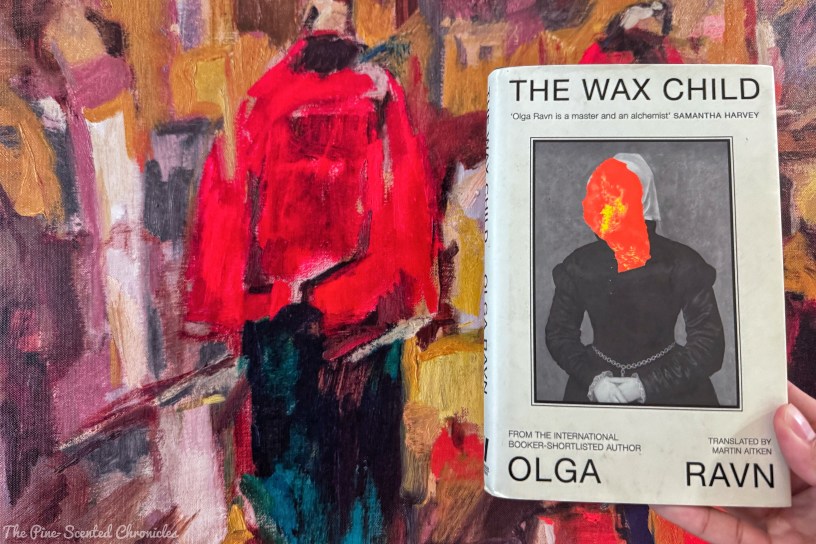
An alleged witch is also at the heart of Olga Ravn’s latest novel, The Wax Child. Originally published in 2023 as Voksbarnet, The Wax Child transports readers to 17th-century Denmark. The spiritual guide to the story is the titular wax child, a small human effigy made from beeswax. It is the creation of Christenze Kruckow, an unmarried noblewoman. Christenze created the doll by melting beeswax and incorporating hair and fingernail clippings. She carries the wax child beneath her arm for forty weeks, treating it, for all intents and purposes, almost like a child. She diligently shapes it as if breathing life into it. The wax child then observes its creator’s life and listens to the townspeople’s whispers. Meanwhile, Christenze, despite having noble blood, possessed no fortune. As such, she had long been part of the household of the wealthy Anne Bille and her husband, serving as Anne’s companion. Their home was a manor house at Nakkebølle Fjord on Funen, Denmark’s third-largest island.
For the longest time, Anne wanted to be a mother. However, she experienced repeated tragedies. She suffered numerous losses—stillbirths and infants who died shortly after birth. She could not understand her misfortune. By the age of thirty-two, she had lost fifteen children. Christenze, meanwhile, remained unmarried. She was also a subject of envy and controversy, particularly because of her unconventional lifestyle, “preferring to horse-ride on her own and drink red wine and read letters well into the night.” In desperation, Anne turned to Christenze for help. Christenze obliged by concealing a spider in sheep’s milk. Anne fed it to the baby, and the infant survived. However, when Anne saw the spider crawl out of the baby’s mouth, she panicked and accidentally dropped the infant onto the stone floor, killing it.
As time passed, Anne became convinced that Christenze was the source of her misfortunes. Drowning in her misery, Anne began resenting Christenze’s independence and contentment, two luxuries not afforded to her. Christenze’s refusal to conform to traditional gender norms led the townspeople to suspect that she practiced witchcraft. Christenze, however, was not overly concerned by the rumors. She believed that her noble status would protect her. However, the increasingly bitter Anne, driven by shame and grief, identified Christenze as a devilish spell-caster responsible for her tragedies. Christenze became associated with the children’s deaths. Like Christenze, a servant named Ousse Lauritzens was accused of witchcraft. Anne had Ousse chained and tortured until Ousse confessed, under duress, that Christenze was responsible for her children’s deaths.
Eiler Brokkenhuus, Anne’s husband, took the accusation to court. Christenze vehemently denied the accusations, responding in writing and rejecting the charge of witchcraft. She also reminded Anne of their friendship, while hinting that a doctor had once explained the deaths of the infants. Although there was no credible evidence against her, the accusation became increasingly difficult to escape. Christenze managed to flee to Aalborg, where she met Maren Kneppis, with whom she developed an intimate relationship. Maren then introduced Christenze to a circle of women who gathered to work, talk, exchange remedies, tell stories, and practice folk rituals while also indulging in the domestic pleasures of spinning wool and carding. Among them were Apelone Ibsdatter and Dorte Kjærulf, a one-eyed widow. This newfound community gave Christenze a sense of belonging that she had never experienced among the nobility.
They consulted their books of demonology, and there read: The woman is more easily tempted by Satan, for she is weaker than the man in both body and soul. And they read: The woman is a wicked and imperfect animal. When a woman weeps she weaves snares, and labors to deceive a man. And they read: When a woman thinks alone, she thinks evil. She is not capable of good thoughts. And they read: The woman is feebler than the man and more easily charmed by the Devil.
Olva Ravn, The Wax Child
What the women considered normal and harmless practices, however, appeared unusual to the general public and the uninitiated. Their rituals were interpreted as evidence of witchcraft. Interestingly, the novel is interspersed with spells taken directly from black books and grimoires. The authorities turned the women’s traditional knowledge of magic into incriminating evidence. As the adage goes, people fear what they do not understand. The situation further deteriorated as rumors spread through Aalborg. Fear and paranoia made the locals suspicious of anything that deviated from the norm. The allegations were amplified by accusations from respected members of the community, such as Pastor David Klyne. Before long, the authorities of King Christian IV began investigating Christenze and her companions.
The Wax Child is inspired by the condemnation and execution of four Danish women in the early seventeenth century. They were alleged to have been part of a “society of witches in North Jutland.” While the other three women were burned at the stake, Christenze was instead decapitated because of her noble status, making her the only member of the Danish nobility ever condemned to death as a witch. Between 1617 and 1625, Denmark burned a “witch” every five days. The period was marked by heightened paranoia surrounding witchcraft, which had become part and parcel of 17th-century life. It was as much a part of daily life as Christianity, albeit in clandestine ways.
Meanwhile, King Christian IV intensified his campaign against witchcraft. He urged citizens to report suspected witches to the authorities and escalated prosecutions against the accused. It was no surprise that most of those condemned were women. Therein lies the crux of the witch trials: women. Women were the most threatening magic of them all, particularly women like Christenze. These were women who refused to be shackled to the ground or conform to society’s expectations. Christenze’s freedom earned the ire of the community, including her fellow women. She was the subject of envy and gossip even though she was simply living her life as she pleased. She acted in ways that were not expected of her gender, from drinking alcohol to riding horses on her own. While she was not harming anyone, her unconventional lifestyle and autonomy offended those around her, including her friend Anne.
Christenze’s experience illustrates how patriarchal expectations can turn ordinary forms of independence into acts of defiance. Women were expected to settle down, marry, bear children, and devote themselves to their husbands and households. The expectation to become a mother weighed heavily on Anne, whose existence was shaped by her desire to have a child. In contrast, Christenze had chosen a different path. Her refusal to conform made her controversial, and ultimately made her vulnerable. A woman by herself was enough to stir the pot; what more if women gathered together? It is when strong and capable women come together that they gain strength. For a weak patriarchy, women working together and defying cultural and social norms constitute the most threatening magic of all.
Jutland – the land itself a wax child, filled with horn and hair, with human remains, human tools, flutes and whistles carved in bone, and the wind became audible unto itself as it passed through them. In the dungeon Dorte whistled too. They took turns to sit by the door, where outside air might waft the face and be breathed, and Dorte whistled in reply to the howl of the wind. She thought about a marzipan mouth that had lain among others on a dish at the grocer’s store, and smacked her lips to recall it, then turned to the others and said, I will get out of here, I have a plan, my son-in-law will come to my rescue, I cannot imagine otherwise.
Olva Ravn, The Wax Child
Ravn vividly depicts men’s role in suppressing women’s voices. King Christian IV’s campaign against witchcraft was motivated by religion as well as the perceived threat posed by those who challenged established gender roles. Women were also subjected to abuse within their homes, as exemplified by Elisabeth, the pastor’s troubled wife. These realities extend beyond the historical setting of the novel. Women continue to be constrained by social expectations, while patriarchal structures remain pervasive. This makes Christenze the perfect tragic center. She is noble and educated and remains composed throughout the adversity she faces. She had the misfortune of having someone decide that her existence was inconvenient. “When there are so many women together it can only be in devilish pursuits,” one character surmises. The statement captures the novel’s underlying anxiety: women who gather, exchange knowledge, and support one another can challenge structures built on their isolation.
Ravn, however, does not sensationalize Christenze or her tragedy. Rather, she studies her. She possesses a charisma that elicits rumors. Yet despite the darkness that looms over the story, The Wax Child vividly captures the intricacies of female camaraderie. When motherhood is used as a moral yardstick, women are set against one another, as seen in Anne’s scathing allegations against Christenze and her resentment of Christenze’s independence. Meanwhile, Christenze finds companionship in Maren and her circle of friends. Their gatherings become a space where the women can exchange knowledge, perform domestic tasks, share spells and stories, and form bonds largely denied to them elsewhere. Christenze develops a deep bond with Maren, finding within their community a rare sense of fellowship, love, and solidarity.
While The Wax Child is rooted in the history of witch hunts, Olga Ravn reaches beyond the seventeenth century to examine the enduring consequences of a society that fears women who refuse to conform. Christenze’s independence, intelligence, and refusal to submit to conventional expectations make her a threat. Her persecution reveals how easily fear, envy, grief, and superstition can be transformed into instruments of control. Yet Ravn also offers a counterpoint to this hostility in the community Christenze finds among Maren and the other women. Their friendship and shared knowledge become acts of solidarity in a world determined to silence them. In this sense, the novel’s most potent magic is not found in spells or grimoires, but in women’s ability to find strength in one another. Haunting, lyrical, and deeply unsettling, The Wax Child is ultimately a powerful meditation on female agency, persecution, and the enduring power of women to resist the forces that seek to confine them.
I am a child shaped in beeswax. I am made like a doll the size of a human forearm. They have given me hair and fingernail parings from the person who is to suffer. I was borne by my mistress for forty weeks under her right arm as if I was a proper child, and my wax was softened by her warmth. After this time, she took me to a pastor; it was night, the church was dark and still, and he christened me, the wax child. I was an instrument.
Olva Ravn, The Wax Child
Book Specs
Author: Olga Ravn
Translator (from Danish): Martin Aitken
Publisher: Viking
Publication Date: 2025 (2023)
No. of Pages: 178
Genre: Historical, Literary
Synopsis
It was a black night in the year 1620 when Christenze Kruckow made the wax child, when she melted down beeswax and set it in the image of a small human. For days, she carried it tucked beneath her arm, shaping it with the warmth of her flesh, giving it life. She fashioned for it eyes and ears that cannot open, and yet – it watches and listens.
It looks on as Christenze is haunted by rumour, it hears what the people whisper. It sees how, in the candlelight, she gazes with love at her friends, and hears the things they say in the shadows. It knows pine forest, misty fjord and the crackle of the burning pyre. It observes the violence in men’s eyes and the cruelty of their laws. In time, it begins to understand that once a suspicion of witchcraft has taken hold, it can prove impossible to shake…
Based on an infamous seventeenth-century Danish witch trial, The Wax Child is a mesmerizing, frightening vision of a time when witches and magic were as real to the human mind as soil and seawater.
About the Author
Olga Sofia Ravn was born on September 27, 1986, in Copenhagen, Denmark, to singer Anne Dorte Michelsen and visual artist and designer Peter Ravn. In 2010, she graduated from the Copenhagen Writers Academy, Forfatterskolen. As a writer, Ravn’s first works were poetry. Starting in 2008, her poems began appearing in various Danish literary journals, with her first poem published in the Copenhagen literary magazine Hvedekorn in 2008. Since then, her poetry has appeared in Konvolut 28/6, Trappe Tusind, Verbale Pupiller, Antologi 2010 and Forfatterskolens Afgangsantologi 2010. In 2012, she published her debut, the poetry collection Jeg æder mig selv som lyng (I Eat Myself Like Heather). In 2014, Ravn published a chapbook of poetry titled et utdrag (Mean Girl). Her second book of poetry, Den hvide rose (The White Rose), was published in 2016.
However, Ravn was more renowned for her novels. In 2015, she pivoted toward full-length prose with the publication of Celestine, a modern horror story. Building on the momentum of her debut novel, she published De ansatte in 2018. It was translated into English in 2022 as The Employees, which was then shortlisted for the International Booker Prize 2021, the Ursula K.Le Guin Prize and longlisted for the National Book Awards and the Dublin Literary Award. Her third novel, Mit arbejde (2020; trans. My Work) won the Politikens Literature Prize in 2021 and led to changes in the country’s maternity rights. Her latest novel, Voksbarnet, was published in 2023 and was translated into English in 2025 as The Wax Child. It was longlisted for the International Booker Prize and was a finalist for the 2026 Locus Award for Best Translated Novel.
In collaboration with Danish publisher Gyldendal, she edited Jeg ville være enke, og jeg ville være digter: Glemte tekster af Tove Ditlevsen (I Wanted to Be a Widow, and I Wanted to Be a Poet: Forgotten Texts by Tove Ditlevsen), a selection of Tove Ditlevsen’s texts and books that relaunched Ditlevsen’s readership worldwide. In 2019, Ravn was awarded the Beatrice Prize, which recognises the quality of an author’s already published work and their potential for further development. Alongside Johanne Lykke Holm, she ran the feminist performance group and writing school Hekseskolen from 2015 to 2019.
Ravn is currently residing in Copenhagen, Denmark.
And I, I am a wax child, secreted from the scaly glands of the honeybee’s abdomen, of rose hip, propolis, pollen, dread, quince, longing, yeast dough, age, and ever young, with infinity’s secret in my folds.
Olva Ravn, The Wax Child

