A Leopard in a Changing World
The island of Sicily has long been a place of wonder. It is a majestic place that has captured the interest and imagination of many. The daunting Mafia is believed to have originated here. Mt. Etna, one of its most enduring symbols, perfectly encapsulates the role the island has played not only in modern Italian history but also in human history. It is strategically located in the heart of the Mediterranean Sea, making it an important crossroads of history and human civilization. For millennia, it was a melting pot of various ethnic groups whose warriors and merchants sought its shores. By around 750 BC, three Phoenician and approximately twelve Greek colonies had appeared and prospered along its coasts. It even became one of the centers of Magna Graecia. Syracuse (Siracusa) emerged as one of the most important Greek city-states on the island. Sicily eventually became the first Roman province in the 3rd century BCE, marking the beginning of the island’s long history of being passed from one empire to another.
By becoming a Roman province, Sicily sealed its intertwined fate with Italy, although it would first pass from one empire to another. Before it was annexed by the Roman Republic, it was under Carthaginian rule; the Punic Wars eventually resulted in the island’s annexation by Rome. As part of the Roman Empire, it played a vital role. However, when the Roman Empire collapsed, Sicily briefly became part of the Byzantine Empire before once again falling into the hands of North African rulers. In 1071, the County of Sicily was established following the Norman conquest of southern Italy. This was succeeded by the Kingdom of Sicily in 1130. The arrival of the 19th century marked the advent of calls for liberation, with Sicily becoming a major center of revolutionary movements. In 1860, Giuseppe Garibaldi’s Expedition of the Thousand resulted in the island’s liberation from the Bourbons, who had governed Sicily since the 18th century. A year later, the island was incorporated into the newly unified Kingdom of Italy.
The tumultuous mid-19th century provides the backdrop for Italian writer Giuseppe Tomasi di Lampedusa’s novel Il Gattopardo. Born on December 3, 1896, Giuseppe Tomasi was the eleventh Prince of Lampedusa and the last of the Tomasi princes of Lampedusa. He was also the twelfth Duke of Palma. A reserved, solitary, shy, and misanthropic aristocrat, he kept his circle small. He spent a great deal of his time reading and meditating. However, Tomasi di Lampedusa is best known for his only novel. Interestingly, Il Gattopardo was published posthumously in 1958. He had long contemplated writing a historical novel based on his great-grandfather, Don Giulio Fabrizio Tomasi. The novel was rejected by Italy’s leading publishing houses, Mondadori and Einaudi, before eventually being published by Feltrinelli in 1958. Il Gattopardo would go on to become one of the best-selling novels in Italian history and is widely considered one of the most important works of modern Italian literature.
This violence of landscape, this cruelty of climate, this continual tension in everything, and even these monuments of the past, magnificent yet incomprehensible because not built by us and yet standing round us like lovely mute ghosts; all those rulers who landed by main force from every direction who were at once obeyed, soon detested, and always misunderstood, their only expressions works of art we couldn’t understand and taxes which we understood only too well and which they spent elsewhere: all these things have formed our character, which is thus conditioned by events outside our control as well as by a terrifying insularity of mind.
Giuseppe Tomasi di Lampedusa, The Leopard
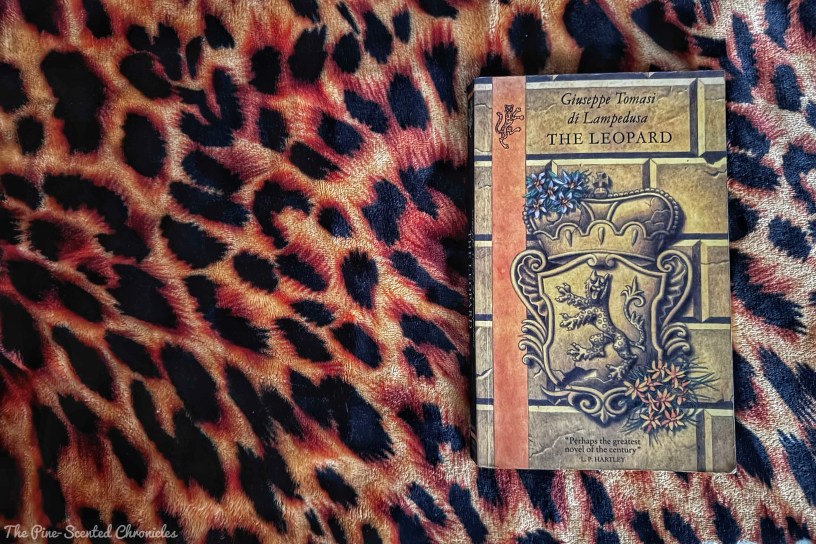
Eventually translated into English as The Leopard, the novel commences in May 1860. At the heart of the novel is the Salina family, a family of Sicilian nobles who reside in a palace outside Palermo, the Sicilian capital. When the story opens, they have just completed their daily Rosary. They are sitting in an ornately decorated drawing room brimming with paintings of Roman deities. The room also contains several depictions of the family’s coat of arms, among them a prominent leopard. The leopard is the family’s symbol. At the helm of the family is Don Fabrizio, Prince of Salina, a large and domineering man whose fair features are marks of his German ancestry, in stark contrast to those of the dark-haired Sicilians. Prince Fabrizio di Salina is seized by a feeling of discontent. He feels that his family and the entire Sicilian nobility are sliding into decline. He is even more frustrated by the realization that he is powerless to stop it.
The crux of the Prince’s concern stems from the political changes that are imminent in Sicily. Tectonic shifts are taking place in Italy’s political landscape. In Sicily, rumors of a revolution led by the prominent nationalist Giuseppe Garibaldi have reached the nobility. Most noble houses, however, oppose the revolution, having sworn allegiance to the King and the Catholic Church. The Prince, however, is less strident, believing that the monarchy has failed to live up to its ideals. Recently, the Prince met with the King of the Two Sicilies, in whom he sensed a growing fear. The King even warned him to speak to his nephew, Tancredi Falconeri, an ambitious young man who openly supports the revolution. Like most of the kingdoms on the Italian Peninsula, the Kingdom of the Two Sicilies is on the brink of being dissolved and incorporated into a unified Italian state. The Risorgimento, or resurgence, entails the dismantling of monarchies across the peninsula, including Sicily.
The Prince soon receives a visit from his nephew, who talks about Garibaldi’s Redshirts. They have recently landed on the Sicilian coast and have camped out in the hills. Tancredi informs his uncle of his plans to join the rebels. He also warns his uncle that, in order for things to remain the same in Sicily, things must also change. This insight leaves a deep impression on the Prince. He believes that many of the bourgeois liberals are merely masquerading as liberals in support of the revolution but are not genuinely in favor of altering the status quo. They are more concerned with their self-interest than with advocating for the welfare of everyone. They want to preserve their privileges while keeping everything essentially the same. They are driven by insatiable greed rather than idealism or nationalism. His friend, Father Pirrone, on the other hand, fears that the revolution is a direct threat to the Catholic Church. He worries that the rebels will seize Church property.
Soon enough, the Redshirts, including Tancredi, make their move and invade Palermo, although the Prince observes that little has changed. The family, along with Tancredi, then sets off on their annual summer vacation to their rural estate in Donnafugata. The traditional greeting they receive upon their arrival further reassures him that everything is as it has always been. The Prince relishes his summer trips to his favorite place. Tancredi relates his experiences during the battle. The Prince soon learns that his daughter, Concetta, is in love with Tancredi. Unfortunately, Tancredi is attracted to Angelica Sedàra, the beautiful daughter of Don Calogero, the newly elected mayor of Donnafugata and a wealthy, ambitious bourgeois landowner. Although aware of his daughter’s feelings and apprehensive about the class disparity, the Prince helps arrange Tancredi’s betrothal to Angelica after his nephew asks for his aid.
But that they did not know then; and they were pursuing a future which they deemed more concrete than it turned out to be, made of nothing but smoke and wind. When they were old and uselessly wise their thoughts would go back to those days with insistent regret; they had been days when desire was always present because it was always overcome, when many beds had been offered and refused, when the sensual urge, because restrained, had for one second been sublimated in renunciation, that is into real love.
Giuseppe Tomasi di Lampedusa, The Leopard
Giuseppe Garibaldi’s Expedition of the Thousand successfully defeated the Kingdom of the Two Sicilies, resulting in its annexation into the newly unified Kingdom of Italy under the rule of King Victor Emmanuel II. Italian Unification stands as one of the most important political events of the 19th century. What was once a divided peninsula was transformed into a single nation. For members of the divided nobility like the Prince, the rise of nationalist sentiments endangered their power and influence. Nationalist revolutionary movements challenged the large, multi-ethnic empires, kingdoms, and governments that had sprung up across Europe. The rise of nationalist movements advocated for the creation of united nation-states. Along with German Unification, Italian Unification was among the most prominent results of these nationalist movements. With this transformation came inevitable and drastic political and societal changes.
For the Sicilian nobility, the unification of Italy was unwelcome. Nationalist sentiments divided the aristocracy, forcing its members to choose sides, while some who outwardly supported the revolution did so primarily to preserve their own interests. Yet the transformation was inevitable. A united Kingdom of Italy meant that the nobility would lose its grip on power and that its influence would wane. But it was not only the nobility whose perspective Lampedusa captured. Different perspectives emerge as Lampedusa is critical not only of the declining nobility but also of the revolutionaries and the modern Italian state that emerges from the upheaval. Despite the redistribution of power among different classes and political structures, he suggests, human nature remains unchanged. Revolution and social upheaval may alter who holds power, but the desire for wealth, influence, and self-preservation endures.
Don Calogero embodies this new order. His wealth, the Prince learns, was accumulated through dubious business dealings and political influence, often at the expense of aristocratic families weakened by the conflict. He is now as wealthy as the Salinas, despite lacking their lineage. As the social hierarchy shifts, the once-untouchable nobility becomes subordinate to an emerging bourgeoisie. The Prince attempts to preserve his family’s influence through the remnants of its former prestige, while Tancredi recognizes that survival requires adaptation. His marriage to Angelica is therefore both romantic and strategic: he gains access to her family’s wealth, while she gains entry into the aristocracy. Although the arrangement initially frustrates the Prince, he recognizes its necessity. To survive the changing social order, his family must compromise.
This struggle between continuity and change lies at the heart of the Prince’s identity. He has built his life around his position as a Sicilian aristocrat, regarding himself not merely as an individual but as the representative of a class whose traditions and privileges stretch back generations. As that world disappears, he struggles to understand his place in the new order. His title and prestige can no longer guarantee the influence they once did. Even his nickname, the Leopard, becomes an ironic reflection of his circumstances. The leopard on the Salina family coat of arms symbolizes strength, dignity, and aristocratic authority, yet the animal also represents a species gradually becoming extinct. Like the Leopard, the Prince belongs to a world that is slowly disappearing.
The truth is that he wanted to draw a little comfort from gazing at the stars. There were still one or two up there, at the zenith. As always, seeing them revived him; they were distant, they were omnipotent and at the same time they were docile to his calculations; just the contrary to humans, always too near, so weak and yet so quarrelsome.
Giuseppe Tomasi di Lampedusa, The Leopard
Change is a constant undercurrent in the story. Sicily itself undergoes a similar crisis of identity. The decline of the historic nobility and its associated culture gives rise to a new order. However, Sicily is unprepared for these changes. Its culture has long been shaped by its resistance to outside influences, but this resistance has also fostered isolation and stagnation. Unable to adapt to changing circumstances, Sicilian society begins to decline from within. The Prince embodies this contradiction. He attempts to preserve an illusion of stability, adopting superficial gestures of adaptation while retreating into memories of the past. Yet nostalgia cannot halt historical change. His struggle reflects that of an entire society attempting to preserve an identity that history has rendered increasingly difficult to sustain.
Death consequently emerges as one of the novel’s most potent metaphors. The gradual death of the aristocracy parallels the political and social upheaval transforming Italy. The Prince is himself preoccupied with mortality, contemplating whether he will meet death with dignity or as an ordinary man stripped of the status that once defined him. Yet death also suggests renewal: the demise of the old political order gives birth to a unified Italy. Lampedusa thus presents change as both destructive and regenerative, though the new order is hardly as different from the old as its revolutionaries might claim. Romance and sensuality reinforce this idea. The Prince’s infidelity and relationships with other women reveal his tendency to pursue personal gratification, while Tancredi and Angelica’s relationship ultimately becomes intertwined with social ambition. Their marriage unites aristocratic lineage with bourgeois wealth, suggesting that even love can become entangled with the pursuit of power and self-interest.
The Leopard was posthumously awarded Italy’s highest literary prize, the Strega Prize, in 1959 and was adapted into an award-winning 1963 film of the same name. Through the story of the Prince and his family, Lampedusa offers a vivid examination of Sicilian society during the Risorgimento. The Prince becomes a microcosm of an aristocratic class confronting its own extinction, while the contrast between elegance and decay captures the contradictions of a society in transition. Ultimately, The Leopard is a novel about revolution, identity, and the persistence of power. Italy undergoes profound political transformation, yet the fundamental structures of privilege largely survive; only those occupying positions of power change. Lampedusa presents history not as a clean break between the old and the new, but as a continuous cycle in which power changes hands while human motivations remain remarkably constant. In doing so, he transforms The Leopard from an incisive portrait of 19th-century Sicily into a timeless meditation on identity, mortality, social change, and the loss of a collective past.
Good manners apart, though, the appearance of those monumental dishes of macaroni was worthy of the quivers of admiration they evoked. The burnished gold of the crusts, the fragrance of sugar and cinnamon they exuded, were but preludes to the delights released from the interior when the knife broke the crust; first came a mist laden with aromas, then chicken livers, hard-boiled eggs, sliced ham, chicken, and truffles in masses of piping hot, glistening macaroni, to which the meat juice gave an exquisite hue of suède.
Giuseppe Tomasi di Lampedusa, The Leopard
Book Specs
Author: Giuseppe Tomasi di Lampedusa
Translator (from Italian): Archibald Colquhoun
Publisher: Harvill
Publishing Date: 1992
No. of Pages: 190
Genre: Historical
Synopsis
In the spring of 1860, Fabrizio, Prince of Salina, still rules over thousands of Sicilian acres and hundreds of subjects in mingled splendour and squalor. But echoes of the new political movements on the Italian mainland are already being heard. Garibaldi is about to arrive; a revolution is about to begin. The Leopard is about to change…
About the Author
Giuseppe Tomasi di Lampedusa was born on December 3, 1896, in Palermo, Italy, to Giulio Maria Tomasi, Prince of Lampedusa, Duke of Palma di Montechiaro, Baron of Torretta, and Grandee of Spain (1868–1934), and Beatrice Mastrogiovanni Tasca Filangieri di Cutò (1870–1946). He was the eleventh Prince of Lampedusa and the twelfth Duke of Palma. He was the last of the Tomasi princes of Lampedusa before the family and its titles became extinct. He was initially homeschooled. In the autumn of 1911, Tomasi attended the liceo classico in Rome and then continued his studies at the liceo in Palermo for roughly three years. He was subsequently enrolled in the Faculty of Law at the University of Genoa, although it is unclear whether he ever attended. In 1915, he was drafted into the army, serving first in the artillery before transferring to the infantry.
During the Battle of Caporetto, he was taken prisoner by the Austro-Hungarian Army during the retreat. He eventually escaped and returned to Italy on foot. After a nervous breakdown prevented him from pursuing the diplomatic career to which he had aspired, he devoted himself to an intensely private intellectual life, reading in several languages, discussing literature with a small group of friends, and writing for his own enjoyment. In 1955, he began writing Il Gattopardo, the novel that, although rejected by publishers during his lifetime, brought him posthumous international acclaim when it was published in 1958. Lampedusa’s posthumously published Racconti (1961; Stories) includes the first chapter of an unfinished novel, I gattini ciechi (The Blind Kittens), as well as a brief memoir. It was partially translated into English as Two Stories and a Memory (1962).
His other works include Le lezioni su Stendhal (Lessons on Stendhal), privately published in 1959 and later published in book form in 1977, and Invito alle lettere francesi del Cinquecento (Introduction to Sixteenth-Century French Literature), first published in 1970. In 2010, a collection of his letters was published in English as Letters from London and Europe. In 1957, Tomasi di Lampedusa was diagnosed with lung cancer. He died on July 23, 1957, in Rome.

