Art, Love, and Obsession
“Art imitates life” is a phrase that has long been etched into humanity’s consciousness. Rooted in ancient Greek aesthetics and later developed by Plato and Aristotle, it also subtly underscores one of art’s strangest and most peculiar abilities: art transcends time. A painting does not only preserve the image of a person or a place but also captures the emotions, desires, and circumstances surrounding its creation. There is a reason why Leonardo da Vinci’s Mona Lisa and her mysterious smile continue to capture the imagination of modern audiences. The Mona Lisa still elicits strong reactions from those who encounter it today. It stirs emotions, memories, and desires that its creator could never have anticipated. The same can be said of other works of art, which are often objects of study and intense scrutiny, not only for their technical aspects but also for the meanings hidden behind every stroke.
A painting, after all, possesses the uncanny ability to preserve a moment long after the people who experienced it have disappeared. It also gives shape to feelings that words cannot adequately express. In this sense, art becomes a simulacrum of a conversation between the past and the present, allowing the past to echo into the present through these evocative works. A recurring theme in the arts is obsession, with art and the process of creating it often eliciting powerful emotional responses. It is not uncommon for artists to become obsessed with their own work or with a particular theme. Famed painter Vincent van Gogh developed an obsession with light and repetition. Meanwhile, Frida Kahlo’s art brimmed with self-portraits chronicling her pain, identity, and trauma, underscoring her preoccupation with suffering.
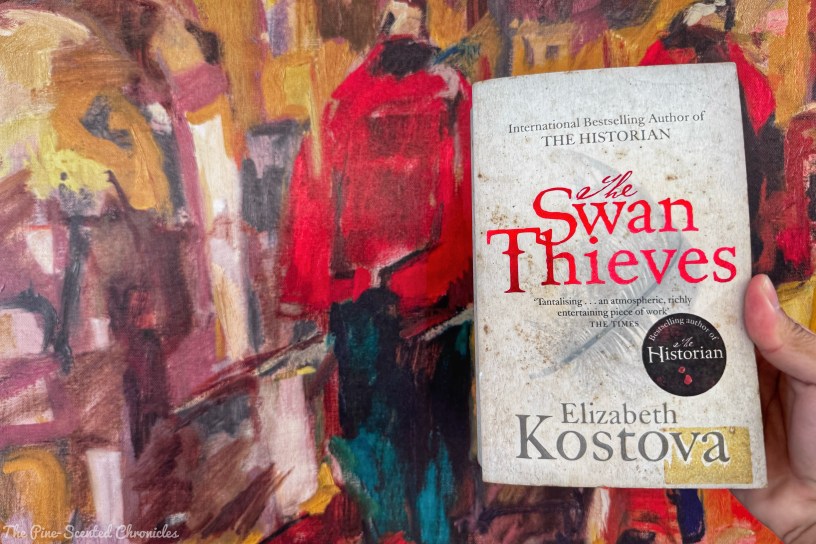
The reverse can also be true. A spectator’s admiration can take a radical turn. So what happens when admiration for art deepens and develops into an obsession? In Elizabeth Kostova’s The Swan Thieves, the boundary between artistic inspiration and destructive fixation becomes increasingly blurred. The novel begins in 1999 in Washington, D.C., where Dr. Andrew Marlow is a successful psychiatrist working at Goldengrove, a psychiatric hospital. Leading a quiet, solitary life, he does not rely on or need others to make him happy. He is content living a regimented life built around his passions. He is devoted to his work, while his hobbies occupy his free time. Marlow also has an interest in the arts and is an amateur painter. When he is not dealing with patients, he spends his free time learning to paint or visiting art galleries. But Marlow’s quiet life is about to be turned upside down.
It’s a shame for a woman’s history to be all about men-first boys, then other boys, then men, men, men. It reminds me of the way our school history textbooks were all about wars and elections, one war after another, with the dull periods of peace skimmed over when they happened.
Elizabeth Kostova, The Swan Thieves
One day, Marlow receives a call from a fellow psychiatrist who refers a new patient to him, Robert Oliver. Oliver is a renowned but troubled painter who has recently found himself at the center of intrigue after trying to attack a renowned Impressionist painting, Leda and the Swan by Gilbert Thomas, at the National Gallery of Art in Washington, D.C., with a knife. Oliver is subsequently admitted to Goldengrove until doctors can determine what is wrong with him. Given Marlow’s interest in painting, it is unsurprising that he wants to take over Robert’s care. He is also drawn into the mystery of why a celebrated artist would attempt to destroy a work of art, particularly one so similar to his own. Marlow is determined to get to the bottom of the mystery while helping Oliver. However, he quickly realizes that the challenge is deeper than he expected. Oliver is unresponsive to all inquiries. He refuses to speak about himself or his motives for attempting to attack the painting.
In his mid-forties, Oliver is said to be experiencing severe mental health issues, including anger and possible depression. When questioned, all Oliver tells Marlow is that if Marlow knew anything about his life, he would understand why he tried to slash the painting. Oliver then spends his days sketching images of swans. This behavior, along with the public outcry surrounding the incident, further intrigues Marlow. However, he is unsure how to break through Oliver’s steely resolve, having never dealt with a patient like him before. Marlow adopts several approaches to help his troubled patient. He goes through his patient’s file and decides to play to Oliver’s strengths by providing him with painting supplies and asking him to draw his feelings. Oliver creates paintings depicting the same mysterious but beautiful woman. However, they provide very little insight into his patient’s personality. To unravel the mystery, Marlow begins digging deeper into Oliver’s life.
The story unfolds alongside a series of letters that Oliver is inexplicably obsessed with and eventually shares with Marlow. The letters date from the late nineteenth century. Robert is very protective of them, naturally piquing Marlow’s interest. He reads some of the letters and discovers that they are correspondence between Béatrice de Clerval Vignot, a nineteenth-century French Impressionist painter and the wife of a French post office executive, and her husband’s uncle, Olivier Vignot, in France. The conversations revolve mainly around art and painting, but their passionate declarations also hint at a more complex relationship. Marlow surmises that Béatrice could be the woman depicted in Robert’s paintings. While the letters do not give Marlow the answers he needs, he realizes that understanding Béatrice is key to unlocking his patient’s complex psychological state. In his quest for answers, Marlow begins interviewing people close to Oliver.
Marlow begins to piece together Oliver’s life. What emerges is the portrait of a reclusive man intensely focused on his art. Two women also emerge as key figures in his life. Marlow is able to track down Oliver’s former wife, Kate. While she cannot explain her former husband’s behavior, she is not surprised by it either. Although their marriage was built on love, it was intertwined with heartbreak. Oliver neglected her and their children, and she no longer cares about what happens to him at Goldengrove. Still, Kate allows Marlow to look through Oliver’s belongings, where he finds more information about Béatrice and another woman, Mary, who is intimately connected to Oliver. However, Mary has no idea what happened to Robert, either. She knows that he is a talented painter, but that he cared more about art than his family. Mary also confesses her guilt over having taken Oliver away from his family.
Marriages are like certain books, a story where you turn the last page and you think it’s over and then there’s an epilogue, and after that you’re inclined to go on wondering about the characters or imagining that their lives continue without you, dear reader. Until you forget most of that book, you’re stuck puzzling over what happened to them after you closed it.
Elizabeth Kostova, The Swan Thieves
As the story progresses, the mystery keeps deepening. More questions float to the surface, with every turn providing more questions than answers. Who is Béatrice? How does the past resonate into the present? What drove Oliver to attack Leda and the Swan? For Marlow, Oliver’s act prompts him to question what drives such passion and despair in a talented artist. Integral to unraveling the mystery surrounding Oliver are the letters between Béatrice and Olivier. Béatrice is twenty-six years old and has been married to Yves Vignot for five years. She lives in Paris, but Yves’ work keeps him away for much of the time, leaving Béatrice alone with her thoughts, duties, and art. In her husband’s absence, she begins corresponding with Olivier, who, like her, is an artist. Béatrice prefers the Impressionist style, in contrast to Olivier’s more traditional techniques.
Art then emerges as the thread that connects the novel’s various threads together. Across time, art influences and connects human experiences. A painting is not merely an aesthetic object to be displayed; it can preserve experiences, convey emotions, and carry stories across generations. Love, sadness, longing, and even wrath become embedded in the works people create and the meanings later generations assign to them. Preserving history and human experiences, art then serves as a repository of secrets and hidden truths. The central mystery revolves around the painting Oliver attempts to vandalize, which becomes entwined with his unresolved emotions and conceals a secret that has shaped his perception of love. Through this connection between the past and present, Kostova shows how a work of art can continue to affect people long after its creation. The act of creating art also carries its own contradictions, capable of producing both immense beauty and profound pain.
Béatrice’s story brings another dimension to the novel by highlighting the difficulties faced by women across generations. Married at a young age, she spends much of her time alone and is depicted as intelligent and sensitive. Like Oliver, she is fiercely dedicated to her craft. She yearns for recognition and self-expression but struggles to find either. When she finally receives a modicum of recognition, she becomes vulnerable to the scrutiny that accompanies it. Exposed, she starts to feel that her artistic soul is being laid bare for the world to see. Nevertheless, Olivier encourages her to embrace these feelings as an inherent part of the creative process and continues to push her to paint despite her doubts. His support and reassuring presence highlight the importance of friendship and human connection in nurturing creative expression.
Despite her enormous talent, Béatrice is constantly overshadowed by her male counterparts and is subsumed by societal expectations. A male colleague, at one point, took credit for one of her works mainly because no one respected female artists at that time. History captures how women are often muted, and Béatrice’s story highlights this. Her story also captures the struggles of unrecognized talent. In the present, Oliver attempts to rectify the historical injustice. This, in a way, is a meditation on how history is told. The victor, after all, gets to dictate history, prompting questions about history’s veracity. This also highlights how many brilliant minds might have been lost or forgotten due to bias and circumstance. The novel then subtly highlights the importance of proactively seeking out and restoring marginalized narratives. All the while, Kostova asks whether there is ever an objective interpretation of an experience, or of a work of art.
Despite her talent, Béatrice is overshadowed by her male counterparts and constrained by the expectations of her time. At one point, a male colleague takes credit for one of her works because female artists receive little respect. Her experience reflects the ways in which women’s contributions have been diminished or erased throughout history. It also raises questions about how many talented individuals may have been forgotten because of prejudice and circumstance. In the present, Oliver attempts to rectify this historical injustice, turning the novel into a meditation on how history is constructed and whose stories survive. The victor, after all, often gets to dictate history. Kostova therefore invites readers to consider whether there can ever be an entirely objective interpretation of an experience or a work of art.
I lay awake for hours in my twin bed next to the other, empty bed, feeling and hearing the spruces, the hemlocks, the rhododendron scraping at the partly open window, the verdant mountain out there in the night, the burgeoning of nature that did not seem to include me. And when, my restless body asked my teeming brain, had I agreed to be excluded?
Elizabeth Kostova, The Swan Thieves
Across time, art evokes strong emotions. The Swan Thieves delves into one of these emotions: obsession. Obsession shapes the novel and comes in different forms. It influences the characters’ lives. Oliver’s fixation on Béatrice and her story crosses the boundaries of time. This fixation foreshadows his own internal strife and ultimately culminates in his psychological unraveling. Marlow develops a quieter form of obsession as he becomes increasingly invested in understanding his patient. Initially a detached professional, he finds his professional judgment challenged by Oliver’s case. Becoming personally invested in Oliver’s story, he becomes personally entangled in the lives of the people connected to him. His growing involvement forces him to confront feelings and ethical questions that extend beyond his professional responsibilities.
Brimming with details, some of which barely move the story forward, The Swan Thieves can be quite a taxing read. Nevertheless, it offers a nuanced exploration of the complicated relationship between obsession, love, and desire. Oliver develops feelings for a woman he has never met, suggesting that love can emerge not only from personal experience but also from an idealized image of another person. The relationship between Béatrice and Olivier similarly occupies an uncertain space between affection and fixation. The novel questions the distinction between loving someone and wanting to possess them. An artist may attempt to preserve a beloved muse through art, but in doing so, risks transforming that person into an image or ideal rather than recognizing them as an individual. Love, therefore, becomes inseparable from loss and longing, as many of the characters are driven by people or experiences they cannot fully possess or recover.
Kostova’s sophomore novel, The Swan Thieves, is a complex and multilayered exploration of art, memory, love, and obsession. What begins as a mystery surrounding a troubled painter gradually unfolds into a meditation on the forces that connect people across generations. Through the intertwined stories of Robert, Béatrice, Olivier, and Marlow, Kostova examines how creativity can preserve what time threatens to erase while revealing the vulnerabilities and desires that lie beneath artistic expression. The novel questions who gets remembered and whose stories are lost, particularly when prejudice determines whose voices are given a place in history. Ultimately, The Swan Thieves suggests that art does more than preserve the past; it lends it a voice, allowing forgotten emotions, relationships, and stories to resonate long after their creators are gone. It reminds us that what we encounter in art can transcend its original moment and, sometimes, profoundly alter the lives of those who come after.
Life and I became friends some years ago – not the sort of exciting friendship I longed for as a child, but a kindly truce, a pleasure in coming home every day to my apartment. I have a moment now and then – as I peel an orange and take it from kitchen counter to table – when I feel almost a pang of contentment, perhaps at that raw color.
Elizabeth Kostova, The Swan Thieves
Book Specs
Author: Elizabeth Kostova
Publisher: Sphere
Publishing Date: 2010
No. of Pages: 607
Genre: Literary, Mystery, Historical
Synopsis
Dr. Andrew Marlow has a perfectly ordered life, full of devotion to his work and the painting hobby he loves. This order is destroyed when renowned artist Robert Oliver attacks a canvas in the National Gallery and becomes his patient.
As Oliver refuses to speak, Marlow’s only clue is the beautiful, haunted woman Oliver paints obsessively day after day. Who is she, and what strange hold does she have over this tormented genius? Desperate to help, Marlow embarks on a journey that leads him into the lives of the women closest to Oliver, and to a dark story at the heart of French Impressionism – a tragedy that ripples out to touch present-day lives.
About the Author
Elizabeth Johnson Kostova was born Elizabeth Johnson on December 26, 1964, in New London, Connecticut, to a professor of urban planning and a university employee. Owing to her father’s profession, she spent her formative years in Europe. However, she was raised in Knoxville, Tennessee, where she graduated from the Webb School of Knoxville. She received her undergraduate degree from Yale University and a Master of Fine Arts from the University of Michigan, where she won the 2003 Hopwood Award for her Novel-in-Progress. While working on her master’s, Kostova held several jobs, including landscaping and teaching business writing.
It was also while working on her postgraduate degree that Kostova started writing what would be her debut novel. Her interest in the legend of Count Dracula, cultivated by the stories her father told her about the vampire when she was a child, influenced her debut novel, The Historian, which was published in 2005. The Historian was an immediate sensation that earned Kostova praise from readers and literary pundits alike. It earned her several awards, including the 2005 Quill Award for Debut Author of the Year and the 2005 International Horror Guild Award for Best Novel. She succeeded it with The Swan Thieves (2010) and The Shadow Land (2017). Her most recent novel, Mystery Play, was published in 2026. Her short fiction, poetry, and essays have appeared in such periodicals and anthologies as The Mississippi Review, Poets & Writers Magazine, The Best American Poetry, The Michigan Quarterly, and Another Chicago Magazine.
Apart from writing, Kostova has taught in programs at the University of North Carolina at Wilmington, the University of Michigan, Drexel University, the University of the Arts in Philadelphia, and Penn State. She has also taught at the Sozopol Seminars on the Bulgarian Black Sea and Bear River Writers’ Conference in northern Michigan. She reads and lectures internationally and is co-founder of the Elizabeth Kostova Foundation, which provides competitive opportunities for Bulgarian writers and translators, as well as opportunities for native-English writers to travel to Bulgaria. She was also a recipient of the Bulgarian Ministry of Culture Award and a Lois Roth Foundation Citizen’s Award for Cultural Diplomacy.
Kostova is married to Gyorgi Kostov, a Bulgarian IT professional. Kostova’s sister, Victoria Johnson, is also a writer.

