
First Impression Friday will be a meme where you talk about a book that you JUST STARTED! Maybe you’re only a chapter or two in, maybe a little farther. Based on this sampling of your current read, give a few impressions and predict what you’ll think by the end.
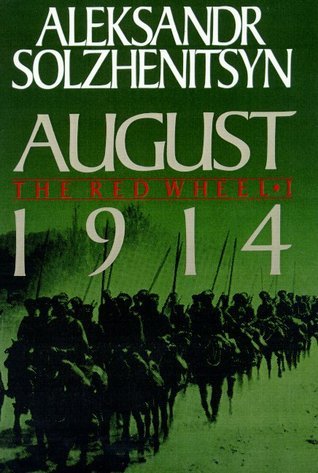
Synopsis:
In his monumental narrative of the outbreak of the First World War and the ill-fated Russian offensive into East Prussia, Aleksandr Solzhenitsyn has written what Nina Khrushcheva, in The Nation, calls “a dramatically new interpretation of Russian history.” The assassination of tsarist prime minister Pyotr Stolypin, a crucial event in the years leading up to the Revolution of 1917, is dazzlingly reconstructed from the alternating viewpoints of historical witnesses. The sole voice of reason among the advisers to Tsar Nikolai II, Stolypin died at the hands of the anarchist Mordko Bogrov, and with him perished Russia’s last hope for reform.
August 1914 is the first volume of Solzhenitsyn’s epic, The Red Wheel; the second is November 1916. Each of the subsequent volumes will concentrate on another critical moment, or “knot,” in the history of the Revolution. The result is a meditation on history unequaled in any novel since War and Peace.
It’s the end of the workweek—yay! Technically, it is already Saturday. Nevertheless, I hope the week has been kind to everyone and that you’re all ending it on a high note. How time flies! We are already in the second half of the fourth month of the year. I hope April proves to be a more promising month. I hope the conflict in the Middle East will continue to de-escalate—or, if not, be resolved soon. The world has become cruel, as men in power continue to instigate hate and chaos. Still, I hope that as the year progresses, everyone is given plenty of opportunities to grow and improve. With the weekend here, I hope everyone has a great one and ends the workweek on a high note. It’s time to dress down and wear more comfortable clothes. I hope everyone spends the weekend wisely—whether by resting from the rigors of a demanding career, pursuing passions, completing household chores, spending time with loved ones, or simply relaxing. I hope you’re all doing well—physically, mentally, and emotionally.
My venture into European literature is in full swing. After spending the first two months of the year reading the works of Latin American and Caribbean writers, I decided to explore the lush, diverse tapestry of the European literary landscape. Interestingly, I was not planning to embark on this European literature journey so early. However, I realized that I have several works by European writers included in my reading challenges. March, in particular, was dedicated primarily to European women writers, in line with the month’s major motif. March is Women’s History Month, and International Women’s Day is celebrated on March 8. Except for the first book I read that month, all the books I read were written by women. With March over, it was a no-brainer to extend this literary journey into April. This time around, I am focusing on other works of European literature that are part of my ongoing reading challenges.
Currently, I am reading Aleksandr Solzhenitsyn’s August 1914. It was through must-read lists that I was first introduced to the Russian writer, whom I later learned was awarded the Nobel Prize in Literature. Almost a decade ago, I secured a copy of his novel One Day in the Life of Ivan Denisovich and read it—a book that is a familiar presence on must-read lists. It also introduced me to Solzhenitsyn’s recurring theme: the Gulags. I also have a copy of The Gulag Archipelago, although I have yet to read it. However, August 1914 does not explore this subject. Instead, it transports us to the years that eventually led to the creation of the Gulags. Furthermore, it is a work of historical fiction, like Ivan Denisovich. After more than a decade, I am finally reading another work by the highly heralded Russian writer.
First published in 1971 as Август четырнадцатого, August 1914 takes us to the early 20th century—a time of great political and social upheaval in Russia. The novel opens with Sanya, a young university student at home for the summer in his provincial town. He boards a train bound for Moscow, planning to enlist in the army. Earlier, Russia had declared its intention to join the First World War. Tsar Nicholas II’s resolute declaration inspires Sanya, who is seized by a sense of patriotism. He rejects his pacifism and makes a secret vow to fight for his country. This reminds me of Ferdinand Bardamu, the main character in Louis-Ferdinand Céline’s Journey to the End of the Night, the book I read before August 1914. Interestingly, both books take readers to the front lines of the First World War.
Meanwhile, on the train to Moscow, Sanya runs into his former girlfriend, Varya. She has grown into an intellectual since meeting him at school. With radical opinions vis-à-vis the war, Varya questions Sanya’s newfound patriotism. She challenges his desire to join the army, even going as far as accusing him of denying support for the common people’s revolution because he supports the tsar. Interestingly, the tsar was initially apprehensive about joining the war. However, he was pressured by his generals to mobilize the Russian army. His trusted adviser, Prime Minister Pyotr Stolypin, had been murdered at a performance at the Kyiv Opera House by a police agent and secret assassin, Dmitri Bogrov. The tsar is cognizant that, had Stolypin been alive, he would have known what was best for Russia.
The story moves forward, and we are taken to the battle lines at Tannenberg, where we meet Colonel Vorotyntsev, the novel’s main character. He is a General Staff officer sent from the Grand Duke’s headquarters (the supreme command of the Russian Army) to the Russian Second Army, which is invading East Prussia under the command of General Alexander Samsonov. Vorotyntsev is sent to the battle lines to find out what is happening with the Second Army; another General Staff colonel is sent to the First Army with the same mission. Given the limitations brought about by distance, Vorotyntsev is tasked with documenting conditions at the front and reporting back to the Grand Duke. It does not help that the Russian Army is generally unprepared for the war, dragged to the battle lines by a corrupt bureaucracy.
The chaos at the Russian-German battle lines is worse than initially thought. Colonel Vorotyntsev is forced to attempt to bring order to the chaos. From one point to another, he tries to mitigate the looming disaster. Still, his intelligence and dedication do not suffice, as he lacks instinctive decision-making. Thankfully, he has with him his friend Arseny Blagodaryov, who makes up for what he lacks. The two soon find themselves surrounded by advancing German troops, forming a bond in the trenches. As they complement each other, they are able to rally the soldiers. Vorotyntsev leads a successful charge through enemy lines. While it is a small victory, it is enough to boost the Russian Army’s morale. In light of what he has witnessed, the colonel abandons his original mission and decides to stay at the battle lines. However, the victory is fleeting. It is soon undermined by the incompetence of General Samsonov, leader of the Second Army.
With the blunders of those in command, will the Russian Army succeed at the battle lines? Solzhenitsyn carefully and vividly captures scenes from the front. Reading the novel, however, is no easy task. At over eight hundred pages long, it requires utmost attention. Despite the atrocities depicted, his writing flourishes. As life and death play a tug-of-war, glimpses of human nature and the human condition rise to the surface. There is a proclivity for philosophy, drawing the reader into deep reflection in the midst of chaos. One line that captured my interest is this: You speak of ordering and perfecting society. But nothing is more precious to a man than the order in his own soul, not even the welfare of remote generations. Somehow, beauty blossoms amid all the chaos. Here is another one: Nobody wants you to give up art. Art is also a means of beautifying life, but it is very far from being the most important. The greatest beauty lies in the struggle for an idea, the greatest joy in combining the Good with the Beautiful.
The intricacies of history, politics, and even leadership all converged in August 1914. It is also an exploration of human conditions, and the human spirit’s indomitability in light of atrocities. From what I understand, this is the first book in The Red Wheel (Красное колесо, Krasnoye koleso), a cycle of novels that probes the demise of Imperial Russia and the birth of the Soviet Union. Despite the challenges of reading August 1914—ironically, I find Leo Tolstoy’s War and Peace a more accessible read—I am looking forward to reading the rest of the books in the cycle. It also provides me with a different perspective on Solzhenitsyn’s prose. I am more than halfway through the book, but it seems there is still much to unfold. I look forward to learning more about this part of history.
How about you, reader? What book or books are you taking with you this weekend? I hope you all have a great one—and that whatever you’re reading provides a brief respite.

