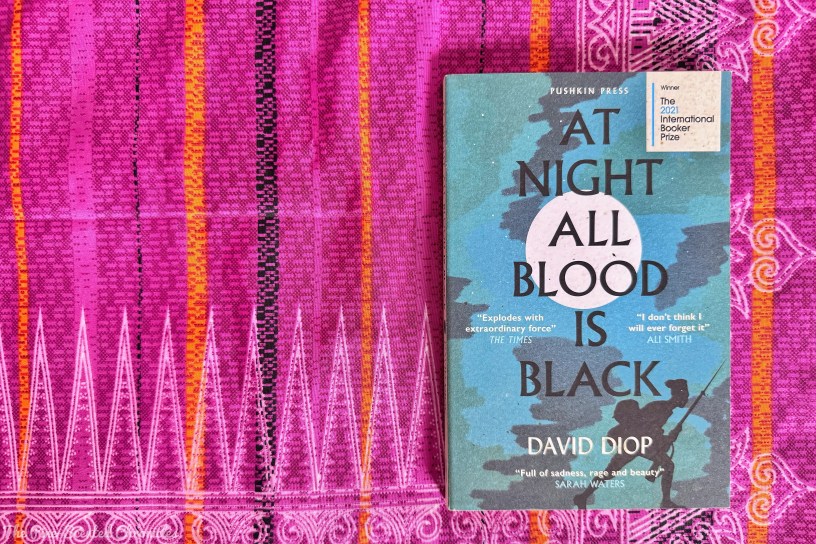
2021 International Booker Prize Winner
(Trigger warning: mentions of euthanasia, death, and graphic violence.)
Millennia of human history have shown our proclivity for war. It began with prehistoric skirmishes aimed at expanding territories, subjugating groups of people, or eliminating enemies. Over the succeeding centuries, war has become synonymous with human existence, shaping the global landscape while also molding the human psyche. It has become a display of power and influence—a violent way of showing the world who is more powerful. It is a dog-eat-dog world. People went to arms not only to explore but also to spread religion. In the process, they gained glory and pillaged the natural resources of new territories. “No guts, no glory,” after all. From empires waging war against other empires to monarchs overthrowing one another for greater power, warfare has become increasingly sophisticated. War has moved from the battlefield to closed rooms, where power is concentrated among the few. It has become a game of strategic alliances and a struggle for control over scarce and valuable resources.
Wars have always been prevalent, dating back to ancient times. Among the most prominent are the Punic Wars (264–146 BC), waged between Rome and Carthage. However, one of the most famous ancient wars traces its origins to mythology. The Trojan War is among the most fabled conflicts in history and has been the subject of numerous films and literary works. Religion played a central role in the Crusades (1095–1291), as the Latin Church attempted to wrest control of holy sites in the Eastern Mediterranean. In Asia, the Taiping Rebellion (1850–1865) resulted in the deaths of millions in China. A stark shift in warfare tactics came with the Cold War (1947–1991), as espionage became a prominent tool for undermining enemy states. Civil wars have also been widespread across the globe. As history has shown, war is ubiquitous. However, two conflicts stand out above the rest in defining modern history: the First and Second World Wars.
It is no surprise that war has become a prominent subject in literature. The Second World War (1939–1945) is a central theme in many works of historical fiction. Notable novels such as Joseph Heller’s Catch-22 (1961), Kurt Vonnegut’s Slaughterhouse-Five (1969), Thomas Keneally’s Schindler’s List (1982), and Anthony Doerr’s All the Light We Cannot See (2014) all situate readers within the context of the conflict. Meanwhile, the First World War (1914–1918) is less prevalent in literature than the Second. Nevertheless, important works such as Erich Maria Remarque’s All Quiet on the Western Front (1928), Pat Barker’s Regeneration Trilogy (1991–1995), Sebastian Faulks’s Birdsong (1993), Aleksandr Solzhenitsyn’s The Red Wheel Cycle, and Ernest Hemingway’s A Farewell to Arms (1929) have immortalized the First World War within the literary canon.
His white belly is exposed, it rises and falls in jerks. The enemy from the other side gasps and screams, now in stark silence because of the gag I’ve cinched around his mouth. He screams in stark silence when I take all the insides of his belly and put them outside in the rain, in the wind, in the snow, or in the bright moonlight. If at this moment his blue eyes don’t dim forever, then I lie down next to him, I turn his face toward mine and I watch him die a little, then I slit his throat, cleanly, humanely. At night, all blood is black.
David Diop, At Night All Blood is Black
Joining this growing list of prominent works chronicling the atrocities of the First World War is David Diop’s sophomore novel, At Night All Blood Is Black. Originally published in French in 2018 as Frère d’âme—which literally translates to “soul brother”—it became available to Anglophone readers in 2020 through an English translation by Anna Moschovakis. The novel transports readers to the trenches of the French army during the First World War. The landscape of the conflict is captured through the lens of its primary narrator, twenty-year-old Alfa Ndiaye. Alfa and his best friend, Mademba Diop, were born and raised in the Senegalese countryside village of Gandiol. Before the Great War, they had never traveled beyond their village and shared a strong bond. When news of the French army reached them, they were both excited and terrified by the prospect of war. Nevertheless, the two friends enlisted.
The novel opened with a horrific scene. Wanting to showcase his bravery, Mademba charges recklessly into battle. Instead, Mademba’s stomach was sliced open, causing his guts to spill out of his body. As he lies dying in No Man’s Land, writhing in pain, Mademba pleaded with his friend to end his agony. However, Alfa was unable to fulfill his friend’s request in respect for human law; his family frowned on euthanasia. Mademba would eventually pass away, but he suffered a slow, painful, and undignified death. After his friend’s passing, Alfa carried Mademba back to the trench. Ironically, he would receive a Croix du Guerre for his courage. Having witnessed his friend’s slow agonizing death, Alfa was eventually swept by regret. He realized that he should have granted his friend’s dying wish, that his refusal was inhumane.
Still, Alfa could not seem to evade his feelings of guilt. Consumed by regret and dark emotions, Alfa was pushed down a twisted path. His inability to confront his feelings of cowardice prompted him to seek vengeance. In the battlefield, he deliberately hunted and captured blue-eyed German soldiers at night. In the same manner that his friend was disemboweled, he cut out his enemies’ intestines. When they beg for death, he grants their pleas. It was, in many ways, a reenactment of what should have been the last scene of his friend’s life. He was making up for what he failed to do for his friend. Afterward, he takes their rifle and a severed hand from the enemy soldiers’ corpses. They serve as trophies he takes with him to the trenches. His comrades then hailed him as a hero for his bravery.
What started as a means to cope with grief and honor his friend’s death eventually transformed into something more sinister. Alfa’s nocturnal hunts became a gruesome ritual. It was palpable that he was quickly spiraling into madness. His comrades, who once hailed him a hero, started to fear him. His reputation at the trenches has plummeted from admiration to resentment with his obsession with death and mutilation. It was exacerbated by the rumors circulating around the camp that he had become a sorcerer or even a demon. The rumors also said that he was haunted by the spirits of the soldiers he had slain. This prompted Alfa into isolation. As the severed hands piled up, Alfa was ordered by his superior officer, Captain Armand, to be sent away from the fron to rest at a military psychiatric hospital where he was treated by Dr. François. As darkness engulfs his psyche, will Alfa be able to release himself from the prison he created in his mind?
Don’t tell me that we don’t need madness on the battlefield. God’s truth, the mad fear nothing. The others, white or black, play at being mad, perform madness so that they can calmly throw themselves in front of the bullets of the enemy on the other side. It allows them to run straight at death without being too afraid. You’d have to be mad to obey Captain Armand when he whistles for the attack, knowing there’s almost no chance you’ll come home alive. God’s truth, you’d have to be crazy to drag yourself screaming out of the belly of the earth.
David Diop, At Night All Blood is Black
The pervasiveness of war makes it a prolific subject in the ambit of literature. Nearly every war, from the civil wars to the Cold War to the Great Wars, they are a seminal component of world literature and historical fiction. After all, they have left indelible marks in the human landscape. The prevalence of wars and violence in literature, however, can be overwhelming, their recurrence a burden to the reader. However, each book that explores these wars and their legacies is a reminder of the voices that have often been silenced by the tumult. The stories of the survivors of Auschwitz and other Nazi concentration and extermination camps, for instance, vividly provide glimpses into the inhumanities and atrocities perpetrated during the Holocaust and the Second World War. While fictional in some sense, these literary works have immortalized the voices of the victims of these atrocities, underlining the unmatched place of literature in chronicling the human experience.
Meanwhile, Diop’s At Night All Blood Is Black attempts to give voice to the Senegalese Tirailleurs (Tirailleurs Sénégalais), a corps of colonial infantry within the French Army. Initially recruited from Saint-Louis, Senegal—the colonial capital of French West Africa—the force later expanded across Western, Central, and Eastern Africa, the principal sub-Saharan regions of the French colonial empire. The term tirailleur translates variously as “skirmisher,” “rifleman,” or “sharpshooter,” a designation used by the French Army for indigenous infantry recruited from its colonies during the nineteenth and twentieth centuries. The corps was established in 1857 by Louis Faidherbe, Governor-General of French West Africa, to supplement the insufficient number of French troops needed to control the territory. While Diop’s novel highlights their role during the First World War, the Senegalese Tirailleurs also served in other conflicts involving the French Army.
At Night All Blood Is Black vividly captures the inhumanities and atrocities perpetrated on the battlefield—vast landscapes riddled with violence and moral ambiguity. With an unflinching gaze, Diop explores the brutal realities of the Great War, detailing the horrors faced by soldiers. Ironically, the narrative begins with a moral dilemma that blurs the thin line between humanity and inhumanity. Alfa, adhering to social and moral conventions, refuses to grant his friend’s dying wish, leaving him in a painful impasse. This decision, however, propels him toward increasingly inhumane actions. He becomes erratic and violent, his behavior bordering on both the monstrous and the supernatural. In a cultural touchstone, his comrades label him a dëmm—a superhuman, cannibalistic witch derived from Senegalese folklore. Though Alfa briefly entertains this notion, he ultimately rejects it.
As Alfa begins to lose the fabric of his humanity, he descends into a state of existential crisis. Following his friend’s death, he blames himself not only for refusing to perform a mercy killing but also for provoking his friend’s reckless actions. On the morning of his friend’s death, Alfa had teased Mademba about his family’s totem, the peacock—contrasting it unfavorably with the Ndiaye family’s lion. Surrounded by death and violence, and burdened by guilt, he gradually loses his sense of self. Yet his rejection of the dëmm identity suggests that remnants of his humanity persist. Their friendship continues to resonate amid the novel’s bleakness. Still, Alfa’s descent into madness emerges as a central theme, underscoring the psychological toll of war. War not only strips individuals of their humanity but also leaves deep psychological scars on those who endure it. The wounds it inflicts are not always visible.
But what we experience is always new because every man is unique, the way every leaf and every tree is unique. Men share with each other the same lifeblood, but each feeds himself from it differently. Even if the new isn’t really new, it’s always new for those who, ceaselessly, wash up on the world’s shores, generation after generation, wave after wave. So, in order to find yourself in life, to not lose yourself on the path, you must listen to the voice of duty. To think too much about yourself is to falter. Whoever understands this secret has the potential to live in peace. But it’s easier said than done.
David Diop, At Night All Blood is Black
Cultural identity also emerges as a central theme. On the surface, the novel portrays the plight of African soldiers, but it extends into broader and darker territories. It exposes the exploitation of African troops as a consequence of colonialism. Senegal, a French colony from 1677 until its independence in 1960, serves as a historical backdrop to this dynamic. Woven into the narrative is Diop’s critique of colonial hypocrisy. When Captain Armand sends Alfa on a one-month leave, deeming him too “barbaric” and ordering his admission to a psychiatric ward, the contradiction becomes clear. The same authority that condemns Alfa’s actions had previously encouraged the Senegalese Tirailleurs to behave like savages to intimidate German soldiers. This paradox highlights the duplicity of colonial ideology: while the French justified their rule by claiming to be more “civilized,” they simultaneously sanctioned brutality when it served their purposes.
Although David Diop was born in Paris, France, and is French by nationality, he was born to a Senegalese father. He also spent part of his childhood in his father’s homeland before returning to France to pursue his studies. These formative years in Senegal were nevertheless instrumental in shaping his appreciation and understanding of his heritage. At Night All Blood Is Black serves as a homage not only to his father’s homeland but also to his French great-grandfather’s service during the war. Diop has mentioned that his great-grandfather never spoke about his wartime experiences—not to his wife, nor to Diop’s mother. This silence once again underscores the vital role literature plays in documenting the stories of those whose voices were muted by the chaos and trauma of war. Literature has a unique power of recovering suppressed histories and preserving the emotional realities that official records often overlook.
In the end, At Night All Blood Is Black is more than a retelling of the First World War; it is a profound meditation on memory, trauma, and the fragile boundaries of humanity. Through Alfa Ndiaye’s psychological descent, David Diop exposes the deeply personal costs of war—costs that linger long after the violence has ceased. The novel interrogates history, giving voice to those who were marginalized, exploited, and ultimately silenced. By centering the experiences of the Senegalese Tirailleurs, Diop challenges dominant narratives of the Great War and compels readers to confront the uncomfortable truths of colonialism and its enduring legacy. Ultimately, At Night All Blood Is Black stands as a haunting reminder that war is not only fought with weapons but also within the human psyche. Announced the winner of the 2021 International Booker Prize, At Night All Blood Is Black is a very intense, but insightful read about the unseen wounds of conflict, ensuring that the voices once lost to history are finally heard.
My brothers in combat, white or black, need to believe that it isn’t the war that will kill them, but the evil eye. They need to believe it won’t be one of the thousands of bullets fired by the enemy from the other side that will randomly kill them. They don’t like randomness. Randomness is too absurd. They want someone to blame, they’d rather think that the enemy bullet that hits them was directed, guided by some cruel, malevolent, evil intent.
David Diop, At Night All Blood is Black
Book Specs
Author: David Diop
Translator (from French): Anna Moschovakis
Publisher: Pushkin Press
Publishing Date: 2021 (2018)
No. of Pages: 145
Genre: Historical, Literary
Synopsis
Alfa and Mademba are two of the many Senegalese soldiers fighting in the Great War. Together they climb dutifully out of their trenches to attack France’s German enemies whenever the whistle blows, until Mademba is wounded, and dies in a shell hole with his belly torn open.
Without his more-than-brother, Alfa is alone and lost amidst the savagery of the conflict. He devotes himself to the war, to violence and death, but soon begins to frighten even his own comrades in arms. How far will Alfa go to make amends to his dead friend?
About the Author
David Diop was born on February 24, 1966, in Paris, France, to a French mother and a Senegalese father. When he was young, his family moved to Dakar, where he spent the majority of his childhood. He returned to France to study when he was eighteen after finishing high school. He received a doctorate from the Sorbonne for his studies on 18th-century French literature. Post-graduate school, he took on a teaching post at the University of Pau in the field of his doctorate as well as in French-language African literature. In 2009, Diop became the head of a research group on European representations of Africa and Africans in the 17th and 18th centuries. He earned his habilitation, the university teaching qualification, in 2014.
It was his research group on Africa’s portrayal in historical European literature that laid the groundwork for his eventual foray into literature. In 2012, he published his debut novel, 1889, l’Attraction universelle. He then followed it up with the publication of his first full-length scholarly work, Rhétorique nègre au xviiie siècle in 2018. In the same year, he published his sophomore novel, Frère d’âme. It was shortlisted for the Prix Goncourt, the Prix Renaudot, the Prix Médicis, and the Prix Femina. Its English translation, At Night All Blood is Black (2020), won the 2021 International Booker Prize, making him the first French author and first person of African heritage to win the prize. The Italian translation has won the Strega European Prize, and the Dutch translation has won the Europese Literatuurprijs. His third novel, La Porte du voyage sans retour (2021), was translated as Beyond the Door of No Return. In 2025, it made the longlist for the International Dublin Literary Award.
Diop is currently residing in Pau.
To translate is never simple. To translate is to betray at the borders, it’s to cheat, it’s to trade one sentence for another. To translate is one of the only human activities in which one is required to lie about the details to convey the truth at large. To translate is to risk understanding better than others that the truth about a word is not single, but double, even triple, quadruple, or quintuple. To translate is to distance oneself from God’s truth, which, as everyone knows or believes, is single.
David Diop, At Night All Blood is Black
 The Pine-Scented Chronicles