Happy Wednesday, everyone! Woah! Just like that, we are nearly midway through the fifth month of the year. I hope the year has been kind and great to everyone. I know life isn’t a walk in the park, but it is my fervent prayer that everyone’s year is going well. Regardless, I hope the rest of the workweek goes smoothly.
That said, the middle of the week also brings a fresh WWW Wednesday update. WWW Wednesday is a bookish meme hosted originally by SAM@TAKING ON A WORLD OF WORDS.
The mechanics for WWW Wednesday are quite simple: you just have to answer three questions:
- What are you currently reading?
- What have you finished reading?
- What will you read next?

What are you currently reading?
It’s already the middle of the week, which means we have only two more days until the weekend. I hope everyone makes it through the workweek. Anyway, my 2026 reading journey is going as planned. After spending the first two months of the year reading works by Latin American and Caribbean writers, I am now in the midst of a European literary adventure. While I had not originally planned to embark on a journey across European literature this early in the year, realizing that I had listed several works by European writers in my reading challenges prompted me to pivot toward them in March. Because of the number of European works in my reading challenges, I am extending the journey into this month. I believe this is the first time I have read works of European literature for three consecutive months. This shift has reintroduced me to familiar names while also introducing me to writers whose oeuvres I have yet to explore. My current read has introduced me to a new name.
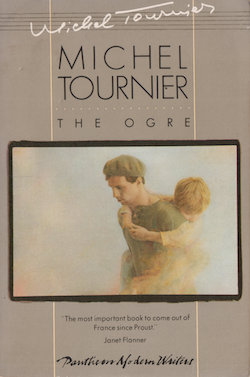
It was through an online bookseller that I first encountered French writer Michel Tournier during the height of the COVID-19 pandemic. His novel The Ogre piqued my interest, prompting me to secure a copy. I would later learn that it is listed as one of the 1,001 Books You Must Read Before You Die. However, the book suffered the same fate as most of my books: it was left to gather dust on my bookshelf. I then included it in my 2026 Top 26 Reading List. Originally published in 1972 as Le Roi des aulnes, the novel charts the fortunes of Abel Tiffauges, a very tall and myopic weirdo. The novel is divided into two parts. The first part takes us to late-1930s France and is narrated in the form of diary entries by the protagonist. He recounts his transformation from a sensitive misfit at an all-boys religious school, St. Christopher’s, where he met Nestor, a privileged student who took him under his wing. Nestor adored Abel so much that he indulged his obsessions.
Abel’s reflections on the past alternate with events in the present. As an adult, he owns a Parisian garage. He spends his free time haunting school playgrounds to photograph children and record their voices. One day, a girl accuses him of molestation, resulting in his arrest. Fortunately for him, his arrest coincides with the outbreak of World War II. The case is dropped, and Tiffauges is drafted into the army instead of serving prison time. In the second part, the story shifts to a third-person narrative. On the battlefield, Abel experiences a picaresque series of adventures before being taken prisoner of war and dispatched to a Prussian labor camp. After catching the eye of Hermann Göring’s forester, he is moved to the Kaltenborn fortress, a Napola institution for boys selected to become the elite of the future Lebensraum. The Ogre is quite an interesting read, grappling with a subject I rarely encounter. I am halfway through the book, and I am looking forward to seeing how it pans out.
What have you finished reading?
In a way, my April reading month shaped up to be a Nobel Prize in Literature binge-reading month. It was unplanned. It was only when I started reading Russian literary titan Aleksandr Solzhenitsyn’s August 1914 that it dawned on me I could turn it into one; I would spend the second half of the month reading the works of Nobel Laureates in Literature. Among them is German writer Hermann Hesse, whom I first encountered through must-read lists, even before I learned about his award from the Swedish Academy. His works regularly appeared on such lists, including 1,001 Books You Must Read Before You Die. In particular, Siddhartha has maintained a prominent presence on these lists, and it was also the first of his novels that I read. I later learned that he was a Nobel laureate in Literature. Nearly a decade after reading Siddhartha, I am now reading my fifth Hesse novel, Peter Camenzind.
Originally published in 1904, Peter Camenzind was actually Hesse’s debut novel, which came as a pleasant surprise to me. The novel transports us to late nineteenth-century Switzerland, where the titular character grows up in a small mountain village surrounded by nature and hemmed in by lake and rock. This majestic landscape shapes his personality, blending strength, melancholy, and poetic yearning. As a young boy, Peter is shaped by solitude, surrounded by silent forests and whispering winds. This solitude is further magnified by an apparent lack of parental affection. His father is gruff, an occasional drinker who remains passive toward his son. His mother, on the other hand, is more dignified but reserves her strength for necessity rather than tenderness. Peter’s world is narrow, dictated by tradition and stubborn villagers—forces that stand in opposition to his yearnings. Lacking parental guidance, Peter finds companionship in his misfit uncle Konrad, a dreamer whose schemes and projects fail because of their eccentricity. He also finds tranquility in the beauty of the mountains; his connection with the natural world is essential to him. However, as he grows older, he begins to yearn for a deeper understanding of himself and for a stronger connection with the world around him. Upon coming of age, he leaves the mountain village for the city in search of freedom. Ambitious and driven, he wants to experience the world. While studying at the university, he falls in love with Erminia Aglietti. He also befriends a young pianist named Richard, who introduces Peter to the seductive warmth of music and the ease of companionship. This is a theme that recurs throughout Hesse’s body of work: a restless young man encountering another young man who introduces him to a world beyond his imagination. Moreover, Richard’s friendship makes Peter feel less isolated.
Without a doubt, Peter Camenzind is the quintessential Hesse novel. It introduced several themes that would become prevalent in his succeeding works; it essentially set the tone for his oeuvre. Peter is a compelling and complex character—ambitious and driven, yet tempered by a sensible nature. He embodies the quintessential Hesse protagonist. Hesse’s poetic and descriptive prose also complements the story beautifully. It is lush and brimming with symbolism. The intricate language brings out Peter’s reflective and eloquent voice. Beyond being a coming-of-age story, Peter Camenzind also brims with philosophy. Its existential melancholy and introspective reflections provide another layer to the narrative. Warm and reflective, with drizzles of existential melancholy, the novel is a testament to why Hesse has earned a devoted fan in me.
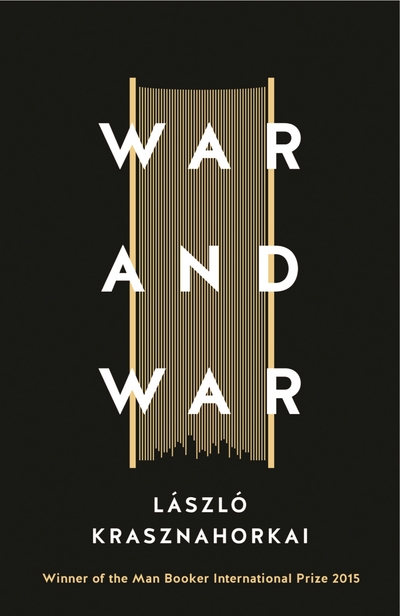
I concluded my mini-venture into the works of Nobel Laureates in Literature with another writer who has long commanded my attention. It was during the lead-up to the announcement of the 2018 Nobel Prize in Literature laureate that I first encountered László Krasznahorkai. In fact, it was the first time I had heard of the Hungarian writer. He was touted as a shoo-in for the prestigious literary prize. Although he won neither the 2018 nor the 2019 Prize, the fact that his name was being floated for the award naturally piqued my interest. I would eventually secure and read some of his works. In 2025, Krasznahorkai finally earned the Swedish Academy’s nod, much to the delight of many readers, myself included. I actually opened my 2026 reading journey with his highly acclaimed novel, The Melancholy of Resistance. Meanwhile, War and War is part of my 2026 Top 26 Reading List.
Originally published in 1999 as Háború és háború, War and War is the fifth book by Krasznahorkai that I have read. It also occupies an important place in my reading journey, as it is the 1,400th novel I have read. The novel charts the fortunes of Korin, a middle-aged Hungarian man consumed by a profound sense of despair and fear. The novel opens with a chapter titled “Like a Burning House.” We first meet the protagonist on a railway bridge, where he is surrounded by seven boys who initially plan to rob him. Believing they intend to kill him, Korin begins to deliver a soliloquy, rambling about his life, his chaotic thoughts, and his fears. This prompts the boys to abandon their original plan as they become drawn to Korin’s monologue. The elderly man reveals his deep loneliness and confesses that he has lost touch with both friends and family. When he turns forty-four, Korin realizes that life’s absurdities have begun to weigh heavily on him, starting with the collapse of his marriage. This is followed by a traumatic love affair that leaves him emotionally scarred. As Korin tries to make sense of the pandemonium his life has become, the boys slowly begin to lose interest in him. Boredom replaces concern, and their attention shifts toward the arriving train. Its arrival serves as a distraction, allowing Korin to escape. The story then moves forward, with Korin embarking on a journey from Hungary to New York City. He is initially detained at the airport because he has no luggage. Furthermore, money and a document are found sewn into his coat. This naturally raises the question: Why has Korin traveled to New York City? When Korin moves in with Sárváry, the interpreter who assists him at the airport, he launches into yet another soliloquy. He confesses that he has arrived in New York not to begin a new life but to end his old one. He has brought with him a manuscript discovered in a records office in Hungary. The manuscript recounts the struggles of soldiers attempting to return home from a catastrophic war, an account Korin believes must be preserved. He does everything within his means to immortalize it, including typing the manuscript and uploading it to the Internet. His drive to preserve and share the text stands in stark contrast to his desire to end his own life.
The story is episodic, but at the same time, it represents a departure from the typical Krasznahorkai work I have read thus far. Still, a subtle sense of chaos reverberates throughout the novel; chaos remains a trademark of the Hungarian writer’s oeuvre. At its core, the novel emerges as an exploration of loneliness and existential dread—subjects that permeate the narrative. Layered onto this is Korin’s search for meaning in a chaotic world. Adding further depth to the story is the mysterious manuscript Korin uncovers. Ironically, this manuscript becomes the catalyst for Korin’s descent into madness. It is also integral to the structure of the novel itself. The first section is set in ancient Crete, where four survivors of a shipwreck are rescued by villagers. The same quartet reappears in the next section, which is set in nineteenth-century Cologne. Like Krasznahorkai’s other works, reading War and War requires utmost attention, with the titular war evolving into different forms of conflict throughout the narrative. Ultimately, the novel is an extensive exploration of the human condition, with Korin’s complex emotional journey providing a profound reading experience.
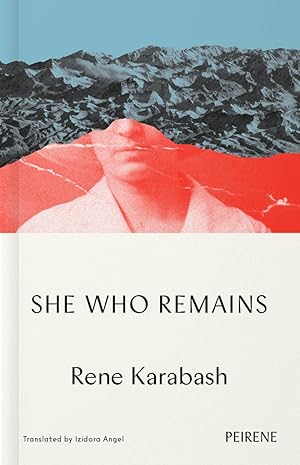
In terms of reading, the previous week has been quite a busy one. Weeks of trying to build some reading momentum have finally paid off. I was able to complete three books over the past week; it has been a while since I last managed the same feat. The conclusion of my Nobel Prize in Literature reading binge marks the commencement of a new journey; technically, it is still an extension of my foray into European literature. Anyway, the third book I completed last week is She Who Remains by Rene Karabash. It was only recently that I encountered Karabash. Her novel She Who Remains was longlisted for the International Booker Prize, which naturally piqued my interest. I eventually secured copies of three books from the longlist. She Who Remains is actually the second book from the longlist that I have read; the first was Women Without Men by Shahrnush Parsipur, which I read during the height of the COVID-19 pandemic.
Originally published in 2018 as Остайница (Ostaynitsa), She Who Remains is Karabash’s debut novel; she had previously published a poetry collection. It is also only the second novel by a Bulgarian writer that I have read. The first was Time Shelter by Georgi Gospodinov, which won the International Booker Prize. However, Karabash’s debut novel transports readers to a different Balkan country: Albania. Interestingly, Karabash drew inspiration from Ismail Kadare’s Broken April. The novel takes place in a rural Albanian village in the Accursed Mountains. At the heart of the story is seventeen-year-old Bekija, who lives with her parents and younger brother, Sále. Her father, Murash, is a pigeon keeper and a hypermasculine bully devoted to a primitive rural legal code known as the Kanun of Lekë Dukagjini. The Kanun governed the region. Lekë Dukagjini was a fifteenth-century Albanian prince who codified the Kanun at a time when there was no effective government in the region. Bekija was originally one half of a pair of twins—a boy and a girl—carried by her mother. However, as the birth approached, the male fetus was mysteriously found to be missing. Murash, who desperately wanted a son, was disappointed and barely acknowledged his daughter. Yearning for her father’s approval, Bekija acted like a tomboy. As an adolescent, Bekija fell in love with Dahna, the visiting granddaughter of a neighbor. At the same time, her father arranged her marriage to Nemanja, the son of another neighbor, without consulting either his wife or daughter. Realizing that the betrothal was essentially a death sentence, Bekija invoked her right to become a “sworn virgin,” a role sanctioned by the Kanun. A sworn virgin undergoes a legal gender transformation that allows women to claim the rights and responsibilities of men. This entails a vow of chastity, and the sworn virgin must live as a man for the rest of her life. Bekija thus became Matija. However, the breach of the marriage contract also violated the Kanun.
Unfortunately, Bekija was not the only one to disappear; she disappeared figuratively as well. Her story underscores a familiar reality for women in patriarchal societies: they must submit to the whims of men, while their voices are often muted as others make decisions for them. Bekija unintentionally sets into motion a chain of events with dire consequences not only for herself but also for her family. Tradition forms an integral part of the story, just as the search for identity does. Bekija’s story also highlights how trauma shapes our understanding of ourselves. Our traumas reveal important yet uncomfortable truths about both who we are and the realities we inhabit. Apart from its premise, what stands out most is Karabash’s writing. As she addresses the harsh realities faced by women in deeply patriarchal societies, she employs a poetic and hypnotic stream-of-consciousness style that draws readers in. She Who Remains is a quick yet memorable read about love, loss, identity, and the weight of societal expectations.
What will you read next?