
First Impression Friday will be a meme where you talk about a book that you JUST STARTED! Maybe you’re only a chapter or two in, maybe a little farther. Based on this sampling of your current read, give a few impressions and predict what you’ll think by the end.
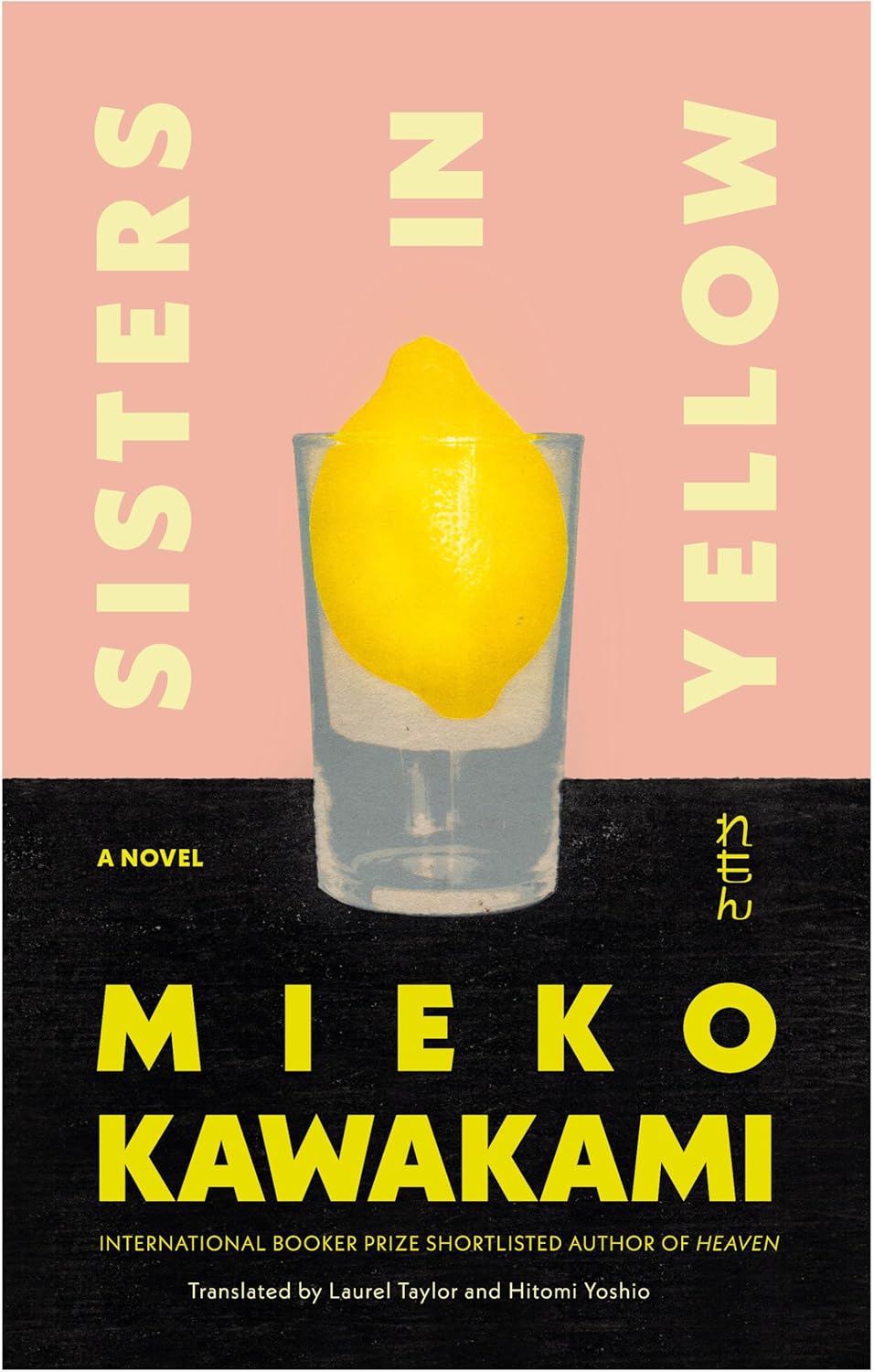
Synopsis:
Hana has nothing – she’s fifteen years old and living in a tiny apartment in a suburb of Tokyo with her young mother, a hostess at a local dive bar. They have no money, no security. Then Kimiko appears. She’s a bright light in Hana’s dark world. Together they set up Lemon, a bar that, despite its shabby setting and seedy clientele, becomes a haven for Hana. Suddenly she has a job she loves, friends to share her days with, and the glittering promise of money. She feels like a normal girl. She feels invincible.
But in the narrow alleys of Sangenjaya, nothing is as it seems. Soon all of Hana’s hope, her optimism, and her drive will be pushed to the limit…
A story of enduring friendship and deep betrayal, Sisters in Yellow is a masterpiece of teenage dreams and adult cruelties that confirms Mieko Kawakami as one of the great writers of her generation.
It’s the end of the workweek—yay! I hope the week has been kind to everyone, although the previous week was quite hectic for me personally. I am still trying to resolve a lot of issues, but more keep floating to the surface. Still, I can’t believe how time flies! We have already crossed the midpoint of the year. We are now in the seventh month of the year. Time takes its natural course. Nevertheless, I hope the first half of the year has been promising. I hope the conflicts in the Middle East and elsewhere in the world continue to de-escalate—or, better yet, are resolved altogether. As the year progresses, I hope everyone is given plenty of opportunities to grow and improve. With the weekend here, I hope everyone has a great one. It’s time to dress down and spend it either resting from the rigors of a demanding career, pursuing your passions, completing household chores, spending time with loved ones, or simply relaxing. I hope you’re all doing well—physically, mentally, and emotionally.
Over the past week, I was finally able to conclude my four-month venture into the works of European literature. I originally planned to stay there for two months, just enough time to complete all the works by European writers in my reading challenges. However, these books ultimately extended my literary adventure into a four-month journey. Instead, I spent the first two months reading works that were not part of those lists. I find this ironic because the main reason I started reading European writers so early in the year was that I usually reserve them for later in the year. The books included in my reading challenges were completed only in June. Nevertheless, I am glad I was finally able to conclude this journey. As always, it was a memorable one, introducing me to new names while reintroducing me to oeuvres I hadn’t visited in quite some time. With the conclusion of this literary journey—the longest I have spent in European literary territory in a single year—comes a new reading adventure.
With July being my birth month, I have decided to venture into the works of Asian writers, with an emphasis on Japanese literature. I have actually run out of books by Japanese writers, at least those on my bookshelf. Still, there are a few waiting to be read. Mieko Kawakami’s Sisters in Yellow, however, is not among them. Kawakami piqued my interest during the pandemic, when her novel Breasts and Eggs became ubiquitous. It was the first work of hers that I read. The book won me over, making me want to explore the Japanese writer’s oeuvre further. I would go on to read two more of her works, including her International Booker Prize-shortlisted novel, Heaven. I recently acquired a copy of Sisters in Yellow, Kawakami’s latest novel to be translated into English. In fact, I had been looking forward to the book ever since I first learned of its release back in 2023. However, it was only this year that it was translated into English.
This makes Sisters in Yellow the fourth Kawakami novel I have read. Originally published in 2023 as 黄色い家 (Kiiroi Ie), the novel is narrated by Hana Ito, who, at the beginning of the story, is forty years old. It is the start of the COVID-19 pandemic, and Hana is working part-time at a deli in Tokyo. As Japan is about to shut down due to the spread of the coronavirus, Hana stumbles upon an online news article that stops her in her tracks. It concerns a crime involving a woman named Kimiko Yoshikawa. The sixty-year-old Yoshikawa is accused of keeping a vulnerable young woman locked in her apartment for two years. Hana is unsettled by the name and age of the accused. As the article stirs long-buried emotions in Hana, her thoughts drift back to the Kimiko she knew two decades earlier, when Hana was twenty and Kimiko was forty. As memories haunt her, Hana worries that the past she has suppressed might resurface after twenty years.
This naturally piques the reader’s curiosity. Who is Kimiko Yoshikawa? How does Hana know her? What was the nature of their relationship? The answers, as always, lie in the past. From the present, Kawakami takes us back to Japan in the 1990s. Hana is fifteen years old and full of hope. However, little else is going well in her life. She lives in a small, run-down apartment with an absent-minded mother who drifts in and out of both her home and her life. Her father has long been gone, while her mother works in late-night dive bars. One day, Hana wakes up to find a strange woman lying beside her: Kimiko. It is a strange experience, to say the least. Apparently, Hana’s mother has disappeared and asked her friend Kimiko to look after Hana for the summer. For the first time in her life, Hana experiences what it feels like to be taken care of. For the impressionable young girl, it is a completely new experience.
When she gets the chance to move in with Kimiko later on, Hana accepts the offer. She wants to earn enough money to leave poverty and squalor behind. When Kimiko suggests opening a bar, Hana agrees to help. The two women work hard to establish a bar they call Lemon. Located in a run-down apartment block, it is named Lemon because it represents the color yellow. Kimiko is fascinated by feng shui, in which yellow symbolizes wealth. Over time, men begin to frequent the bar, and it becomes a success. Kimiko introduces Hana to Yeongsu, a shady businessman. Lemon eventually transforms into a refuge of sorts for them both. While it lacks glamour, it is something they can call their own. For Hana, that means hope. For Kimiko, it means survival. The two women become known as the “sisters,” hence the book’s English title; the Japanese title, however, literally translates to Yellow House.
The sisters are eventually joined by Ran Kato, a calming influence, and Momoko, a runaway rich girl. As the bar becomes more successful, Hana becomes the antithesis of her mother. While her mother lives in the present, Hana lives for the future. She works hard and saves every yen she earns. However, something always seems to thwart her plans. For instance, someone steals her box of cash. At one point, her mother needs to be bailed out after getting into debt and falling victim to a scam. Everything comes to a head when the bar burns down after becoming entangled in a credit card scam. No matter how hard Hana tries to build a future, she always finds herself starting from scratch. These are difficult economic times. The world grows darker, Hana changes, and reality reveals itself in all its cynicism. Will life finally start looking up for the battle-scarred young woman?
Sisters in Yellow is quintessential Kawakami. Hana shares many qualities with Kawakami’s other protagonists. There is something distant about them, a sense of disconnection. Yet they remain characters with whom readers somehow form a deep connection. This is one of the many magics of Kawakami’s writing. However, Sisters in Yellow also stands on its own, just as each of her works does. Kawakami’s latest novel takes readers into the Japanese underworld at the turn of the twenty-first century. It is therefore no surprise that the narrative employs elements of noir and suspense. At its heart, however, the novel emerges as Hana’s coming-of-age story. The intersection of these elements makes the novel a compelling read. Darkness looms over the story, and it is something Kawakami depicts with remarkable vividness. She can be utterly unsparing when it comes to detail.
I am halfway through the novel, and I can already tell that much more lies ahead. I am looking forward to seeing how Hana develops as a character and how Kawakami weaves the rest of her story. I just might finish it over the weekend. How about you, fellow reader? What book or books are you taking with you this weekend? I certainly hope you get to enjoy them. For now, I hope everyone has a great and restful weekend!
 The Pine-Scented Chronicles