The Long Shadows of War
Heroes and heroic deeds riddle human history. History does not run out of heroes, whose deeds have reached mythological levels. They are highly revered across the world, with their deeds being subjects of paeans. Their reputation precedes their names, and history speaks highly of them. Alexander the Great, George Washington, Mahatma Gandhi, Martin Luther King Jr., Charlemagne, Abraham Lincoln, and Nelson Mandela are revered figures. They have all demonstrated different acts of heroism that helped shape the course of history. From conquering vast tracts of territory to dismantling some of the most severe institutions in history, like apartheid, they have all left a lasting impact. Some also dismantled colonialism and played fundamental roles in securing the liberty of entire peoples. Each deed is different, but all have impacted many lives. Their deeds still resonate in the contemporary period, underscoring the vital role they have played in history.
These heroes are also the subject of global discourse and study, with some local heroes renowned in other parts of the world. However, there is a remarkably glaring reality: there is a lack of recognition for women. Unfortunately, history is biased toward men because, historically, women were relegated to roles within the household. Even some of the most popular heroes in mythology are men: Hercules, Odysseus, Perseus, and Achilles. The modern concept of heroism is also anchored in men. Popular culture has created predominantly male superheroes. Captain America, the Hulk, Iron Man, and Wolverine all embody overflowing virile energy. There are female superheroes, but they are few and far between and are not as visible as their male counterparts. More often than not, women are portrayed as damsels in distress. They are Disney princesses in need of rescuing. In more radical tales, women are villains. Notice how witches often have negative connotations while wizards do not?
Unfortunately, history and society have pigeonholed women while rewarding men. However, this does not mean that there are no female heroes. A prominent example is Joan of Arc, whose indomitable courage is often highly praised. Florence Nightingale is also revered for revolutionizing modern nursing. History is filled with female heroes, although their heroism is not as praised as that of their male counterparts. But with the advent of modernization and the rise of feminism, their contributions to humanity are slowly being recognized. It is a long time coming. Even the world of literature has been quick to the task. Writers across the world have started paying homage to women’s contributions. Among them is Ethiopian writer Maaza Mengiste, who pays homage to the seminal but often hushed roles of women during the Second Italo-Ethiopian War through her novel The Shadow King.
See this man in the tender moment before he takes his wife. See him wrestle with the first blooms of untapped emotion. Let the minutes stretch. Remove the expectations of a father. Remove the admonishments to stand tall and stay strong. Eliminate the birthright, the privilege of nobility, the weight of ancestors and blood. Erase his father’s name and that of his grandfather’s father and that of the long line of men before them. Let him stand in the middle of that empty bedroom in his wedding tunic and trousers, in his gilded cape and gold ring, and then disappear his name, too. Make of him nothing and see what emerges willingly, without taint of duty or fear.
Maaza Mengiste, The Shadow King
Originally published in 2019, The Shadow King is Mengiste’s sophomore novel, published nearly a decade after her debut novel Beneath the Lion’s Gaze (2010). The novel opens in 1974, forty years after the Second Italo-Ethiopian War ended. Ethiopia found itself yet again on the brink of revolution against the imperial government. The story, however, focuses on a woman named Hirut, who is sitting on the floor of a train station in Addis Ababa. A former honor guard and warrior, Hirut is holding an old metal box containing Ettore Navarra’s photographs. As she clutches the box, she begins hearing the voices of the dead calling out to her. As she scans through the images, the story shifts back to 1935. Hirut is an orphaned young maid in the house of Kidane and Aster, who knew her parents. Kidane is one of the most important officers in the Ethiopian army. The young Hirut holds on to the hope that Kidane’s former affection for her late mother will guarantee her safety and protection.
While Kidane grows fond of Hirut, Aster begins to resent her. Aster is still grieving the death of her own child and is jealous of the attention Kidane gives Hirut. Kidane’s unwanted sexual advances toward Hirut also precipitate a power struggle between the two women. Aster abuses Hirut in every way possible, even blaming her when her necklace goes missing. While searching for the pendant, Aster uncovers Hirut’s rifle, her father’s Wujigra; it was a gift from him. When Kidane sees the gun, he seizes it. He insists that his men need as many weapons as possible before the Italians invade.The mid-1930s are a tumultuous period in Ethiopia. Italian strongman Benito Mussolini is preparing to invade Ethiopia. To counter the looming Italian offensive, Kidane is preparing an army. As a form of retaliation for the theft of her rifle, Hirut begins stealing valuable items from her master’s home. When Aster discovers the loot, she abuses and punishes Hirut.
The story’s complexion begins to dramatically shift with the news of the arrival of the Italians at the Port of Massawa. Immediately, Kidane gathers his men and mobilizes them in preparation for battle. Aster wants to join the fight herself, but her husband forbids her from joining. Still, she is determined, mobilizing dozens of women whom she encourages to meet Kidane and his men on the battlefield. Kidane reluctantly agrees to allow their participation, particularly after Aster, during an Italian offensive in his absence, leads the women out of danger. In Kidane’s camp on the outskirts of Debark, Aster continues to assist the men. She inspires the women to make gunpowder while secretly preparing them to stand with the men. On the battle lines, Colonel Carlo Fucelli, the Italian army commander, orders his photographer, Ettore, to document and capture on film his campaign and the series of gory deaths of Abyssinian captives he has engineered.
As the battles intensify, the Ethiopian emperor, Haile Selassie, hides himself away in his chambers. He is overwhelmed by his failure to halt the Italian invasion. The recent death of his young daughter, Zenebwork, still lingers. His sense of impending doom is exacerbated by the news of the slaughter of Ethiopians by the Italians. As the emperor communes with the ghost of his daughter, the Ethiopian army’s spirit begins to wane.Then comes serendipity. At Kidane’s camp, Hirut notices that one soldier, Minim, uncannily resembles the emperor. Kidane and Hirut hatch a plan to transform Minim into their Shadow King. He will act as a double of the emperor, helping to mobilize and encourage the troops. Hirut appoints herself as the Shadow King’s protector, along with Aster. The women then train and transform themselves into fierce soldiers. On the cusp of history, will the Abyssinians be able to hold the fort in the absence of their leader?
There are countless ways to put the living in the service of the dying and the dead, to pull a veil over the feebleness of every effort. It is easy to shield ourselves, she [Hirut] thinks as she watches the women continue to pray, from a fact that has always been so: that the dead are stronger. That they know no physical boundaries. They reside in the corners of every memory and rise up, again and again, to resist all our efforts to leave them behind and let them rest.
Maaza Mengiste, The Shadow King
The Shadow King is steeped in historical context. Mengiste frames her narrative between two pivotal moments in Ethiopian history that profoundly shaped the nation’s modern identity. The novel opens in 1974, when Ethiopia once again stands on the brink of revolution. The Ethiopian Revolution began in January 1974 with a mutiny among soldiers stationed in Negele Borana in southern Ethiopia. The uprising was fueled by mounting dissatisfaction with the government of Emperor Haile Selassie. Although Selassie had returned from exile in 1941 following the liberation of Ethiopia during the Second Italo-Ethiopian War, the final years of his reign were marked by widespread political unrest and economic hardship. Students, junior military officers, teachers, laborers, and taxi drivers joined mass demonstrations demanding political reform, social justice, land redistribution, and the release of political prisoners.
The Second Italo-Ethiopian War, also referred to as the Second Italo-Abyssinian War, was a war of aggression waged by Italy against Ethiopia. The war lasted from October 1935 to May 1936 and demonstrated the ineffectiveness of the League of Nations in preventing aggression. It also highlighted the political power dynamics in Europe during the period and would become one of the preludes to the Second World War. In Ethiopia, the war severely affected the country. The Shadow King provides readers with intimate glimpses into the war, chronicling events on the battlefield. As the Abyssinian forces were converging, Colonel Fucelli enlisted a mercenary army of Somali, Sudanese, and Eritrean soldiers, referred to as ascari. They helped him adapt his tactics to the landscape. The Ethiopian army was brave and fierce; however, they were no match for the advanced weaponry and tactics of the invaders.
Consumed by his desire for glory, Kidane resorted to desperate measures. At one point, he used Hirut and the other women as shadow warriors. They were used as decoys to instill fear in the Italian soldiers. However, this tactic only widened the rift between Kidane and Aster; Aster could not bear to see her husband’s descent into cruelty. All the while, Mengiste underscores the important role women played during the conflict. When Hirut volunteers to be the emperor’s guard, she demonstrates that women can also rise to the occasion, even in times of conflict. Hirut’s heroism inspires other women, who shed their traditional roles and join the fight. Hirut serves as a rallying cry for Ethiopian women who rise to transcend the boundaries set by society. She is a testament to bravery and indomitable courage. While Mengiste highlights the significant contribution of women to resistance movements, she also challenges the established view of war as a male-dominated event.
History has shown how women’s courage has been muted. Their contributions are often undermined. It is novels like The Shadow King that serve as their mouthpiece, capturing their bravery and resilience. Beyond the war, the novel captures how women rise against systemic oppression. Hirut and Aster’s lives are testaments to the pursuit of dignity and rights. However, as the shadow of war looms, Hirut grapples with personal battles. As she fights for national dignity, she also embarks on a journey to understand who she truly is. The women find the power of their voices, but they face insurmountable odds. Adding another layer to Hirut’s plight is Ettore Navarra, the Italian Jewish photographer tasked with documenting the horrors of the war. He struggles with his own moral dilemmas, but his interactions with Hirut reveal how deep human connections can transcend the brutal landscape of war.
The real emperor of this country is on his farm tilling the tiny plot of land next to hers. He has never worn a crown and lives alone and has no enemies. He is a quiet man who once led a nation against a steel beast, and she was his most trusted soldier: the proud guard of the Shadow King. Tell them Hirut. There is no time but now. She can hear the dead growing louder: we must be heard. We must be remembered. We must be known. We will not rest until we have been mourned. She opens the box.
Maaza Mengiste, The Shadow King
As the novel unfolds, it vividly captures the moral complexities of war and its cost. It provides glimpses into the atrocities that often accompany invasion. The narrative interrogates the aggression of men in the face of conflict. As the war inches toward its inevitable conclusion, its cost becomes apparent, and its aftermath has far-reaching consequences. The Ethiopian people are left devastated; their lands are occupied and their culture is under siege. For the women who fought valiantly during the resistance, they are faced with the challenge of rebuilding their lives and their country. All the while, the story captures the hope rendered by a Shadow King. As vivid as the female characters are the male characters, who are complicated by their motivations. Ettore’s moral dilemma is the antithesis of Fucelli’s merciless pursuit. Kidane is also a morally gray character.
Still, The Shadow King vividly depicts the resilience of Ethiopia and its people. The indomitable courage of the women is evocatively captured by Mengiste. Hirut’s story comes full circle in a reflection marked by photographs that capture both suffering and bravery—testaments to a collective memory that was slowly being lost. As the adage goes, history is dictated by the victors, and in conflicts, it is often men who are the victors while women are muted. The photographs captured by Ettore, however, memorialize these voices muted by history. They are records that would have otherwise been erased. In many ways, they challenge conventional narratives of war. The titular Shadow King is not merely a symbol; it embodies the collective spirit of the Ethiopian people. They refuse to be consumed by darkness and submit to the invaders. They bravely stand their ground in spite of the odds.
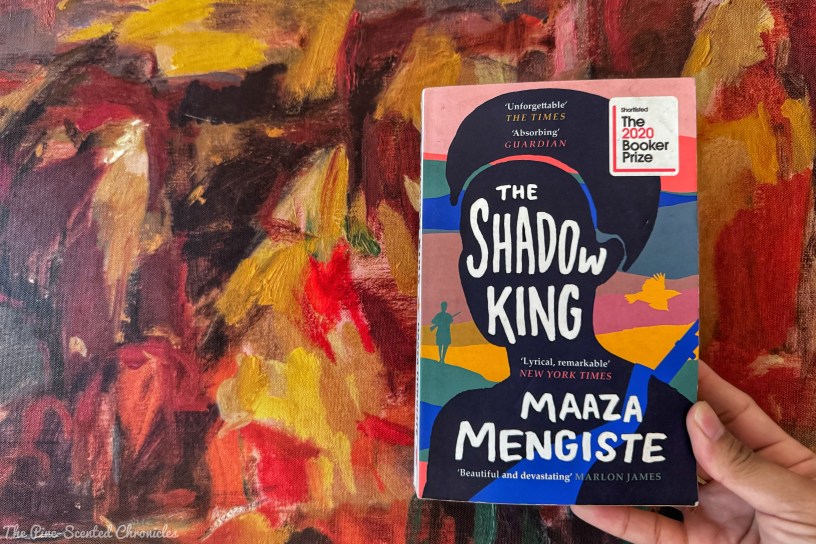
Shortlisted for the 2020 Booker Prize, The Shadow King reclaims history from silence and challenges the traditional boundaries of heroism. By centering women’s experiences during the Second Italo-Ethiopian War, Maaza Mengiste exposes how acts of courage, leadership, and resistance have too often been narrated through a masculine lens. Through Hirut, Aster, and the other women who demonstrated indomitable courage in light of conflict, the novel demonstrates that heroism is not defined by gender but by resilience in the face of oppression and violence. At the same time, its morally complex characters reveal that war resists simple divisions between good and evil, heroism and brutality. In recovering the voices of those long overlooked, Mengiste not only revises a historical narrative but also reshapes how memory itself is constructed. The Shadow King ultimately affirms that history is not only made on the battlefield but also preserved in the stories that survive it.
The real emperor of this country is on his farm tilling the tiny plot of land next to hers. He has never worn a crown and lives alone and has no enemies. He is a quiet man who once led a nation against a steel beast, and she was his most trusted soldier: the proud guard of the Shadow King. Tell them Hirut. There is no time but now. She can hear the dead growing louder: we must be heard. We must be remembered. We must be known. We will not rest until we have been mourned. She opens the box.
Maaza Mengiste, The Shadow King
Book Specs
Author: Maaza Mengiste
Publisher: Canongate
Publishing Date: 2020 (2019)
No. of Pages: 424
Genre: Literary, Historical
Synopsis
Ethiopia, 1935.
With the threat of Mussolini’s army looming, recently orphaned Hirut struggles to adapt to her new life as a maid. Her new employer, Kidane, an officer in Emperor Haile Selassie’s army, rushes to mobilise his strongest men before the Italians invade.
Hirut and the other women long to do more than care for the wounded and bury the dead. When the Emperor goes into exile and Ethiopia quickly loses hope, it is Hirut who offers a plan to maintain morale. But how could she have predicted her own personal war is still to come, as a prisoner of one of Italy’s most vicious officers?
About the Author
Maaza Mengiste was born in 1971 in Addis Ababa, Ethiopia. When she was four, her family fled the country due to the Ethiopian Revolution. She spent the rest of her childhood in Nigeria, and Kenya, before settling down in the United States. She earned a Bachelor of Arts degree in English from the University of Michigan. She later studied in Italy as a Fulbright Scholar and earned an MFA degree in creative writing from New York University. At a young age, she discovered the power of words while learning how to read English. However, her family didn’t consider writing as a career; she ended up becoming a business strategy consultant
Mengiste, however, never forgot the experience of immersing in literary works She never stopped reading. Mengiste’s initial forays into publishing occurred through essays and nonfiction pieces that appeared in prestigious literary publications such as Granta, The Guardian, and The New York Times during the mid-2000s. In 2010, she published her first full-length work of prose, Beneath the Lion’s Gaze. It was selected by the Guardian as one of the 10 best contemporary African books and named one of the best books of 2010 by different publications. Nearly a decade later, she released her second book, The Shadow King. The novel was shortlisted for the Booker Prize in 2020. It was a 2020 LA Times Book Prize Fiction finalist and was named best book of the year by the New York Times, NPR, Elle, and Time. Her story, “Dust, Ash, Flight,” which appeared in Addis Ababa Noir, edited by Maaza, was awarded a 2021 Edgar Award for Best Short Story.
Apart from writing, Mengiste has taught at institutions like Queens College, City University New York; Lewis Center for the Arts, Princeton University; and Wesleyan University, and held a residency in Zurich, offered by “Writers in Residence,” the Literaturhaus Zurich and the PWG Foundation. She has won a Guggenheim Fellowship, an American Academy of Arts and Letters Award, and a Fulbright Fellowship, amongst others. She has also worked with Words Without Borders.

