
First Impression Friday will be a meme where you talk about a book that you JUST STARTED! Maybe you’re only a chapter or two in, maybe a little farther. Based on this sampling of your current read, give a few impressions and predict what you’ll think by the end.
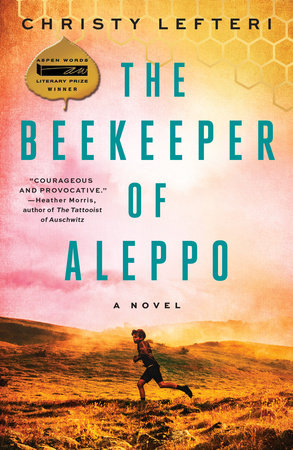
Synopsis:
Every morning, Nuri the beekeeper rises early to hear the call to prayer before driving to his hives in the countryside. On weekends, his wife Afra, a gifted artist, sells her paintings at the open-air market in the square. They live simply, rich in family and friends, in the hills of the beautiful Syrian city of Aleppo – until the unthinkable happens. When all they love is destroyed by war, Nuri knows they have no choice except to leave their home. But escaping Syria will be no easy task: Afra has lost her sight, leaving Nuri to navigate her grief as well as a perilous journey toward an uncertain future in Britain.
Moving, intimate, and beautifully written, this is a story for our times: It reminds us that our lives can be upended instantly – and brings a journey in faraway lands close to home, never to be forgotten.
It’s the end of the workweek—yay! I hope the week has been kind to everyone and that you’re all ending it on a high note. Just like that, we are already a third of the way through the eighth month of the year. August, interestingly, is also referred to as the Ghost Month. It is often considered an ominous period, when businesses experience slowdowns and travel is discouraged. Nevertheless, I hope you’re being showered with blessings and good news. How time flies! We are already nearly through August. Time takes its natural course, with little regard for us. I hope the first seven months of the year have been promising. As the year progresses, I hope everyone is given plenty of opportunities to grow and improve. With the weekend finally here, I hope everyone has a great one. It’s time to dress down and spend it resting from the rigors of a demanding career, pursuing your passions, completing household chores, spending time with loved ones, or simply relaxing. It is going to be another damp weekend here in the Philippines. I hope you’re all doing well—physically, mentally, and emotionally.
After four months of exploring European literature, I finally concluded the journey. I had originally planned to complete it in just two months, just enough time to finish all the works by European writers on my reading challenges. Ironically, it was these very books that ultimately extended my literary adventure. With my European literary adventure this year officially complete—the longest I have spent immersed in European literature in a single year—I have commenced a new literary journey. With July being my birth month, I decided to embark on a literary adventure into a territory closer to home: Asian literature. Apart from being part of the region, I have often dedicated July to the works of Japanese writers, as Japanese literature is one of my favorite literary traditions. As always, I had several works of Asian literature on my reading list. It was therefore a foregone conclusion that I would extend this journey into August. With August drawing to a close, I am slowly wrapping up this memorable literary adventure.
Speaking of Japanese literature, I am quite excited about the news of Haruki Murakami’s latest novel. I am eagerly awaiting its English translation, as it promises to offer a different dimension of Murakami’s prose. My current read, however, takes me beyond Japan to a literary tradition that I, admittedly, have rarely ventured into. This is literally uncharted territory. During the 2010s, Syria became part of the world’s collective memory. The outbreak of the Syrian Civil War divided the Middle Eastern nation. This was exacerbated by the rise of terrorist groups and the involvement of foreign powers, most prominently Russia. While I have long been familiar with Syria and Damascus (one of the oldest continuously inhabited cities in the world), I can’t say that I have explored its literature to any significant extent. The closest I came to it was Zeyn Joukhadar’s The Map of Salt and Stars, a book that explores the refugee crisis that ensued following the Syrian Civil War. Tenderly written, it is easily one of my favorite books.
This places Christy Lefteri’s The Beekeeper of Aleppo in a unique position. Interestingly, Lefteri was born to Greek Cypriot refugee parents who met in London after fleeing the 1974 invasion. Nevertheless, I am interested to see what the novel has in store. My curiosity has been piqued in part because the book seemed to be ubiquitous. I was finally able to read it, although it had been sitting on my bookshelf for half a decade already. In a way, it shares similarities with The Map of Salt and Stars, as Lefteri’s novel also explores the Syrian refugee crisis. Originally published in 2019, The Beekeeper of Aleppo chronicles the story of Nuri and Afra, who are from the city of Aleppo, the second-largest city in Syria. The story alternates between two timelines: the past and the present. The novel opens in the present timeline. It is 2016, and Nuri and Afra find themselves in a bed-and-breakfast in England while attempting to claim asylum.
The novel commences with Nuri confessing his fear about Afra’s eyes. He fears that her eyes are disappearing. The reason for her blindness is not immediately explained. However, it is obviously causing distress between the couple, especially for Nuri, who can fully see and grasp the dire nature of their present circumstances. They are joined by other refugees in the bed-and-breakfast, among them the Moroccan Hazim and Diomande. Despite their different backgrounds, they are united by the same cause: they are all waiting to begin the process of claiming asylum in England. Lucy Fisher, a social worker, assists them by processing their paperwork and helping them prepare for their immigration interviews. There is a lingering fear of rejection. This elicits the question of the circumstances that brought them to England. The answers, as always, lie in the past.
In Aleppo, Nuri and his family are living a simple life. Nuri is a beekeeper; he is the titular beekeeper of Aleppo. He learned the craft from his cousin, Mustafa. Together, they run a successful business caring for their bees. They also sell honey-based products. Nuri loves his work. Afra, on the other hand, earns a living as a prolific artist. The couple has a young son named Sami. Their family shares meals with Mustafa and his wife, Dahab, and their children, Firas and Aya. Their idyllic life, however, is slowly shattered by the encroaching war. Sensing trouble brewing on the horizon, Mustafa sends his wife and Aya to England. Soon after, the war makes its way into their city. Vandals destroy their apiaries, prompting Mustafa to plan his departure from Syria. Unfortunately, before they can leave, Firas is killed. Mustafa eventually flees to England. Before leaving, he leaves a note for Nuri, asking him to follow as soon as he can.
Nuri, however, has a challenging time convincing Afra to leave. She is grief-stricken by the death of their son; just like her blindness, Lefteri leaves the details of Sami’s death unexplained. Afra refuses to leave Syria. She eventually changes her mind when soldiers threaten Nuri’s life and ransack their house. Thus commences their long journey to England, leaving their country behind. The Syrian Civil War of the 2010s made waves, literally, especially through the refugee crisis it instigated. As their homes and cities were destroyed by soldiers and terrorists, ordinary Syrians were forced to flee their country. They made it out of the country through different channels, but many were smuggled by ship. Some of these ships met with disaster. In fact, one of the most enduring symbols of this crisis is the drowning of two-year-old Alan Kurdi. He and his parents were fleeing Syria and ISIL. The photograph of Kurdi’s drowned body became a symbol of the suffering of refugees trying to reach Europe.
The Beekeeper of Aleppo subtly references this incident. On the ship on which Afra and Nuri are smuggled, they meet Mohammed, a young boy around Sami’s age who seems to be alone. Nuri takes him under his wing, especially after Mohammed repeatedly expresses his fear that the ship will sink. Nuri comforts the boy and even pretends to be his father when interacting with the local authorities. The details of Afra and Nuri’s journey are richly rendered. This is one of the finer elements of the novel. I am looking forward to seeing how it further unfolds. Interestingly, despite the book’s dark themes, the novel is a quick read. Or perhaps accessible is the operative term. I am nearly halfway through the book, but there are still many things I am looking forward to. How about you, fellow reader? What are you reading this weekend? I hope you’re enjoying your current book. Happy weekend!
 The Pine-Scented Chronicles