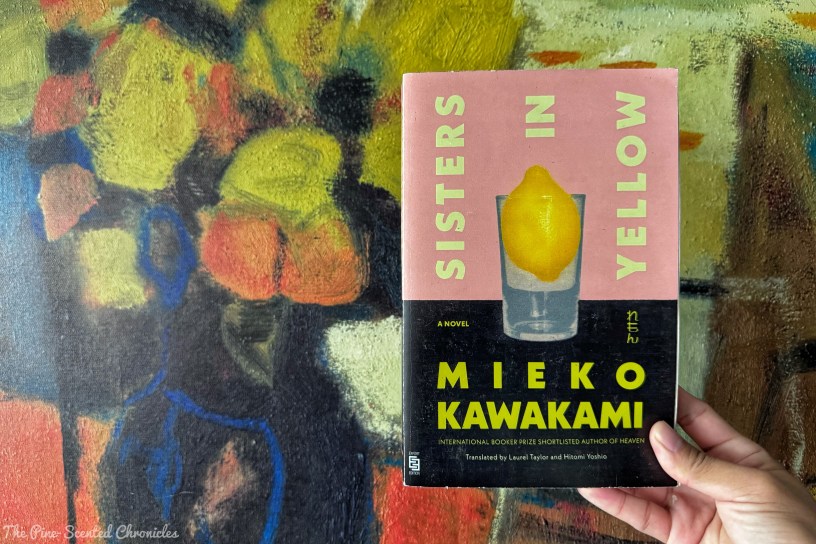
Into the Japanese Criminal Underworld
Japan parades a long and credible list of writers who have conquered the world stage. It is a vast and rich part of the literary world, boasting a literary lineup that includes two Nobel Laureates in Literature: Yasunari Kawabata (1968) and Kenzaburō Ōe (1994). Kazuo Ishiguro, the 2017 Nobel Laureate in Literature, is also of Japanese descent. This literary trio is joined by a formidable list of highly acclaimed and globally renowned writers, including Jun’ichirō Tanizaki, Yukio Mishima, Natsume Sōseki, and Haruki Murakami. They are remarkable writers. However, as one sifts through the list, it becomes increasingly palpable that Japanese literature, like much of the literary and publishing world, is dominated by male writers—or, at the very least, that male Japanese writers were the first to achieve global recognition. Interestingly, The Tale of Genji, widely regarded as the first, if not one of the first, novels ever written, was penned by a court lady during the Heian period, Lady Murasaki Shikibu.
However, if there is anything Lady Murasaki Shikibu has proven, it is that female Japanese writers are as capable as their male counterparts. Since the success of The Tale of Genji, female Japanese writers have risen to the challenge. They are taking the global literary stage by storm. The age of globalization has made their works more accessible to non-Japanese-speaking readers. They have made their mark, earning recognition on their own merits; some of their works have even been recognized by prestigious award-giving bodies. The remarkable rise of female Japanese writers is astounding to witness, to say the least. Names like Yōko Ogawa, Yoko Tawada, Kikuko Tsumura, Natsuo Kirino, Hiromi Kawakami, Banana Yoshimoto, and Sayaka Murata are leading a new wave of promising Japanese writers, further ensuring the continuity of excellence in one of the literary world’s most revered traditions. With their captivating works, they have become household names.
In the company of these amazing writers is Mieko Kawakami. She is also at the forefront of the recent surge of interest in the works of female Japanese writers. Since the release of the English translation of her novel Natsu Monogatari (夏物語, Breasts and Eggs, 2019), she has been making remarkable strides toward global recognition. The original manuscript of the novel, Chichi to ran (2008), earned Kawakami the prestigious Akutagawa Prize, underscoring her prominent position in local literary circles. The global success of Breasts and Eggs has also opened new doors for Kawakami. Some of her earlier works were eventually translated into English, earning her further praise from readers and literary pundits around the world. More recently, the English translation of her 2009 novel Hevun (Heaven) made the shortlist for the 2022 International Booker Prize. In the same year, her 2011 novel, すべて真夜中の恋人たち (Subete Mayonaka no Koibitotachi), was released as All the Lovers in the Night
How did people go on living? People I passed on the street, people reading newspapers in the cafés or drinking booze in the izakaya, eating ramen, going out with friends to make memories, people coming from somewhere, going elsewhere, laughing, raging, crying, people who live for today and would wake up and do the same tomorrow. How did they do it?
Mieko Kawakami, Sisters in Yellow
Striking while the iron is hot, Kawakami made her literary comeback in 2023 with the publication of 黄色い家 (Kiiroi Ie). In 2026, it was made available to Anglophone readers as Sisters in Yellow. At the heart of the novel is Hana Ito, who, at the beginning of the story, is in her late thirties. It is the start of the COVID-19 pandemic, and Hana is working part-time at a deli in Tokyo. As Japan is about to shut down because of the spread of the coronavirus, Hana stumbles upon an online news article that stops her in her tracks. It concerns a crime involving a woman named Kimiko Yoshikawa. The sixty-year-old Yoshikawa is accused of keeping a vulnerable young woman locked in her apartment for two years. The article stirs long-buried emotions in Hana, causing her thoughts to drift back to the Kimiko she knew two decades earlier, when Hana was twenty, and Kimiko was forty. As memories begin to haunt her, Hana worries that the past she has long suppressed might resurface.
This naturally piques the reader’s curiosity. Who is Kimiko Yoshikawa? How does Hana know her? What was the nature of their relationship? The answers, as always, lie in the past. From the present, Kawakami takes us back to Japan in the 1990s, when Hana is fifteen years old and full of hope. However, little else is going well in her life. She lives in a small, run-down apartment with an absent-minded mother who drifts in and out of both her home and her life. Her father has long been gone, while her mother works in late-night dive bars. One day, Hana wakes up to find a strange woman lying beside her: Kimiko. It is a strange experience, to say the least. Apparently, Hana’s mother has disappeared and asked her friend Kimiko to look after Hana for the summer. For the first time in her life, Hana experiences what it feels like to be taken care of. In Kimiko’s company, Hana experiences companionship and a sense of belonging. For the impressionable young girl, being with Kimiko provided her with a completely new experience.
When she gets the chance to move in with Kimiko later on, Hana accepts the offer. She wants to earn enough money to leave poverty and squalor behind. When Kimiko suggests opening a bar, Hana agrees to help. The two women work hard to establish a bar they call Lemon. Located in a run-down apartment block near Sangenjaya Station in central Tokyo, it is named Lemon after the yellow fruit that echoes Kimiko’s name. The fruit also represents the color yellow. Kimiko is fascinated by feng shui, in which yellow symbolizes wealth. Over time, men begin to frequent the bar, and it becomes a success. Kimiko introduces Hana to Yeongsu, a shady businessman. Lemon eventually transforms into a refuge of sorts for them both. While it lacks glamour, it is something they can call their own. For Hana, that means hope. For Kimiko, it means survival. The two women become known as the “sisters,” hence the book’s English title; the Japanese title, however, literally translates to Yellow House.
Over the following months, Hana befriends Ran Kato, a young woman at a nearby cabaret club and a calming influence. They are later joined by Momoko, a runaway rich girl with a remarkable singing voice. The three develop a close bond. Hana’s life of isolation is slowly replaced by one surrounded by laughing voices. The four women build a kind of family, along with the growing success of Lemon. Despite this success, Hana continues to work hard and save every yen she earns. However, something always seems to thwart her plans. For instance, someone steals her box of cash. At one point, her mother needs to be bailed out after getting into debt and falling victim to a scam. Everything comes to a head when the bar burns down after becoming entangled in a credit card scam. No matter how hard Hana tries to build a future, she always finds herself starting from scratch. These are difficult economic times.
Yeah. People like Kimiko, you can make them do anything, do anything to them. No family, no connections to the normal world, no real ID. If they disappear all of a sudden, nobody cares. There are lots of folks like that working in the dark, and to some people, they’re just things. Things you can use. Because they’re so easy to get rid of, to sink. That’s what I mean.
Mieko Kawakami, Sisters in Yellow
With Lemon burning down, the world grows darker. It feels as though all hope has been dashed. This prompts Hana to change as reality slowly reveals itself in all its cynicism. Will life finally start looking up for the battle-scarred young woman? As fate would have it, the financial independence Hana yearned for kept getting further out of reach. The four women’s situation further deteriorates. They struggle to earn money through legitimate means. They become increasingly desperate, especially Hana, who wants to escape the insecurity of poverty that has defined her childhood. Their desperation pushes them toward increasingly risky and illicit ways of earning a living. Securing financial independence proves to be a slippery slope, and the young women find themselves with fewer and fewer options. They become entangled in fraud and with shady businessmen. With no other recourse, they eventually become involved with the criminal underworld.
Sisters in Yellow is a multilayered novel that grapples with a plethora of themes and subjects. At the outset, it is Hana’s coming-of-age story. Despite the abject poverty that surrounds her and growing up in a household bereft of love and care, she is brimming with optimism and dreams. She is vulnerable, but she does not let her childhood experiences weigh her down. Still, she yearns for escape, affection, and security. Her entry into adolescence thus emerges as the novel’s emotional backbone. As she grows up, Hana also yearns for a sense of belonging. Everything she has been looking for is provided by Kimiko. Kimiko’s encounter with Hana is serendipitous. It is the opening Hana does not know she needs. In the company of the women of Lemon, Hana is able to find what she has been looking for. Together with Kimiko, Ran, and Momoko, she finds a makeshift family. It provides Hana with the affection and security she has always yearned for.
Family then emerges as a central theme. Hana is unable to find it at home, but Kimiko provides her with a semblance of one. Momoko, on the other hand, is raised in an affluent environment. However, like Hana, she is searching for stability and belonging. Lemon is also symbolic. It is not merely a place where men can pass their time; for the four women, it is a safe haven. It provides them with a sense of security and something they can call their own. The story of the four women then captures the beauty and intricacies of found families. In one another, they find the security of companionship, something that society at large has failed to provide. Like typical families, found families also come with complications. They have their misunderstandings and disagreements. Hana is a taskmaster who assumes the role of the household’s leader, a role shaped by the circumstances in which she was raised. She controls the household’s finances, and every penny is accounted for. She works hard and saves every yen she earns.
There seems to be a lingering fear of running out of resources, of scarcity. This is something she tries to instill in Ran and Momoko. It is also her fear of returning to destitution that drives Hana to work even harder. Of equal importance to the novel as a whole are the factors that lead to the convergence of the characters’ paths. The young women are pushed to the brink by poverty; class plays a prominent role in the story. Kawakami vividly captures the suffocating sense of desperation and fear that destitution creates. While the novel captures the beauty of found families, it gradually transforms into an exploration of how poverty limits one’s options. What was supposed to be a yearning to live becomes a struggle to survive in a dog-eat-dog world. Tender moments of affection among the four women are interspersed with scenes in which Hana learns the ropes of the underground business. There is also an urgency for her to learn, lest they sink further into the quagmire of poverty.
How do people go on living? People I passed on the street, people reading newspapers in the cafes or drinking booze in the izakaya, eating ramen, going out with friends to make memories, people coming from somewhere, going elsewhere, laughing, raging, crying, people who live for today and would wake up and do the same tomorrow. How did they do it? I knew they had honest jobs, earned honest money. But embarrassed I didn’t understand was how they’d first obtained the qualifications to live within that honesty. How had they made it to that side? I wanted someone to tell me. My nights were sleepless, filled with worry, tossing and turning, and my thoughts grew distorted, so much so that I almost called my mother.
Mieko Kawakami, Sisters in Yellow
Kawakami is unsparing in her depiction of the Japanese underground. She provides intimate details of the scams, small tricks, and grifts that sustain this shadowy economy. Readers learn about them at the same time Hana does. This vicarious experience lends the novel an added layer of realism. Kawakami depicts the lives of marginalized working-class women and girls, a subject that is rarely explored in contemporary Japanese literature. After all, the stories of marginalized women have often been obscured from public view. Because of her experiences, Hana slowly sheds the idealism and innocence with which she initially approaches her found family. She realizes that there is more to adulthood than merely gaining the freedom to pursue one’s own path. The search for independence becomes perilous in the absence of financial and social support. These layers of social critique provide the novel with considerable nuance.
As an adult, Hana looks back on her experiences in an attempt to understand her younger self and the choices she made. Hana shares many qualities with Kawakami’s other protagonists. She is the kind of character with whom readers can naturally form a deep connection. What also stands out is Hana’s insatiable desire for belonging. She keeps trying to hold everyone and everything together, despite the cracks that keep appearing. Beyond the bonds of female companionship, the relationship among the four women is complicated by trust, manipulation, and self-interest. Their subtle acts of betrayal capture how people can change when their survival is on the line. There is a thin line between sisterhood and survival. The world is stacked against them. They survive on ramen and bento boxes from convenience stores, and their lives revolve between work and days spent watching television. The canned laughter provides a temporary distraction from their dreary lives.
Sisters in Yellow, however, does not reduce itself to a mere coming-of-age story or a journey into the Japanese underworld. At its heart, it is a poignant examination of what people are willing to do when the desire for security, belonging, and independence collides with the harsh realities of poverty. Through Hana and the women of Lemon, Kawakami explores the fragility of found families and the difficult choices that emerge when survival becomes an overriding concern. Hana’s journey from an optimistic and vulnerable girl into a battle-scarred young woman is marked by disillusionment. Even amid poverty, betrayal, trauma, and despair, she continues to search for meaning and connection. This tension between darkness and hope gives the novel much of its emotional power. Unflinching yet deeply compassionate, Sisters in Yellow is a compelling portrait of young women struggling to carve out a place for themselves in a world that has given them very little. An engrossing coming-of-age tale about young women living in the shadows of Japan’s criminal underworld, Sisters in Yellow is a welcome addition to Kawakami’s growing oeuvre.
A piggy bank, a stuffed animal, a pair of chopsticks, a makeup pouch, a pencil case, envelopes, notepads, stickers, a ball of yarn, a bunch of boxes in all different sizes, a keychain, fake flowers, a spool of ribbon, and even a yellow good-luck cat. Every time I added something new to the already crowded shelf, I felt like it made our future just a little brighter—like it was bringing us more good luck, one step at a time.
Mieko Kawakami, Sisters in Yellow
Book Specs
Author: Mieko Kawakami
Translators (from Japanese): Laurel Taylor and Hitomi Yoshio
Publisher: Alfred A. Knopf
Publishing Date: 2026 (2023)
No. of Pages: 430
Genre: Historical, Literary
Synopsis
Hana has nothing – she’s fifteen years old and living in a tiny apartment in a suburb of Tokyo with her young mother, a hostess at a local dive bar. They have no money, no security. Then Kimiko appears. She’s a bright light in Hana’s dark world. Together they set up Lemon, a bar that, despite its shabby setting and seedy clientele, becomes a haven for Hana. Suddenly she has a job she loves, friends to share her days with, and the glittering promise of money. She feels like a normal girl. She feels invincible.
But in the narrow alleys of Sangenjaya, nothing is as it seems. Soon all of Hana’s hope, her optimism, and her drive will be pushed to the limit…
A story of enduring friendship and deep betrayal, Sisters in Yellow is a masterpiece of teenage dreams and adult cruelties that confirms Mieko Kawakami as one of the great writers of her generation.
About the Author
To learn more about the Japanese writer, do click here.
 The Pine-Scented Chronicles