Crisis at the Border
Latin American Boom was instrumental in catapulting Latin American literature to global recognition in the 20th century. It was a period that featured literary titans such as Colombian Gabriel García Márquez, Peruvian Mario Vargas Llosa, Cuban Lezama Lima, and Argentine Julio Cortázar. Their works placed Latin American literature on the global literary map. García Márquez’s Cien años de soledad (1967; One Hundred Years of Solitude), Cortázar’s Rayuela (1963; Hopscotch), Lima’s Paradiso (1966), and Vargas Llosa’s La ciudad y los perros (1963; The Time of the Hero) all remain among the most recognized works today and are among the cornerstones of contemporary Latin American literature, pivotal in elevating Latin American literature to global consciousness. Their legacy endures, with succeeding generations of Latin American writers drawing inspiration from their fabled lives and diverse oeuvres.
Mexican literature has also played a prominent role in this remarkable rise of Latin American literature. Mexican literature is one of the most influential bodies of Spanish‑language writing. Like its Latin American peers, Mexican literature traces its origins to indigenous oral traditions, which were eventually shaped by colonial movements. Post-independence and modern cultural movements allowed it to diverge from the colonial movements and assume its own distinct identity. This evolution reflects Mexico’s complex history, identity, and social struggles. Over time, Mexico has produced some of the most revered names in the world of literature and some of the world’s most recognized titles. Carlos Fuentes was among the pillars of the Latin American Boom. Several Mexican writers have been nominated for the prestigious Nobel Prize in literature. Among them are Rafael Altamira y Crevea, Enrique González Martínez, and María Enriqueta Camarillo Roa. In 1990, poet and diplomat Octavio Paz Lozano was recognized by the Swedish Academy.
The Mexican literary tradition continues to thrive in the contemporary period. The works of writers such as Yuri Herrera, Mario Bellatin, Guadalupe Nettel, Luís Alberto Urrea, Álvaro Enrigue, and Cristina Rivera Garza have gained international recognition and earned numerous accolades. They are joined by Valeria Luiselli. Born in Mexico City, her younger years were shaped by constant uprooting. Her father’s work in NGOs and later as a diplomat moved the family to Costa Rica, South Korea, and South Africa. Luiselli even attended UWC Mahindra College in India before returning to Mexico, where she completed a BA in philosophy at the National Autonomous University of Mexico. She eventually moved to New York City to pursue a master’s degree in Latin American studies and a PhD in comparative literature at Columbia University. In 2010, she published her first book, Papeles falsos, a collection of essays. A year later, she published her first novel, Los ingrávidos, which was translated into English as Faces in the Crowd.
I also like the constant tension in those pictures, a tension between document and fabrication, between capturing a unique fleeting instant and staging an instant. She wrote somewhere that photographs create their own memories, and supplant the past. In her pictures there isn’t nostalgia for the fleeting moment, captured by chance with a camera. Rather, there’s a confession: this moment captured is not a moment stumbled upon and preserved but a moment stolen, plucked from the continuum of experience in order to be preserved.
Valeria Luiselli, Lost Children Archive
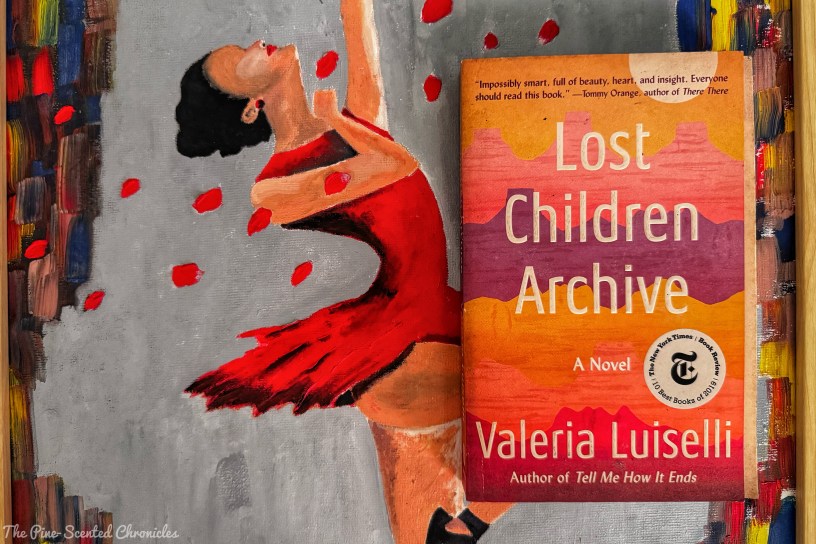
In 2019, Luiselli published Lost Children Archive, her first novel written in English. At the heart of the story is an anonymous family, whose matriarch serves as the novel’s spiritual guide. The narrator and her husband are documentarians whose paths first crossed when they were hired for a project documenting the Big Apple’s diverse soundscape. The soundscape is a recorded compilation of the diverse languages spoken by the people of New York City. It was a fated meeting, as they instantly fell in love. A whirlwind romance resulted in marriage, and they brought their families together as one. Before meeting, the couple already had children. The wife has a daughter from her first marriage, while the husband has a son from his first marriage to his now-deceased wife. Together, the four live in relative harmony. However, following the conclusion of the soundscape project, cracks in their marriage begin to emerge.
The couple starts to notice their differences. Their creative goals and professional aspirations begin to diverge. Their interests and perspectives on life are also not aligned. The narrator attributes these differences to her being a “documentarian” and him being a “documentarist.” The former is likened to a chemist, while the latter is compared to a librarian. Their creative differences also spill over into their emotional connection, creating a wedge in their ability to communicate. Following the completion of their New York City soundscape project, the couple becomes engrossed in separate sound projects. Her husband becomes fixated on a project documenting an inventory of echoes about Geronimo and the Apache people in the region once known as Apacheria. He wants to capture Apache ghosts, echoes, and absences through recordings of mundane sounds such as birdsong and the humming of insects in places once inhabited by the Apaches. To document these sounds, the family has to move to Arizona.
Meanwhile, the narrator volunteers as a Spanish-language translator in New York City’s federal immigration court. Her proximity to the stories of migrants leads her to develop a project documenting their experiences, particularly the voices of the lost refugee children caught up in the immigration crisis at the border. This project is born out of her interaction with Manuela, who seeks the narrator’s assistance in translating legal papers to help free her two young daughters from Border Patrol custody. Manuela has hired a “coyote” to help guide her daughters to her home in New York City; a coyote is an individual hired to help migrants cross the Mexican-American border. However, her daughters are being held in a detention center. When her husband proposes moving to Arizona, the narrator agrees to temporarily accompany him. She hopes to find Manuela’s daughters. Once she locates them, she plans to return to New York with her daughter, while her husband and his son remain in Arizona.
The family of four then embarks on a journey to Arizona. They are cognizant that the conclusion of the trip could also mark the end of their life as a family unit. With this in mind, they bring along their own archive boxes containing books, Polaroid photographs, and other scraps of research significant to their respective projects. While they are driving, the children engage in playful car games and sing along to uplifting music. These light moments, however, are constantly disrupted by radio broadcasts bringing troubling news about an impending immigration crisis at the southwestern border. Several refugee children are reported missing. Some are detained while attempting to cross the border, while many are separated from their families. This harrowing news deeply affects the mother. While her husband becomes preoccupied with his Apache project, she slowly becomes obsessed with the plight of these “lost children.”
When you read words like that in a book, beautiful words, a powerful but fleeting emotion ensues. And you also know that soon, it’ll all be gone: the concept you just grasped and the emotion it produced. Then comes a need to possess that strange, ephemeral afterglow, and to hold on to that emotion. So you reread, underline, and perhaps even memorize and transcribe the words somewhere—in a notebook, on a napkin, on your hand.
Valeria Luiselli, Lost Children Archive
On the way to Arizona, the family also makes several stops, visiting a range of towns and historical sites. The couple believes these sites will illuminate the subjects and intentions of their respective projects. The mother also reads to the children from a collection of books. Most of these books are about lost or displaced children, such as Chronicle of a Death Foretold by Gabriel García Márquez and Trieste by Daša Drndić. This only underscores the mother’s looming mission. It becomes increasingly palpable, however, that the narrator is desperate to get to the bottom of the story she is tracing. She desperately wants to find Manuela’s daughters. Meanwhile, her husband records the children’s conversations and the sounds they encounter. He wants to create his own archive of their journey. The stark contrast between the parents’ projects underscores their divergent responses to the border crisis. The wife’s growing interest in the “lost children” is contrasted with her husband’s increasing detachment.
The border and immigration crises are the central themes of the novel. The unexpected ascent of Donald Trump to the presidency of the world’s most powerful country sent chills down the spines of many global citizens. Many could already foresee the implications of this unwelcome development. He took a hard-line position on immigration, which confounded many who yearned to escape the violence and economic hardships in their homelands. He repeatedly proposed the construction of a physical wall along the American-Mexican border as part of his “Make America Great Again” agenda. This was even though Mexicans and other migrants form a bedrock of contemporary American society. Among the measures instituted by the Trump administration was the Migrant Protection Protocols, also known as the “Remain in Mexico” policy. The policy required asylum seekers to wait in Mexico for their US immigration hearings.
However, the immigration crisis had long been present. Even President Barack Obama’s administration declared a crisis in 2014 amid an influx of unaccompanied minors and women making their way through the border. This crisis became one of the focal points of Donald Trump’s 2016 campaign. The impact of tightening border controls was felt most acutely by refugee children. They were forcibly separated from their parents and guardians. The novel notes, “More than eighty thousand undocumented children from Mexico and the Northern Triangle, but mostly from the latter, had been detained at the US southern border in just the previous six or seven months.” They did not arrive in the United States to pursue the proverbial American Dream. Rather, they were fleeing the unspeakable atrocities perpetrated in their homelands. Their countries had become overrun by gangs that had evolved into parastates and usurped state power. They had effectively taken over the rule of law.
History has shown how children are stuck in precarious positions during times of upheaval. In making the trek to the American border, the “lost children” are seeking safety. Vulnerable, they only want to escape the nightmares they witness daily. For the mother, their stories pluck the proverbial heartstrings. What starts as a mission to locate her friend’s daughters evolves into a desire to document and convey the stories of the “lost children.” The novel underscores the power of storytelling and of giving voice to those whose voices have been muted by circumstances and history. Luiselli subtly but astutely juxtaposes fiction, through references to literary classics, against reality, through the stories of the lost children and other immigrants. Trieste also vividly captures how war—in this case, the Second World War—adversely affects children. While this juxtaposition highlights the power of storytelling, the novel also captures the limitations of storytelling in providing solutions to real-world tragedies.
Children force parents to go out looking for a specific pulse, a gaze, a rhythm, the right way of telling the story, knowing that stories don’t fix anything or save anyone but maybe make the world both more complex and more tolerable. And sometimes, just sometimes, more beautiful. Stories are a way of subtracting the future from the past, the only way of finding clarity in hindsight.
Valeria Luiselli, Lost Children Archive
As the story progresses, the journey to Arizona is transformed from a physical journey into an emotional one. Lost Children Archive is as much about the immigration crisis as it is about the intricacies of family dynamics. As the family draws closer to the border, deeper concerns rise to the fore. Tensions between the parents that were previously glossed over begin to escalate. Initially, the differences between the husband and wife center on their creative directions. Their diverging interests and professional projects expose the cracks in their marriage. However, this barely scratches the surface. The journey exposes the husband’s indifference to the border crisis, a major concern in which his wife is deeply invested. Her obsession with the “lost children” also places further strain on their marriage. There is a personal dimension to the novel’s exploration of marital woes. Luiselli began writing the novel as her marriage to fellow writer Álvaro Enrigue was also beginning to fall apart. Toward the novel’s climax, their children run away, further intensifying the tension between the parents. This also physically embodies the “lost children” they hear about on the radio. Their family’s struggles thus reflect the broader crises surrounding migration.
In conveying the story of the lost children, Luiselli also employs different literary and plot devices. Lost Children Archive transforms into a literal archive. Veering away from conventional literary forms, Luiselli organizes the story around archival “boxes” of materials that the characters collect and reference throughout their journey. The novel’s chapters are interspersed with inventories of the contents of each box. These boxes contain appendices of sound recordings, Apache myths, maps, historical documents, lists of words, and journalistic excerpts on border policy. A combination of fictional and nonfictional narratives, quotations from inspirational authors, and a collection of images also provides nuance to the story. The creation of a literal archive underscores the human desire to preserve memory and prevent experiences from disappearing. This also highlights two of the novel’s major themes: memory and history. The contemporary immigration crisis is connected to earlier histories of displacement, violence, and even colonialism.
The winner of the 2021 International Dublin Literary Award, Lost Children Archive is ultimately a poignant meditation on displacement, memory, family, and the power of storytelling. Luiselli deftly connects the intimate struggles of a family with the larger humanitarian crisis unfolding at the American-Mexican border. The family’s gradual disintegration mirrors the separation experienced by migrant families, particularly the children who are left vulnerable by circumstances beyond their control. The creation of archives underscores the importance of preserving stories that might otherwise disappear into the margins of history. In telling the stories of the “lost children,” Luiselli gives them visibility and dignity. However, telling their stories cannot remedy the political and social conditions that made them vulnerable in the first place. Still, Luiselli demonstrates the enduring power of literature to humanize statistics, preserve memory, and give voice to those who have been silenced. Thought-provoking, innovative, and deeply affecting, Lost Children Archive is a powerful testament to the importance of remembering those who have been lost to history.
I suppose that words, timely and arranged in the right order, produce an afterglow. When you read words like that in a book, beautiful words, a powerful but fleeting emotion ensues. And you also know that soon, it’ll all be gone: the concept you just grasped and the emotion it produced. Then comes a need to possess that strange, ephemeral afterglow, and to hold on to that emotion. So you reread, underline, and perhaps even memorize and transcribe the words somewhere – in a notebook, on a napkin, on your hand.
Valeria Luiselli, Lost Children Archive
Book Specs
Author: Valeria Luiselli
Publisher: Vintage Books
Publishing Date: 2019
No. of Pages: 350
Genre: Historical, Literary
Synopsis
In Valeria Luiselli’s fiercely imaginative novel, a mother and father set out with their two children, a boy and girl, driving from New York to Arizona in the heat of summer. As the family travels west, through Virginia, to Tennessee, across Oklahoma and Texas, their bonds begin to fray: a fissure is growing between the parents, one the children can almost feel beneath their feet.
Through sons and maps and Polaroid camera’s lens, the children try to make sense of both their family’s crisis and the larger one engulfing the news: the stories of thousands of kids trying to cross the southwestern border into the United States but being detained – or getting lost in the desert along the way.
A breathtaking feat of literary virtuosity, Lost Children Archive is timely, compassionate, subtly hilarious, and formally inventive – a powerful, urgent story about what it is to be human in an inhuman world.
About the Author
Valeria Luiselli was born on August 16, 1983, in Mexico City, Mexico, to a Mexican family with ties to international affairs. Her father worked in nongovernmental organizations (NGO) before pursuing a diplomatic career. This prompted the family’s early relocations abroad. At around age two, they moved to Madison, Wisconsin, before moving to Costa Rica, South Korea, and South Africa. Following her parents’ separation, she moved back to Mexico City with her mother at the age of 16. Luiselli then attended UWC Mahindra College in India before completing a BA in philosophy at the Universidad Nacional Autónoma de México (UNAM; National Autonomous University of Mexico). At the age of twenty-five, she moved to New York City, where she pursued a master’s degree in Latin American studies and a PhD in comparative literature at Columbia University.
Luiselli’s literary debut came with Papeles falsos, a collection of narrative essays published in 2010. A year later, she ventured into full-length prose with the publication of Los ingrávidos (trans. Faces in the Crowd, 2014). La historia de mis dientes was first serialized in Spanish in 2013 and published in English in 2015 as The Story of My Teeth. In 2017, she published another essay collection, Tell Me How It Ends. Her first novel to be originally written in English is Lost Children Archive (2019); it was translated into Spanish as Desierto sonoro. The book was a critical success. It was longlisted for the 2019 Booker Prize and the 2019 Women’s Prize for Fiction, shortlisted for the 2019 Dayton Literary Peace Prize and the 2020 Rathbones Folio Prize. It was also selected as one of The New York Times‘ ten best books of 2019. It also won the 2021 International Dublin Literary Award. Her latest novel is Beginning Middle End, which was released in 2026.
She teaches literature and creative writing at Bard College, collaborates as a writer with a number of art galleries, and has worked as a librettist for the New York City Ballet. She served as a juror for the Neustadt International Prize for Literature in 2016. Luiselli married Mexican writer Álvaro Enrigue around 2011, after several years together; the couple resided in New York and collaborated informally on literary projects before separating.


I’ve read the book and admired it. I didn’t know the author’s background so thank you for this.
LikeLike