Amid the Turmoil: The Poet’s Struggle to Exist
In the contemporary literary landscape, Austrian literature (Österreichische Literatur) is among the most influential literary traditions. Interestingly, it is closely tied to German literary traditions, with Austrian literature predominantly written in Standard German. However, Austrian literature distinguishes itself from the broader body of German literature because of its divergent historical trajectory and cultural milieu. Historically, Austrian literature traces its origins to the medieval period, when religious epics primarily constituted its body. Courtly literature centered on Minnesang, a lyric tradition of love songs (Minne) that emerged around the period when knights became more important and prosperous as a result of the Crusades. Minnesang idealized knightly service to noble ladies, virtue, and harmonious social order. These songs were often performed by itinerant Minnesingers at princely gatherings. However, Minnesang waned by the fourteenth century as it gave way to didactic and epic forms.
Over the following centuries, Austrian literature was influenced by various literary movements originating elsewhere on the continent, such as Latin humanism, which was supported by Emperor Maximilian I. However, it was during the nineteenth century that Austrian literature began to assume a more distinct identity, diverging from its German origins. The Biedermeier era, spanning from 1815 to 1848, was shaped by depictions of domestic harmony, moral introspection, and observations of nature in response to Chancellor Klemens von Metternich’s repressive policies and strict censorship. In contrast, Vormärz literature channeled veiled dissent through satirical poetry and social criticism, navigating censorship through allegory and the use of pseudonyms. The nineteenth century also saw the emergence of highly acclaimed writers such as Bertha von Suttner, who was awarded the Nobel Peace Prize in 1905 for her novel Die Waffen nieder! (Lay Down Your Arms).
Austrian literature gained further momentum with the arrival of the twentieth century, achieving increasing global recognition. Austria became home to novelists and short-story writers such as Adalbert Stifter, Arthur Schnitzler, Franz Werfel, Stefan Zweig, Thomas Bernhard, and Robert Musil. Poets such as Georg Trakl, Rose Ausländer, Franz Grillparzer, and Paul Celan also contributed significantly to the development of Austrian literature. Collectively, these writers helped place Austrian literature on the international literary map. In the twenty-first century, Elfriede Jelinek and Peter Handke were awarded the Nobel Prize in Literature in 2004 and 2019, respectively. However, two names have become particularly synonymous with Austrian literature. The first one was Franz Kafka. Although he was born in Prague, his influence extends far beyond geographical and national boundaries. His distinctive fusion of realism and the fantastic helped reshape the modern literary landscape, and his legacy continues to transcend time and borders.
And to think that I might have become a poet like that if I had been allowed to settle somewhere, anywhere in the world, in one of the many shuttered-up houses in the country that no one looks after anymore. I would only have needed one room (the light room in the gable). I would have lived inside it with my old things, my family portraits, my books. And I would have had an armchair, and flowers and dogs, and a stout stick for rocky paths. And nothing else. Only a book bound in yellowing ivory-coloured leather with a flowery pattern for its endpapers: I would have written in it. I would have written a great deal, because I would have had many thoughts and memories of many things.
Rainer Maria Rilke, The Notebooks of Malte Laurids Brigge
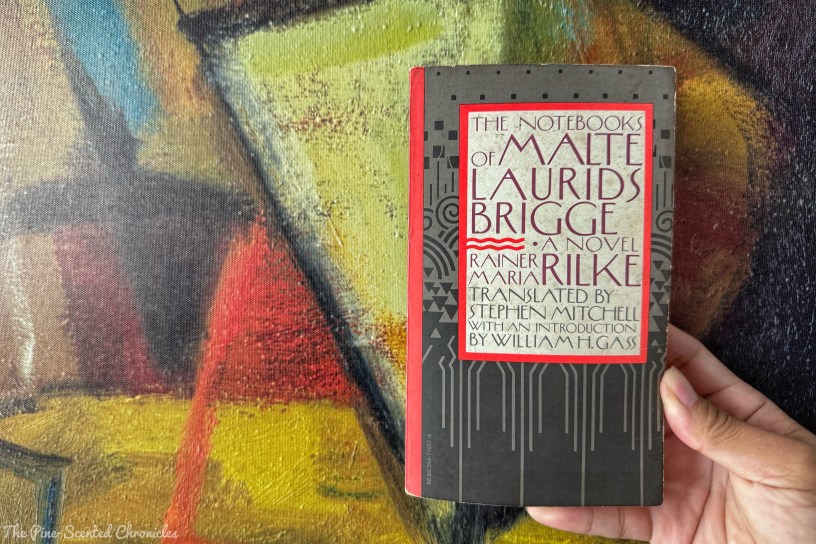
The second name is the poet Rainer Maria Rilke. While Rilke was renowned for his poetry, his oeuvre also includes a few prose works, the most substantial of which is The Notebooks of Malte Laurids Brigge. Originally published in German in 1910 as Die Aufzeichnungen des Malte Laurids Brigge, its first English translation was published under the title The Journal of My Other Self. The titular Malte Laurids Brigge is a 28-year-old Danish man who has moved to Paris to document the work of the sculptor Rodin. He was born into and raised by an affluent and aristocratic family. He pursued a career as a poet but has recently struggled to find the motivation to write even a single poem. He struggles to find his voice as a poet. Distracted, but above all overwhelmed by the French capital’s harsh realities, he instead records his observations of life in the city. His series of 71 notebook and journal entries of varying lengths comprises the novel.
In Paris, Malte finds himself in circumstances starkly different from those in which he was raised. He rents a cheap room on a side street, sharing his surroundings with other poor and struggling people. His first entry is dated September 11, while the rest remain undated. Through these notebook entries, Malte captures life on the streets of Paris, beyond the glitz and glamour often associated with the city. He is transfixed with horror and revulsion by the squalor he encounters, yet most of his early entries focus on the squalor, noise, anonymity, and human suffering he witnesses daily. He is fascinated by the sick, the dying, the poor, and their struggles to stay alive. He feels an intense, almost physical empathy that borders on terror. Interestingly, he differentiates himself from the poor people around him. While they may be as poor as he is, he takes pride in his cleanliness and his expensive suits. His suits have become tattered and worn, but they still allow him admission to the salons and cafés that most poor people cannot enter.
As he wanders through Paris, Malte feels himself changing. The city’s indifference and fast pace gradually wear him down, further isolating him from the world around him. The sights, sounds, and smells of the city are overwhelming. Still, the young Malte feels that he needs to expose himself to the travails of modern life. He hopes this will help him better understand the world. Malte’s memories and musings often drift back to his childhood in Denmark, where he was raised on the family estates of Ulsgaard and Urnekloster. The story constantly moves between the present and the past. His mother, Sophie, died when he was still young. He vividly remembers a trip he took to visit his grandfather, Count Christoph Detlev Brigge, shortly after his mother’s death. The Brahe home was a grand but decaying castle with long corridors, tapestries, and portraits of his ancestors. However, the stately home no longer belonged to the family. The castle’s dark rooms and the eccentricities of his aunts, uncles, and cousin made him feel strange and uneasy.
Many members of the family were fixated on spiritualism and the occult. They even collectively witnessed the ghost of a young woman passing through the dining room on several occasions. However, it was an incident they did not discuss with one another. Malte also writes about their deaths, capturing the unusual ways in which they passed away. This underscores his preoccupation with mortality. Ironically, he harbors a lingering fear of death, which stems from the illnesses he suffered as a child. He recalls his periods of illness, during which he experienced a heightened sensitivity, a blurring of the lines between reality and imagination, and a deeper connection to the unseen. In a way, by writing extensively in his notebooks, he combats his fear of death while also exhausting himself. In Paris, Malte also passes the time reading poetry in the National Library, where he enjoys being surrounded by people who are completely absorbed in their books.
The existence of the terrible in every particle of the air. You breathe it in as part of something transparent; but within you it precipitates, hardens, acquires angular, geometrical forms in among your organs; for all the torments and horrors suffered at places of execution, in torture chambers, in madhouses, in operating theatres, under the arches of bridges in late autumn – all this is possessed of a tenacious permanence, all of it persists and, jealous of all that is, clings to its own frightful reality. People would prefer to be able to forget much of it; sleep files away gently at the grooves in the brain, but dreams drive it away and trace the lines anew. And they wake, panting, and dissolve the gleam of a candle in the dark, and drink in the half-lit solace as if it were sugared water.
Rainer Maria Rilke, The Notebooks of Malte Laurids Brigge
The Notebooks of Malte Laurids Brigge is the renowned Austrian poet’s only novel. Interestingly, it does not read like one. Refusing to conform to the strictures of conventional writing, the book takes the form of a journal composed of fictionalized ‘notebooks,’ diary entries, and journal fragments. The story lacks a formal plot. Instead, Rilke provides a meandering account of the titular Brigge’s daily experiences and observations while living in Paris in the early twentieth century. These observations, however, serve as Rilke’s vehicle for exploring a plethora of themes and subjects. At the outset, Rilke captures the follies of modernity. In Paris, Malte is constantly bombarded by the city’s overwhelming atmosphere. Noise and squalor greet him at every corner, in stark contrast to the glamour and opulence with which the city has become synonymous. The sheer amount of anonymous human suffering confronting him at every turn is overwhelming and suffocating.
This overwhelming feeling gradually transforms into a deep sense of isolation. The urban alienation that envelops him makes him feel like a stranger not only to the rest of the world but also to himself. His personal identity is slowly eroded by the human suffering and noise that surround him. He is a faceless individual among the city’s throng of people. Paris is thus transformed into a tragic setting where traditional identities are lost and gradually replaced by a harsh, impersonal reality. The isolation that Malte feels is evident in his notebooks and ruminations. This compounds his struggle to truly connect with others despite his sensitivity. In his small corner of the world, he struggles with his sense of self. He often questions who he is. Malte ruminates: “I am sitting here in my room, a man of twenty-eight, and I am afraid, afraid of the city, of the people, of the darkness.” Mortality is a prevalent theme, both literal and metaphorical. Death forms part of a larger loss of identity in the modern world.
Through stream-of-consciousness, Rilke evocatively captures the landscape of Malte’s mind, feelings, and perceptions. This creates a sense of immediacy and authenticity as it follows the associative flow of his inner life. These passages provide a glimpse into Malte’s mind, allowing readers to witness his inner anxieties and most intimate thoughts as they are juxtaposed against the noise of his external world. Gradually, his story transforms into a vigorous examination of existence. As his sense of self erodes, he begins to feel as though he is dissolving, becoming a mere observer. This is further underscored by his reflections on False Dmitry, a historical figure who claimed to be the rightful Tsar of Russia. While Malte’s analysis of False Dmitry’s motivations initially appears to be a digression, the story nevertheless highlights the novel’s exploration of identity and authenticity. False Dmitry’s story resonates with Malte’s own struggles with his identity as a poet and his feelings of inadequacy in the world.
To think, for instance, that I have never been aware before how many faces there are. There are quantities of human beings, but there are many more faces, for each person has several. There are people who wear the same face for years; naturally it wears out, it gets dirty, it splits at the folds, it stretches, like gloves one has worn on a journey. These are thrifty, simple people; they do not change their face, they never even have it cleaned. It is good enough, they say, and who can prove to them the contrary? The question of course arises, since they have several faces, what do they do with the others? They store them up. Their children will wear them. But sometimes, too, it happens that their dogs go out with them on. And why not? A face is a face.
Rainer Maria Rilke, The Notebooks of Malte Laurids Brigge
Despite the pressures surrounding him, Malte seeks to create an authentic self. Memory also plays a seminal role in his attempt to understand his own identity and the world around him. His reflections on his family’s unique identities contribute to this exploration of identity. They evoke nostalgia, but they also help Malte understand both his sensitivities and his family’s legacy. Rilke vividly examines the role the past plays in shaping the present. The past is intricately woven into Malte’s story. His memories of his childhood, the eccentricities of his family, and the unique ways in which his relatives lived and died not only anchor him to his roots but also starkly contrast with the overwhelming urban alienation he experiences in Paris. His memories offer both refuge and a deeper understanding of his own being. The past lingers, constantly accompanying him and providing him with company amid the urban bedlam.
Unsurprisingly, the novel contains autobiographical elements. Both Rilke and Malte lived in Paris, and both had connections to the sculptor Auguste Rodin. Malte, an affluent Dane, travels to Paris to write about the French sculptor, who eventually became Rilke’s friend. Rilke even served as Rodin’s secretary. Rilke was also sickly as a child. In a way, Malte serves as Rilke’s alter ego. Through Malte, he examines the role played by poets in a world full of suffering and superficiality. To capture life’s essence through poetry, its harsh realities should not be avoided. They can be transformed into art, but they must first be confronted and absorbed. However, Rilke does not romanticize human suffering. More than being a seer or an observer, one must deeply experience and internalize the world’s pain. The ugly and the bad, after all, must be taken in alongside beauty and goodness. Malte’s notebooks vividly capture his struggles to describe the indescribable and express the inexpressible.
The Notebooks of Malte Laurids Brigge is ultimately less a novel about what happens to Malte than an exploration of what it means to exist, to remember, to suffer, and to create in a world increasingly defined by anonymity and alienation. As Malte confronts the poverty, illness, death, and loneliness surrounding him, he is forced to confront the equally unsettling reality within himself. The present threatens to dissolve his sense of identity, yet his memories anchor him to the past. His notebooks, however, are more than a record of his disintegration; they become an attempt to make sense of it. For Rilke, the poet cannot remain a detached observer of existence. He must absorb both its beauty and its ugliness, and transform these experiences into art. What begins as a young poet’s attempt to document the world around him becomes a profound meditation on identity, memory, death, and artistic creation. Fragmentary but deeply introspective, The Notebooks of Malte Laurids Brigge captures the turmoil of a consciousness struggling to find meaning in modern life. In doing so, it becomes a powerful testament to Rilke’s enduring vision of what it means to be human.
But now that so much is changing, is it not up to us to change? Could we not try to evolve just a little, and gradually take upon ourselves our share in the labour of love? We have been spared all of its toil, and so it has slipped in among our amusements, as a scrap of genuine lace will occasionally fall into a child’s toy-box, and give pleasure, and cease to give pleasure, and at lengthe lie there among broken and dismembered things, worse than all the rest. We have been spoiled by easy gratification, like all dilettantes, and are held to be masters. But what if we despised out successes? What if we began to learn, from the very start, the labour of love that has always been done for us? What if we were to go and become beginners, now that so much is changing?
Rainer Maria Rilke, The Notebooks of Malte Laurids Brigge
Book Specs
Author: Rainer Maria Rilke
Translator (from German): Stephen Mitchell
Publisher: Viking
Publication Date: April 1985 (1910)
No. of Pages: 260
Genre: Historical, Literary, Coming-of-Age
Synopsis
“So this is where people come to live; I would have thought it is a city to die in.” So begins Rilke’s only novel, the brief, haunting Notebooks of Malte Laurids Brigge. First published in 1910, it has proven to be one of the most influential and enduring works of fiction of our century – an instance of lyric expression unmatched in modern prose.
Malte Laurids Brigge is a young Danish nobleman and poet living in Paris. Obsessed with death and with the reality that lurks behind appearances, Brigge muses on his family and their history and on the teeming, alien life he sees in the city around him. Many of the themes and images that occur in Rilke’s poetry can also be found in the resonant pages of the novel, which pre-figures the modernist movement in its self-awareness and imagistic immediacy. As Rilke wrote after the book was published, “Poor Malte begins so deep in misery and, in a strict sense, reaches to eternal bliss; he is a heart that strikes a whole octave: after him almost all songs are possible.
William H. Gass has contributed an introduction to accompany Stephen Mitchell’s powerfully fluent contemporary version of this great book.
About the Author
René Karl Wilhelm Johann Josef Maria Rilke was born on December 4, 1875, in Prague, Kingdom of Bohemia. His father, Josef Rilke, was a railway official, while his mother, Sophie Entz, came from a well-to-do family. His parents’ marriage, however, was unhappy, and Rilke was also forced to live under the shadow of an older sister who had died within a week of birth. His mother treated him like a daughter, dressing him in girls’ clothing for several years. She eventually left his father in 1884 and moved to Vienna so that she could be close to the imperial court. Meanwhile, Rilke’s education was ill-planned and fragmentary. After spending several years at a relatively selective school run by the Piarist religious order in Prague, he was enrolled in the military lower Realschule in Sankt Pölten, Austria. Four years later, he entered the military upper Realschule at Mährisch-Weisskirchen in Moravia. He was eventually forced to leave the school prematurely because of poor health.
After another unsuccessful year at the Academy of Business Administration in Linz (1891–92), Rilke, with the help of a paternal uncle, was able to put his educational career back on track. In the summer of 1895, he completed his studies at the German Gymnasium in the Prague suburb of Neustadt. By the time he left school, Rilke had already published a volume of poetry, Leben und Lieder: Bilder und Tagebuchblätter (1894; Life and Songs). After matriculating at Prague’s Charles University in 1895, he enrolled in courses in German literature and art history and, to appease his family, studied law for one semester. Between 1895 and 1896, he published his second collection, Larenopfer (Sacrifice to the Lares). A third collection, Traumgekrönt (Dream-Crowned), followed in 1896. In the same year, he left the university and moved to Munich, beginning a period of restless travel that would characterize much of his mature life.
In 1897, Rilke travelled to Russia, a journey that would prove to be a milestone in his life and mark the beginning of his first major works. During his travels, the young poet met Leo Tolstoy and Leonid Pasternak, the father of Boris Pasternak. Later, while living in the artists’ colony of Worpswede, Rilke met and married the sculptor Clara Westhoff, who had been a pupil of Auguste Rodin. In 1902, he became Rodin’s friend and, for a time, his secretary. While living in Paris, Rilke entered one of the most productive periods of his poetic career. His first major poetic work, Das Stunden-Buch (The Book of Hours), appeared in 1905, followed by Neue Gedichte (New Poems) in 1907. Among his earlier works were Vom lieben Gott und Anderes (Stories of God) and the romantic cycle Die Weise von Liebe und Tod des Cornets Christoph Rilke (The Story of the Love and Death of Cornet Christoph Rilke). Although he was more renowned for his poetry, Rilke also wrote prose, most notably Die Aufzeichnungen des Malte Laurids Brigge (1910; The Notebooks of Malte Laurids Brigge).
The outbreak of the First World War prompted Rilke to leave France for Munich. In 1919, he moved to Switzerland, where he spent the final years of his life. It was there that he completed his last two major works, Duineser Elegien (1923; Duino Elegies) and Sonette an Orpheus (1923; Sonnets to Orpheus). Rilke died of leukemia on December 29, 1926, in Valmont, Switzerland. Following his death, his reputation continued to grow, and he became one of the most widely admired and influential German-language poets of the twentieth century.
And isn’t the whole world yours? For how often you set it on fire with your love and saw it blaze and burn up and secretly replaced it with another world while everyone slept. You felt in such complete harmony with God, when every morning you asked him for a new earth, so that all the ones he had made could have their turn. You thought it would be shabby to save them and repair them; you used them up and held out your hands, again and again, for more world. For your love was equal to everything.
Rainer Maria Rilke, The Notebooks of Malte Laurids Brigge

