
First Impression Friday will be a meme where you talk about a book that you JUST STARTED! Maybe you’re only a chapter or two in, maybe a little farther. Based on this sampling of your current read, give a few impressions and predict what you’ll think by the end.
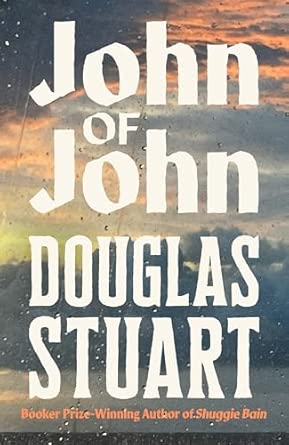
Synopsis:
Out of money and with little to show for his art school education, John-Calum Macleod takes the ferry home to the island of Harris to find that not much has changed except for him. In the windswept croft where he grew up, Cal resumes his old life, caught between the two poles of his childhood: his father John, a sheep farmer, weaver and pillar of their local Presbyterian church, and his Glaswegian grandmother Ella, who has kept a faltering peace with her son-in-law for decades.
While Cal wonders if any young men might be found on the barren hillsides of home, John is dismayed by his son’s long hair and how he seems unwilling to be Saved. As lambing season turns to shearing season, everything is poised to change as the threads holding together the fragile community become increasingly tangled.
John of John is the heartbreaking story of a young man’s return home and how the bonds of family life are torn by the weight of expectation. It confirms Douglas Stuart as one of the great British writers at work today.
It’s the end of the workweek—yay! I hope the week has been kind to everyone and that you’re all ending it on a high note. Just like that, we are about to enter the last week of the tenth month of the year. Things are certainly looking up, at least professionally, although I am still trying to fully integrate into my new job and environment. I am also learning the ropes while looking for ways to improve the current processes. Still, I hope the rest of the year will be just as good. But how time flies! Time takes its natural course, with little regard for any of us. As the year approaches its inevitable close, I hope everyone is rewarded for their hard work. I hope everyone will be showered with blessings and good news. With the weekend finally here, I hope everyone has a great one. It’s time to dress down and spend the weekend resting from the rigours of a demanding career, pursuing your passions, completing household chores, spending time with loved ones, or simply relaxing.
So far, October has brought fine weather, in stark contrast to the relentless rains of August and early September. Still, fear lingers as the prospect of a super El Niño threatens the entire country and much of the world. Some places are already experiencing drought. Unfortunately, forecasts suggest that it could wreak havoc over the coming months, and the situation could only intensify as the year goes on. I hope these forecasts are off the mark, as such conditions could adversely affect the livelihoods and even the health of many. Regardless of where you are in the Philippines or elsewhere in the world, I hope you’re all doing well—physically, mentally, and emotionally. Anyway, with the end of the workweek comes a fresh First Impression Friday update. In September, I crossed the Pacific from my previous literary venture into Asian literature. American literature has been a staple of my annual literary journey.
Given how readily available works by American writers are, I suppose one can never escape them. Thankfully, with the completion of Don DeLillo’s Underworld, I have now completed all the works by American writers in my ongoing reading challenges. They were, after all, the reason I pivoted towards American literature. This now allows me to pursue other books as well. At the start of the year, while searching for books to include in my 2026 Books I Look Forward To List, I learned about the release of Douglas Stuart’s latest novel, John of John. It was at the start of the pandemic that I first came across the Scottish writer. His debut novel, Shuggie Bain, was ubiquitous, especially after it was awarded the prestigious Booker Prize. This naturally piqued my interest, prompting me to secure a copy of the book and read it. I did love Stuart’s prose, although I felt that his sophomore novel, Young Mungo, was more cleanly written.
I was actually surprised when I learned about the release of John of John. My interest in the book multiplied after it was longlisted and eventually shortlisted for the Booker Prize. The novel transports us to the remote Isle of Harris in Scotland’s Outer Hebrides. At the heart of the story is John-Calum “Cal” Macleod, a recent art school graduate who was living in Edinburgh. He struggled to find a permanent address, earning a meagre income from a demeaning cleaning job. He also maintained a fragile connection to his home through weekly phone calls with his father, John. His father was a sheep farmer and weaver. During one of their calls, his father informed him that his maternal grandmother, Ella Morrison, was ailing. He coaxed his son into returning home to Falabay to look after his grandmother. Cal reluctantly agreed, although he dreaded returning home, swallowing an ecstasy pill on the ferry. He hoped it would numb him as he arrived at the small white house at the edge of the sea.
Cal’s reunion with his father is immediately difficult. Their strained relationship is evident, with John quickly criticising his son’s bleached ginger hair and second-hand clothes. John even compared Cal’s appearance to that of a ceard (a vagrant). John also serves as a deacon in the local Presbyterian church. It is a strict Calvinist congregation that still disciplines its members in public shaming sessions and forbids its children from activities such as using the swings on the Sabbath. Cal, however, refuses to embrace his father’s austere faith. As soon as he arrives, Cal learns of his father’s deception. His father exaggerated his grandmother’s condition to lure him home. Trapped and in debt from student loans, Cal is left with no recourse but to stay home. He also deflects his father’s pressure for him to work secretly at the family loom. This is a violation of the weavers’ code that would allow them to increase their output.
Cal then attempts to find alternative work. He tries applying at the local inn, run by Aonghas “Flash” Calder. However, his attempts are futile. He then tries reconnecting with his childhood friend, Doll Macdonald. Their interactions reveal a bitter, resentful young man struggling with alcohol addiction and a sense of being left behind. Meanwhile, the tension in the Macleod home culminates in a vicious argument at the dinner table. John berates Ella for not learning Gaelic; Ella is Glaswegian and clings to her profanity-laced English. This prompts Cal to storm out and seek an escape. He responds to a lonely-hearts ad from a man named William in Inverness. However, his hopeful and revealing letter is met with rejection. Cal’s sexuality is slowly revealed. Queerness, after all, has been a staple of Stuart’s works, and this revelation was expected. In Edinburgh, Cal has been sleeping with men.
But there is more to the story than just the sexuality Cal has concealed from his family. As the story progresses, it becomes clear that it is not only Cal who is concealing a secret. Secrets and resentments permeate the Macleod household. John himself is keeping a secret from his family. I surmise that he uses his devoutness to conceal this secret and keep the public’s eyes from prying into his personal life. It seems that he uses religious dogma to deflect social judgement. After all, rural life can be stifling. Secrets and rumours spread like wildfire. The locals’ judgemental glances do not escape Cal’s notice, even though they try to keep their suspicions quiet. Tradition also subtly factors into their lives, with John standing for conservatism and the past, while his son is a symbol of the present and a more liberal way of life. Just like Stuart’s earlier works, John of John also explores how economic decline can expose the fractures hidden beneath the pretence of communal life.
John of John is an interesting and thought-provoking read. I expect nothing less from Stuart. He vividly examines a plethora of timely subjects. His atmospheric writing also evokes nostalgia for both small-town life and the laid-back life of the 1990s. I am looking forward to seeing how the father-and-son story develops and unravels. How will the secrets they conceal from each other impact their lives? This is just one of the questions that tickle my imagination as I lose myself in the beauty of Stuart’s prose. I am also curious about how the stark difference in language plays into the story; each chapter is numbered in both English and Gaelic.
How about you, fellow readers? What are you reading this weekend? I hope you’re enjoying your current book.

