History, Politics, and Modern Egypt
As one navigates the vast world of literature, one is inevitably bound to encounter works of Arabic literature. With its long and colorful history, Arabic literature has gifted the world with epic tales, tragic romances, and thrilling adventures. It is a literary smorgasbord, a feast for readers. Who has not heard of One Thousand and One Nights, more popularly known as The Arabian Nights? It is easily the most recognizable work of Arabic literature and has influenced countless literary works across cultures. Prominent examples include Jonathan Swift’s Gulliver’s Travels and Daniel Defoe’s Robinson Crusoe. Even the renowned Argentine writer and essayist Jorge Luis Borges drew inspiration from the tales. Despite the passage of time, The Arabian Nights continues to influence popular culture, with its characters and motifs appearing in film, art, music, card games, board games, and video games such as Prince of Persia and Assassin’s Creed: Mirage.
A prominent figure in Arabic literature is Scheherazade. A gifted storyteller, she is a central character in The Arabian Nights and has become deeply embedded in contemporary literary imagination. For their mastery of storytelling and their ability to command the attention of readers and audiences alike, Arabic writers are natural Scheherazades. Across centuries, Arabic literature has produced writers of exceptional caliber whose works remain relevant today. Among those who have kept the flame of Arabic literature burning in the contemporary era are Saud Alsanousi, Alaa Al Aswany, Khaled Khalifa, and Nawal El Saadawi. Yet if there is one name that stands above the rest in Arabic literature, it is that of the Egyptian novelist Naguib Mahfouz. With a prolific career spanning seven decades, Mahfouz’s name is revered in the sacrosanct halls of both Arabic and world literature. His evocative portraits of Egypt earned him the distinction of becoming the first Arabic-language writer to receive the Nobel Prize in Literature in 1988.
In its citation, the Swedish Academy lauded Mahfouz as one “who, through works rich in nuance—now clear-sightedly realistic, now evocatively ambiguous—has formed an Arabian narrative art that applies to all mankind.” Mahfouz firmly established his literary mastery and distinctive prose style through The Cairo Trilogy (Thulathiyyat al-Qahira). The trilogy comprises Palace Walk (Bayn al-Qasrayn; 1956), Palace of Desire (Qasr al-Shawq; 1957), and Sugar Street (Al-Sukkariyya; 1957). These novels remain immensely popular and are widely regarded by literary scholars as the crowning achievement of his career. Interestingly, they were translated into English only after Mahfouz received the Nobel Prize. This fact underscores how some of the world’s most powerful literary works remain largely unexplored in the Anglophone world.
The massive old building confronts me once again. How could I fail to recognize it? I have always known it. And yet it regards me as if we had shared no past. Walls paintless from the damp, it commands and dominates the tongue of land, planted with palms and leafy acacias, that protrudes out into the Mediterranean to a point where in season you can hear shotguns cracking incessantly.
Naguib Mahfouz, Miramar
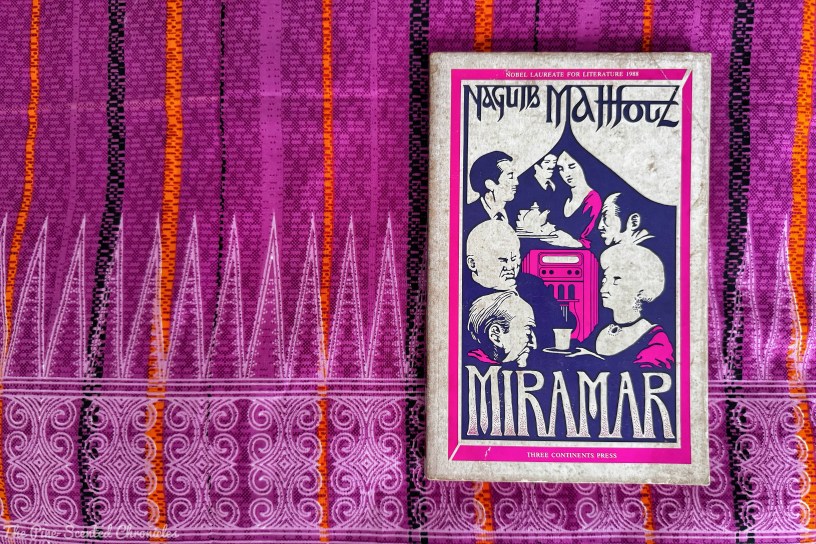
Beyond The Cairo Trilogy, Mahfouz’s oeuvre is filled with equally compelling stories. Among them is Miramar, originally published in Arabic in 1967 as Miramar (ميرامار) and translated into English in 1978. While The Cairo Trilogy is set in Cairo, Miramar transports readers to Alexandria, Egypt’s second-largest city, during the 1960s. The titular Miramar is a pension run by Madame Mariana, a Greek woman. Though the building is past its prime, it still clings to the remnants of its faded glory. The story unfolds through the perspectives of four men residing in the pension. The first is Amer Wagdi, an elderly retired journalist and the oldest resident. He lived through the glory days of the Egyptian national press and witnessed the Egyptian Revolution of 1919 associated with Saad Zaghloul and the Wafd movement. A former member of the Wafd Party, which was sidelined after the rise of Gamal Abdel Nasser, Amer serves as the novel’s historical memory.
Having neither family nor close relatives, Amer moves to Alexandria, which he now considers his true home, and returns to Miramar after an absence of two decades. Drawn by its familial atmosphere and his friendship with Madame Mariana, he hopes to spend his remaining years in peace, content to live among his memories and accept what life has given him. Yet this proves difficult, particularly with the presence of Tolba Bey Marzuq, a fellow pensioner and longtime acquaintance of Madame Mariana. Marzuq is a former landowner whose estates were confiscated during the revolution and redistributed among the peasants. He also serves as Amer’s ideological opposite. The two older men are joined by a younger generation of boarders: Sarhan al-Beheiry, Hosny Allam, and Mansour Bahy. They become acquainted during a gathering preceding one of the celebrated monthly radio broadcasts of the legendary singer Umm Kulthum.
Hosny Allam is a frivolous and sarcastic young aristocrat from the countryside who still possesses considerable landholdings. Obsessed with wealth and social status, he fears suffering the same fate as Marzuq. Disillusioned and directionless, he remains uncertain whether to pursue the business venture that originally brought him to Alexandria or simply drift through life. As a result, he spends his days indulging in fleeting pleasures. Meanwhile, Mansour Bahy is a former revolutionary with ties to leftist political circles. Ironically, his brother is a high-ranking police officer who effectively rescues him from the consequences of his political affiliations. Mansour later becomes a radio broadcaster, hoping to contribute progressive ideas to Egyptian society. Completing the quartet is Sarhan al-Beheiry, a charming university graduate turned government employee from a middle-class rural background. Beneath his charm, however, lies a manipulative and opportunistic man driven by an insatiable desire for wealth and advancement.
At the heart of the novel stands Zohra Salama, a young peasant woman employed by Madame Mariana as the pension’s maid. Having fled her village to escape an arranged marriage to an older man negotiated in exchange for a dowry, Zohra arrives at Miramar through a series of fortunate coincidences. Despite her difficult circumstances, she remains optimistic and determined to improve herself through education and self-discipline. The novel chronicles her interactions with the men of the pension. Significantly, Zohra never narrates her own story. Nevertheless, her arrival serves as the catalyst for the actions and revelations that follow. Amer assumes the role of a protective grandfather who wants to see her succeed, while the younger men become increasingly captivated by her. She gradually becomes the object of their affection, desire, and, in some cases, obsession.
I make the round of all the rooms where I used to stay in summer; the pink, the violet and the blue, all vacant now. There was a time when I stayed in each a summer of more, and though the old mirrors, the rich carpets, the silver lamps and the cut glass chandeliers are gone, a certain faded elegance lingers still on the papered walls and in the high ceilings, which are adorned with cherubs.
Naguib Mahfouz, Miramar
Despite being surrounded by men who seek to possess or define her, Zohra acquits herself admirably. They all vie for her affection, yet she remains a model of self-restraint and quiet defiance. She resists their advances and refuses to surrender her autonomy. Though often reserved, she possesses an inner strength that enables her to withstand the hardships that befall her. Through her interactions with the men, deeper social and personal tensions are exposed. For instance, her relationship with Hosny forces him to confront the emptiness of his superficial lifestyle. What begins as physical attraction gradually compels him to examine his own values. As each man competes for her affection or allegiance, tensions rise, and jealousy becomes pervasive.
As the narrative progresses, the men’s pursuit of Zohra reveals broader societal issues that permeate modern Egypt. Each male character emerges as the embodiment of a particular political ideology or social class. Egypt gained nominal independence from Britain in 1922 following the nationalist movement that arose from the Revolution of 1919. Amer represents this earlier phase of Egyptian history. A devoted supporter of the nationalist movement, he becomes both the novel’s historical lens and its moral conscience. Through his reflections on life, love, and lost ideals, he provides much of the novel’s emotional depth. To Zohra, he serves as a guiding figure and benevolent grandfather.
The defining historical event underpinning the novel, however, is the Egyptian Revolution of 1952. The revolution transformed Egyptian society by dismantling the old aristocratic order and introducing sweeping social reforms. Before it, wealth and power had been concentrated in the hands of a small landed elite. Hosny represents this declining feudal aristocracy. Although he manages to retain his lands, he finds himself adrift in post-revolutionary Egypt, uncertain of his place in the new social order. Embittered and increasingly aggressive, he spends his time drinking and pursuing women. He resents the new regime and often projects his frustrations onto Zohra. Yet beneath his hedonistic exterior lies a longing for genuine human connection.
Mansour Bahy represents the disillusioned left-wing intelligentsia. Though he retains his socialist sympathies, he is consumed by guilt and uncertainty. Haunted by his past and struggling to define himself in an increasingly authoritarian state, he becomes detached from the world around him. His affection for Zohra remains largely passive, reflecting his inability to act decisively. Under Nasser’s rule, Egypt increasingly suppressed dissenting voices, including many leftist intellectuals. Finally, Sarhan al-Beheiry embodies the emerging post-revolutionary ruling class. A member of the Arab Socialist Union, he publicly champions revolutionary ideals while privately pursuing personal gain. Opportunistic and calculating, he courts Zohra primarily for physical gratification while secretly planning to marry a wealthy woman to advance his social standing. Through Sarhan, Mahfouz explores how the revolution’s lofty ideals can devolve into bureaucratic corruption, greed, and opportunism.
A lovely portrait, throbbing with youth and life: a young woman, her right knee on a chair, her left foot resting lightly on the floor, her wrists poisedon the back of the chair, bending forward facing the camera and smiling with a proud sense of her own beauty, the extravagant décolletage of her old-fashioned dress showing a graceful neck and marble-white bosom.
Naguib Mahfouz, Miramar
Miramar thus becomes a microcosm of Egypt’s political landscape. The novel transcends the boundaries of a simple tale of romantic rivalry and transforms into a powerful critique of post-revolutionary society, where the ambitious, the restless, the confused, and the disillusioned converge. In doing so, Mahfouz highlights the cyclical nature of power and social hierarchy. Above them all stands Zohra, who emerges as a symbolic representation of Egypt itself. She seeks independence and refuses to be constrained by tradition. While the men around her remain haunted by the past, she is among the few characters who look toward the future. More importantly, she does so on her own terms. Determined to overcome her illiteracy, she hires a teacher and commits herself to learning how to read despite the skepticism of those around her. She serves as a moral counterpoint to the flawed men who surround her, embodying purity, resilience, and hope amid a clash of competing ideologies.
Zohra knows what she wants and works tirelessly to achieve it. She survives hardship and tragedy with her autonomy and dignity intact. Through her determination and perseverance, she becomes the embodiment of resilience and strength of character. Alongside her stands Amer, whose wisdom reverberates throughout the narrative. As the novel’s most objective and compassionate observer, he quietly mourns the passing of the old world while remaining fully aware of its shortcomings. Unlike the other men, who often view Zohra as an object of desire, Amer respects her as an individual and sees in her the possibility of a brighter future for Egypt. Beyond its political and historical dimensions, Miramar also captures the beauty of Alexandria during the 1960s, one of the final moments of the city’s cosmopolitan Mediterranean splendor.
Deceptively slender, Miramar offers far more than a portrait of a boarding house in Alexandria. Mahfouz captures a nation at a crossroads. Each resident embodies a different vision of Egypt, their competing desires and ideologies transforming Miramar into a stage upon which the country’s social and political struggles unfold. Yet it is Zohra who emerges as the novel’s true center of gravity. She alone possesses the courage to move forward, determined to shape her own destiny, elevating her into a symbol of renewal and possibility. More than half a century after its publication, Miramar remains relevant. Its exploration of power, class, corruption, gender, and political idealism resonates with contemporary readers. Through his nuanced characters and elegant prose, Mahfouz transforms a seemingly intimate story into a timeless meditation on a society in transition. Miramar is at once deeply Egyptian and profoundly universal—a testament to Naguib Mahfouz’s enduring place in the canon of world literature.
However painful your past experience has been life will still be the same. You’ll still go on looking for the one man who can make you happy. And you will find the man who is worthy of you. He’s right there now, somewhere. Perhaps he’s been waiting for the right happy moment to meet you.
Naguib Mahfouz, Miramar
Book Specs
Author: Naguib Mahfouz
Translator (from Arabic): Fatma Moussa-Mahmoud
Publisher: Three Continents Press
Publishing Date: 1990 (1967)
No. of Pages: 131
Genre: Literary, Historical
Synopsis
Naguib Mahfouz is the most successful and best-known Arabic novelist. He was born in the Jamaliyyah quarter of Cairo in 1911, the son of a merchant. He graduated from Cairo University in 1934 with a degree in philosophy. He has worked as a civil servant and in the administration of Cairo University and then for governmental film broadcasting organizations. He has published some twenty volumes of novels and short stories many of which have been made into films. The Trilogy written between 1945 and 1952 stands out as one of his highest literary achievements. For seven years after Nasser’s revolution he wrote nothing, but since that time has published a dozen other books including Midaq Alley. Mahfouz was the recipient of the Nobel Prize for Literature in 1988.
About the Author
To learn more about the first and, so far, only Egyptian Nobel Laureate in Literature, click here.

